Mark Carney Appoints Louise Arbour as Canada's Next Governor General
The former Supreme Court justice and UN war crimes prosecutor takes on the viceregal role at a time of institutional stress.
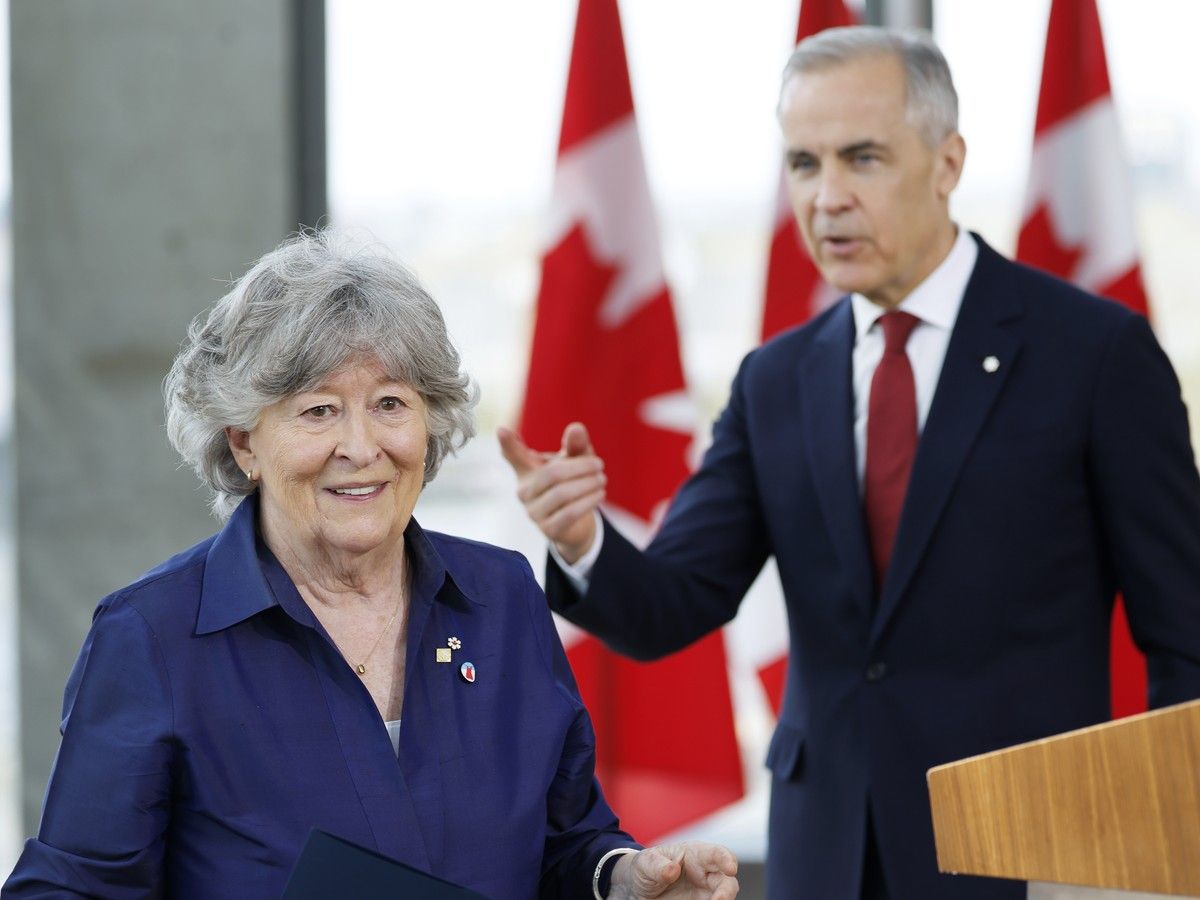
CANADA —
Key facts
- Louise Arbour, 79, will be Canada's 31st governor general since Confederation.
- She is the first governor general appointed by King Charles III.
- Arbour served as a justice on the Supreme Court of Canada and as chief prosecutor for the International Criminal Tribunals for the former Yugoslavia and Rwanda.
- She was UN High Commissioner for Human Rights from 2004 to 2008 and UN Special Representative for International Migration from 2017 to 2018.
- Arbour led an independent review of misconduct in the Canadian Armed Forces.
- She is a Companion of the Order of Canada and holds 42 honorary doctorates.
- Prime Minister Mark Carney announced the appointment on Tuesday, citing the importance of institutions.
- Arbour succeeds Mary Simon, whose tenure was marked by controversy over her French-language skills.
A Steady Hand at a Turbulent Moment
Prime Minister Mark Carney has chosen former Supreme Court justice Louise Arbour as Canada's next governor general, a selection that emphasizes institutional stability over symbolic novelty. The appointment, announced Tuesday, comes as the country faces unique external pressures and internal divisions. "At a time when much of the world is buffeted by crisis and the worst are full of passionate intensity, Canada's history, our institutions, and our enduring traditions matter more than ever," Carney said, quoting William Butler Yeats. "We retain our convictions. We reinforce our institutions." Arbour, 79, will be the 31st governor general since Confederation and the first appointed by King Charles III. She replaces Mary Simon, whose tenure was overshadowed by questions about her French proficiency.
A Career Forged in Law and Human Rights
Arbour brings a record that spans nearly every senior judicial and international human rights office a Canadian can hold. She served on the Supreme Court of Ontario, the Court of Appeal for Ontario, and the Supreme Court of Canada. In 1996, the United Nations appointed her chief prosecutor for the International Criminal Tribunals for the former Yugoslavia and Rwanda, where she secured the first conviction for genocide since the Genocide Convention and the first indictment of a sitting head of state for war crimes. She later became UN High Commissioner for Human Rights and, from 2017 to 2018, UN Special Representative for International Migration. More recently, she led an independent review of misconduct in the Canadian Armed Forces, sparking widespread reform. "Canada has been shaped by its diversity of people, of perspectives and experiences, but I think shaped also mostly by a common respect for strong public institutions and for the rule of law," Arbour said in her brief remarks.
Critics Question the Pick's Divisive Past
Not all reactions have been positive. Arbour's long public record includes statements that could prove polarizing for a figurehead meant to unite Canadians. She has praised Fidel Castro for "unprecedented positive engagement with the UN human rights system" and commended China for its "commitment to the spirit of the Universal Declaration of Human Rights" after Beijing donated to her UN office. She has also been criticized for seeming to condemn Israel more harshly than its adversaries. "It is divisive from the get-go, which is the No. 1 thing a governor general is not supposed to be," one commentator wrote. "It's entirely possible she might be really good at it: stranger things have happened. But at 79 years of age, she is starting the job in a hole the government had no reason to dig." Carney, however, framed the appointment as a choice of experience over flash. "When the rare and relatively unfettered opportunity arises, it might be tempting for a prime minister to use the selection of a governor general to do something splashy or exciting or unconventional," he said. "But this is perhaps not a moment for indulging in viceregal adventurism."
The Role of Governor General in Canada's Constitutional Monarchy
As the representative of the Sovereign, the governor general carries out constitutional duties, serves as commander-in-chief, and represents Canada at home and abroad. The role is largely ceremonial but includes reserve powers that can be critical in times of political crisis. Canada's system of government, a constitutional monarchy with a parliament comprising the Sovereign, the Senate, and the House of Commons, is among the most stable in the world. The governor general's responsibilities include encouraging excellence and bringing Canadians together. Arbour's appointment underscores the importance of institutional continuity, Carney said. "Arbour would bring to Rideau Hall a conviction that institutions are the load-bearing walls of a civil society, and that they remain trustworthy only as long as someone is willing to hold them accountable."
A Record of Controversy and Achievement
Arbour's career has not been without its detractors. Her praise for authoritarian regimes has drawn sharp criticism from human rights advocates. Yet her achievements in international law are undeniable: she led the prosecution that resulted in the first genocide conviction since the Genocide Convention and indicted a sitting head of state for war crimes. She has received nearly 100 honours and awards, including 42 honorary doctorates from universities worldwide. She is a Companion of the Order of Canada and a Grande officière de l’Ordre national du Québec. "Even if everyone won't agree with every opinion she has ever expressed, Arbour has about as long and considerable a record in civic life as it is possible for someone to accumulate," noted one analyst. "Which should at least mean she knows what she is now getting herself into."
What Comes Next for Rideau Hall
Arbour will assume the role after Mary Simon's tenure, which ended amid controversy over her French-language skills. Simon, the first Indigenous governor general, was praised for her advocacy for Inuit rights and Indigenous self-determination but faced criticism for her limited French. The next governor general was always expected to be francophone, given the political sensitivity of the language issue. Arbour, who is fluently bilingual, meets that requirement. Carney expressed deep thanks to Simon for her "exemplary tenure" and "lifetime of advocacy for Inuit rights, Indigenous self-determination, and the preservation of Indigenous language, culture, and identity." Her legacy, he said, will endure "not only in her service, but in the way she served – with an unshakable belief in Canada."
A Test of Institutional Trust
Arbour's appointment arrives at a moment when trust in institutions is under strain globally. Her task will be to embody the stability and impartiality that the role demands, even as her own past opinions may invite scrutiny. "Whatever she herself brings to Rideau Hall, Arbour will be the personification of an institution — at a moment when the country those institutions underpin is under unique stress," one observer wrote. Carney's choice signals a preference for depth over dazzle. Whether that gamble pays off will depend on Arbour's ability to transcend the controversies of her past and serve as a unifying figure for a divided nation.
The bottom line
- Louise Arbour, a former Supreme Court justice and UN war crimes prosecutor, will become Canada's 31st governor general.
- Prime Minister Mark Carney emphasized institutional strength in announcing the appointment, quoting Yeats.
- Arbour's past praise for Fidel Castro and China has drawn criticism, raising concerns about her ability to be a unifying figure.
- She is the first governor general appointed by King Charles III and is fluently bilingual, addressing language controversies from the previous tenure.
- Her career includes landmark achievements in international criminal law, including the first genocide conviction since the Genocide Convention.
- The appointment reflects a deliberate choice of experience over symbolic novelty at a time of national and global uncertainty.



Mavericks Hire Masai Ujiri as President, Charging Him to Rebuild After Dončić Trade Fallout
Massive Cold Front to Sweep 25+ States with Snow, Severe Storms, and Flooding

Jakub Dobes Stops 28 Shots as Canadiens Edge Lightning 2-1 in Game 7
