Rolls-Royce shares slide 14% from March peak as defence orders surge
Despite a 20% jump in defence deliveries and a string of military contracts, the stock has fallen sharply amid Middle East tensions and jet fuel concerns.
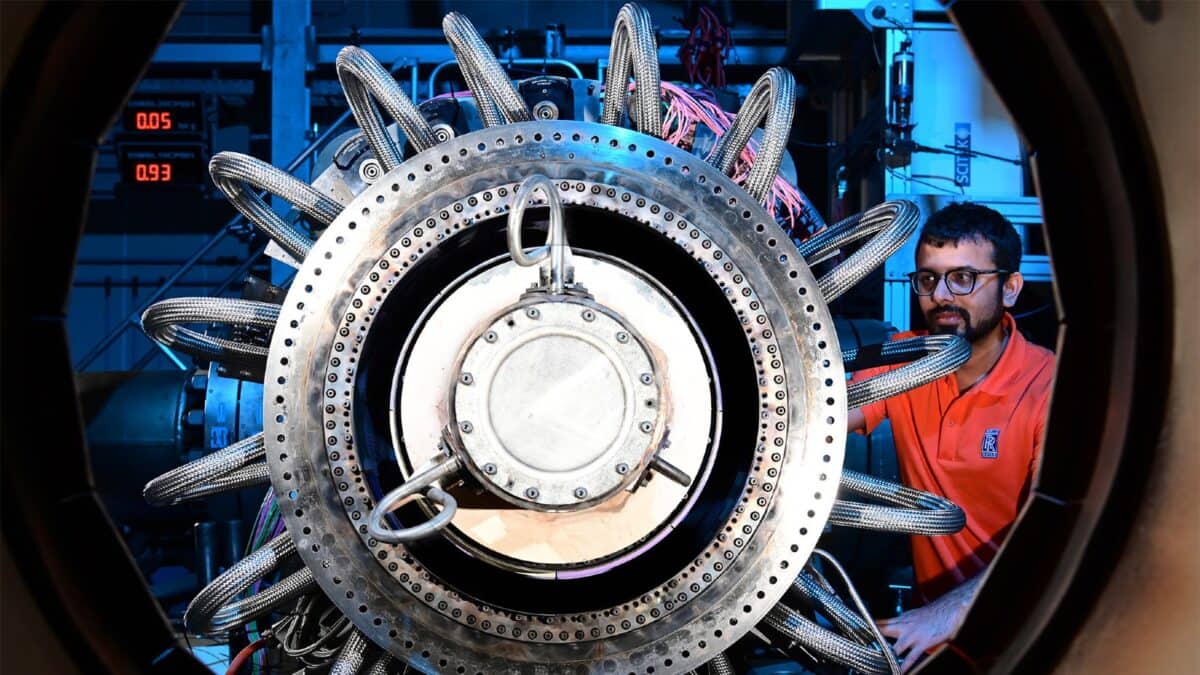
UNITED KINGDOM —
Key facts
- Rolls-Royce shares traded at £12 on 4 May, down 14% from March levels.
- Defence original equipment deliveries rose more than 20% year-on-year in early 2026.
- The AE 3007 engine powered the first flight of the US Navy's MQ-25 autonomous refuelling aircraft in April.
- Rolls-Royce received an order for EJ200 engines for 20 Eurofighter Typhoons for Turkey.
- The MT30 marine gas turbine was selected to power up to 11 Australian Navy frigates.
- Rolls-Royce maintained 2026 guidance of £4.0-4.2 billion operating profit and £3.6-3.8 billion free cash flow.
Share price wobble tests investor confidence
Rolls-Royce Holdings shares have fallen sharply since March, dropping 14% to around £12 by 4 May, raising questions about whether the post-pandemic rally has run its course. The decline comes despite a string of positive defence announcements and a trading update in which the company said it expects to fully mitigate the financial impact of the Middle East conflict. For investors who missed the earlier surge, the pullback presents a potential entry point. The stock had climbed dramatically from pandemic lows, but recent volatility has prompted debate over whether the shares are now undervalued or facing headwinds that could persist.
Defence business delivers record growth
“a strong start to the year driven by our transformation and self-help,” highlighting that the diversified portfolio leaves the company “better equipped to respond to changes in the external environment.” Defence was identified as one of the most resilient parts of the business, with original equipment deliveries up more than 20% year-on-year. Among the milestones, Rolls-Royce confirmed its AE 3007 engine powered the first flight of the US Navy’s MQ-25 autonomous refuelling aircraft in April. The MQ-25 Stingray is the Navy’s first carrier-based uncrewed aircraft, designed to extend the operational range of the carrier air wing by taking over aerial refuelling from crewed F/A-18 Super Hornets.
Major contracts across air, sea and land
In March, Rolls-Royce received an order as lead partner in the EUROJET consortium to provide EJ200 engines for a new fleet of 20 Eurofighter Typhoons for Turkey. The order adds to an existing production programme that powers Typhoons operated by the UK, Germany, Spain, Italy, Saudi Arabia, Austria, Oman and Kuwait. The company’s MT30 marine gas turbine was selected in April to power up to 11 of the Australian Navy’s new general-purpose frigates, enhancing undersea warfare and air defence capabilities. The MT30 already serves in the Royal Navy’s Type 26 frigates and the US Navy’s Freedom-class littoral combat ships, and the Australian selection extends its international footprint.
Power Systems and next-generation programmes advance
In Power Systems, Rolls-Royce announced it would supply 350 upgraded mtu Series 199 engines for new Boxer armoured wheeled vehicles for the German Armed Forces and other international customers. It also received an order for around 200 compact mtu PowerPacks for the Bundeswehr’s Puma armoured personnel carrier, and signed a memorandum of understanding with Polska Grupa Zbrojeniowa, Poland’s largest defence technology group, to service mtu engines used by the Polish armed forces. Engine testing for the US Army’s MV-75 programme, which will power the Sikorsky-Boeing SB>1 Defiant X competing for the Future Long-Range Assault Aircraft requirement, is progressing well. Endurance and altitude testing remain on track for later this year, keeping pace with an accelerated production timeline. Rolls-Royce also collaborated closely with Boeing in March on the next stages of the critical design review for the US Air Force’s B-52 re-engining programme, which will see the Cold War-era bomber fleet fitted with the company’s F-130 engine.
Civil aerospace under pressure from Middle East tensions
Despite the defence strength, investors remain concerned about the impact of the Middle East conflict on Rolls-Royce’s civil aerospace division. Soaring jet fuel prices and flight cancellations could reduce the number of hours that engines are flown, which is the basis for the majority of the division’s revenue. In a trading update on 30 April, the company stated: “We expect to fully mitigate the current financial impact of the disruption to our business.” The group maintained its full-year guidance of £4.0 billion to £4.2 billion of underlying operating profit and £3.6 billion to £3.8 billion of free cash flow for 2026.
Long-term bets on SMRs and aviation resilience
Some analysts point to the group’s small modular reactor (SMR) programme as a source of long-term potential. These factory-built mini nuclear power stations offer low cost compared to large-scale plants that often run over budget. The SMR programme could provide a new revenue stream beyond aerospace and defence. The post-pandemic recovery demonstrated the resilience of the aviation industry, and the recent share price fall may be seen as an opportunity for latecomers. One observer noted that Warren Buffett’s Berkshire Hathaway did not invest in Apple until after the iPhone 6 launch, yet still realised gains of over $160 billion from the stock.
Outlook: defence momentum versus macro headwinds
Rolls-Royce enters the rest of 2026 with a robust defence pipeline and reiterated financial targets, but the share price remains sensitive to geopolitical developments. The company’s ability to fully mitigate the Middle East conflict’s impact will be tested if disruptions persist. With a diversified portfolio spanning civil aerospace, defence, and power systems, Rolls-Royce is better positioned than in previous downturns. However, the immediate trajectory depends on whether the aviation recovery continues and whether new conflicts emerge. The next trading update will be closely watched for evidence that the defence growth can offset civil aerospace weakness.
The bottom line
- Rolls-Royce shares fell 14% from March to £12 by 4 May, despite strong defence results.
- Defence deliveries rose over 20% year-on-year, with key contracts for the MQ-25, Eurofighter Typhoon, and Australian frigates.
- The company maintained 2026 guidance of £4.0-4.2 billion operating profit and £3.6-3.8 billion free cash flow.
- Civil aerospace faces headwinds from Middle East tensions and jet fuel prices, but the company expects to fully mitigate the impact.
- Long-term growth drivers include the SMR programme and next-generation defence platforms like the B-52 re-engining and MV-75.

Bolton Secure Playoff Spot as Five-Way Battle for Final Places Heads to Final Day

Liverpool Accelerate Right-Back Search as Jeremie Frimpong Fails to Convince
Real Madrid puts Premier League boss on shortlist to rival Mourinho for job
