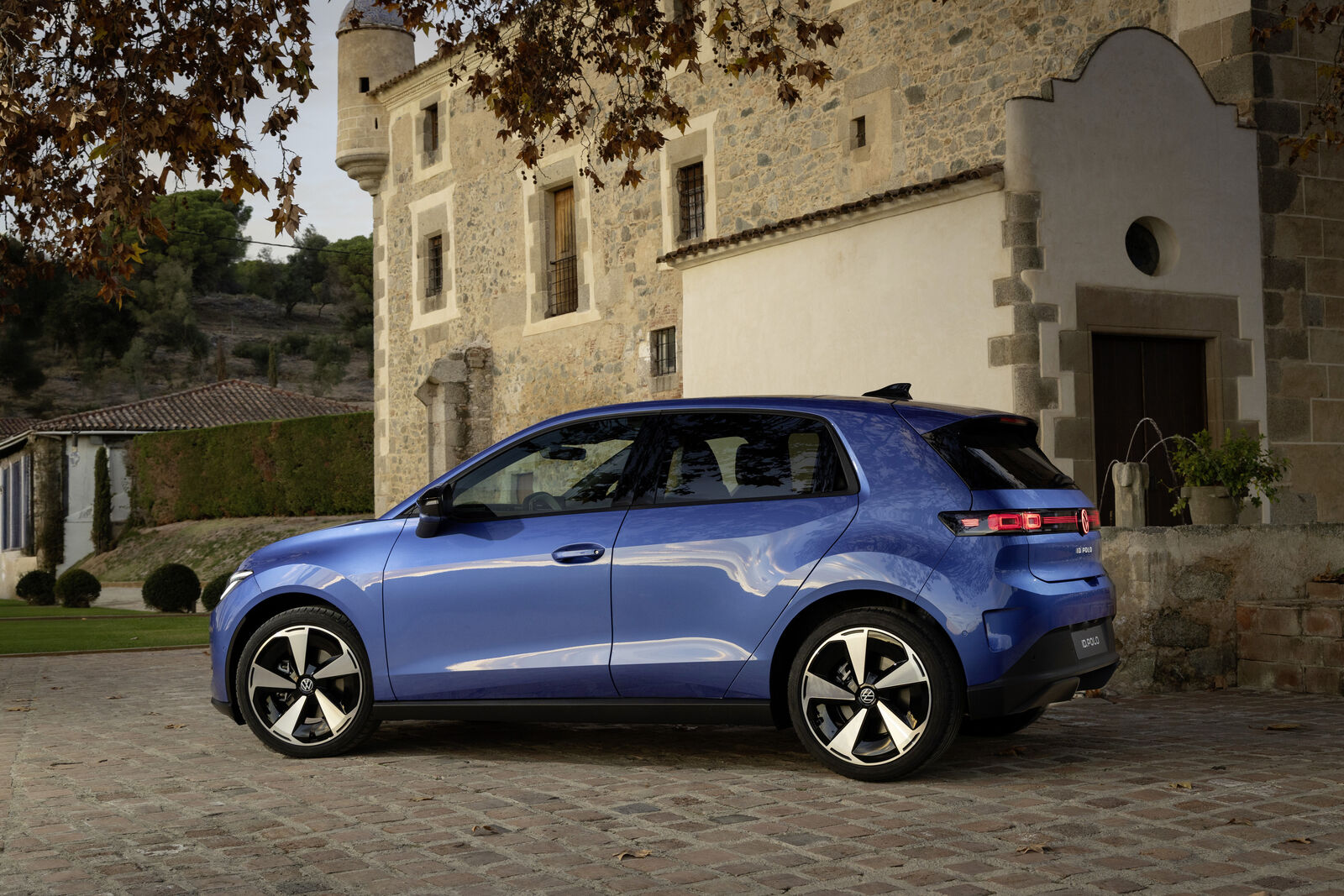
Volkswagen launches ID. Polo from under €20,000 in Ireland, undercutting rivals
The first all-electric Polo arrives with a starting price of €19,885 after grants, positioning it as the most affordable EV in its class and a direct challenge to the Renault 5 and Hyundai Inster.

IRELAND —
Key facts
- The ID. Polo starts at €19,885 in Ireland after SEAI grant and VRT relief.
- It offers a 37kWh LFP battery with a range of up to 329 km (WLTP).
- Pre-sales begin at the end of April in Germany, with Irish launch details pending.
- The ID. Polo is the seventh generation of a model sold over 20 million times.
- Three power outputs available: 85 kW, 99 kW, and 155 kW; GTI version in 2027 with 166 kW.
- Higher-spec 52kWh NMC battery provides up to 454 km range and 105 kW DC charging.
- Design led by Andreas Mindt, with sketches started at Stefan Walburg’s kitchen table.
- Interior features Pure Positive design with physical buttons and a retro display inspired by the Golf I facelift.
A pricing shock for the small EV market
Volkswagen Ireland has detonated a pricing hand grenade in the small electric vehicle segment by unveiling the ID. Polo at a starting price of €19,885, inclusive of the SEAI grant and VRT relief. That figure undercuts the newly announced Hyundai Ioniq 3 by more than €8,000 and the Renault 5 E-Tech by over €6,000. The entry-level model, badged ID. Polo Trend, delivers a 115 hp electric motor driving the front wheels, a 37 kWh lithium-iron-phosphate battery, and a WLTP range of up to 329 km. Alan Bateson, director of Volkswagen Ireland, called the car “the electric car the market has been waiting for” and said the sub-€20,000 price “sends a clear signal of Volkswagen Ireland’s ambition: to make electric mobility truly accessible, without compromise.” For comparison, the ultra-compact Hyundai Inster, with a 327 km range, starts at €19,595 — a mere €290 less. The ID. Polo’s closest rival, the Renault 5 E-Tech, begins at €25,995 for the 40 kWh, 312 km version.
Seventh generation, first electric iteration
The ID. Polo is the seventh generation of a nameplate that has sold more than 20 million units globally, but it is the first to be fully electric. It rides on the latest evolution of Volkswagen’s modular electric drive platform, MEB+, which enables a front-wheel-drive layout and significantly more interior space than the combustion-engined Polo. Thanks to the compact MEB+ modules, the ID. Polo offers 441 litres of luggage capacity — a substantial increase over the MQB-based Polo. The car measures 4,053 mm long, 1,816 mm wide, 1,530 mm high, with a wheelbase of 2,600 mm. By comparison, the outgoing Polo is 4,074 mm long but only 1,751 mm wide, with a shorter wheelbase of 2,552 mm. The development was a joint project within the Volkswagen Group’s Brand Group Core, generating strong synergy effects that the company says help the ID. Polo deliver “excellent value for money.”
Design born at a kitchen table
The ID. Polo is the first production model to adopt Volkswagen’s new Pure Positive design language, created by chief designer Andreas Mindt and his team. Mindt revealed that the initial sketches were drawn at the kitchen table of Stefan Walburg, head of exterior design, with children playing in the background — a setting that shaped the car’s family-friendly ethos. The design incorporates iconic cues such as a C-pillar inspired by the original Golf, a friendly front end, and a powerful rear. It deliberately avoids the retro charm of the Renault 5, opting instead for a clean, functional aesthetic. “We wanted to create an interior that feels like a friend from the very first encounter,” Mindt said, pointing to clear physical buttons, warm materials, and a “retro display” that evokes the Golf I facelift. The interior also features an integrated ID. Light in the dashboard and front doors, providing intuitive interaction between vehicle and driver.
Three powertrains, two batteries, one GTI to come
At launch, the ID. Polo will be available with three power outputs: 85 kW (116 PS), 99 kW (135 PS), and 155 kW (211 PS). The entry-level 85 kW and 99 kW versions use a 37 kWh (net) LFP battery, capable of DC fast charging at up to 90 kW, with a provisional range of 329 km. The 155 kW variant gets a 52 kWh (net) NMC battery, enabling up to 454 km of range and DC charging at up to 105 kW. All versions come with the Group’s newly developed unified cell in a cell-to-pack design. DC quick charging is standard across the range. A sporty ID. Polo GTI will follow in 2027, producing 166 kW (226 PS) and using the 52 kWh NMC battery. The car also introduces new technologies such as Connected Travel Assist with automatic traffic light recognition, one-pedal driving, and a Vehicle-to-Load function that allows the car to power external devices like e-bikes.
Equipment lines and German pricing
The ID. Polo will be offered in three equipment lines initially: Trend (entry-level), Life (comfort-focused), and Style (dynamically elegant). The ID. Polo Trend in Germany starts at €24,995, already equipped with 90 kW DC charging, LED headlights with main-beam control, a 10-inch Digital Cockpit, a 13-inch Innovision infotainment system, and a leatherette multifunction steering wheel. Standard assist systems include Side Assist, Lane Assist with Emergency Assist, and automatic air conditioning. The higher trims add features like the Connected Travel Assist and the retro display. Volkswagen’s subsidiary Elli will offer a We Charge City Tariff to make public charging in cities as affordable as home charging.
Irish and Australian prospects remain uncertain
While Irish pricing and specifications have been confirmed, Volkswagen Ireland has not yet announced a specific on-sale date. In Germany, pre-sales begin at the end of April. The ID. Polo is expected to arrive in other European markets shortly after. In Australia, a spokesperson for Volkswagen Australia said the brand “is not able to confirm availability of the ID. Polo or detailed timing at this stage.” If it does arrive, the ID. Polo would compete with the BYD Dolphin, MG4, GWM Ora 5, and GAC Aion UT — all priced under A$40,000. Given its German starting price equivalent to about A$41,000, plus export costs, the Australian variant would likely carry a premium. The ID. Polo also faces crossover rivals such as the Zeekr X and Renault Megane E-Tech.
A reinvention of Volkswagen’s electric line-up
The ID. Polo represents more than a new model; it is a strategic reinvention of Volkswagen’s electric car range. Unlike the updated ID.3 Neo or the renamed ID. Tiguan, the ID. Polo is the first model to combine a classic Volkswagen badge with fully electric power from the ground up. It is central to CEO Thomas Schäfer’s plan to remind buyers why they love the brand. By pricing the car aggressively in Ireland and offering a compelling mix of range, space, and technology, Volkswagen is betting that the ID. Polo can replicate the success of its combustion-engine predecessor. The question now is whether the market — and regulators — will respond with the same enthusiasm that made the Polo a 20-million-seller.
The bottom line
- The ID. Polo is Volkswagen’s first all-electric version of its iconic hatchback, starting at €19,885 in Ireland after incentives.
- It undercuts key rivals like the Renault 5 E-Tech (€25,995) and Hyundai Ioniq 3 (€28,000) by thousands of euros.
- The car offers up to 454 km range from a 52 kWh NMC battery, with DC charging up to 105 kW.
- Design follows the new Pure Positive language, with physical buttons and a retro-inspired digital display.
- Pre-sales begin in Germany at the end of April; Irish and Australian launch details are pending.
- The ID. Polo is central to Volkswagen’s strategy to revive brand appeal and lead in affordable electric mobility.



Boy George in tears after being caught up in Golders Green terror attack

Patrick Kielty's Late Late Show Future Uncertain as Contract Expires Without Renewal

Westlife, Boy George and Viral Marathon Runner Join Patrick Kielty for Late Late Show Season Finale