Indian Navy and DRDO Succeed in First Salvo Launch of Indigenous Anti-Ship Missile
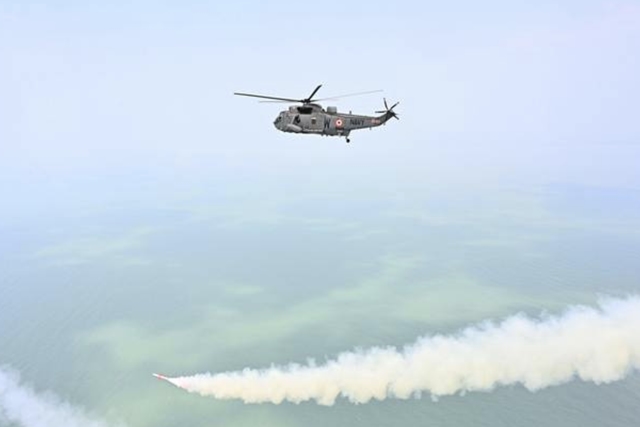
Two NASM-SR missiles fired in quick succession from a Sea King helicopter off Odisha's coast demonstrate salvo and waterline hit capability, marking a milestone in India's naval missile development.

INDIA —
Key facts
- First salvo launch of NASM-SR from a Sea King helicopter off Odisha coast on 29 April 2026.
- Two missiles launched in quick succession, proving salvo capability to overwhelm enemy defenses.
- Missiles demonstrated waterline hit capability, increasing damage to target vessels.
- NASM-SR has a range of 55 km, speed of Mach 0.8, and carries a 100 kg warhead.
- All critical subsystems, including seeker and inertial navigation system, developed indigenously.
- Defence Minister Rajnath Singh congratulated DRDO, Navy, Air Force, and industry partners.
- Bharat Dynamics Limited identified as production partner; longer-range variant NASM-MR under development.
- Test witnessed by senior scientists, Navy and Air Force representatives, and development partners.
Maiden Salvo Launch Proves Lethal New Capability
The Indian Navy and the Defence Research and Development Organisation have successfully conducted the maiden salvo launch of the Naval Anti-Ship Missile–Short Range from a Sea King helicopter off the coast of Odisha in the Bay of Bengal, the Ministry of Defence announced on Wednesday. Two missiles were fired in quick succession from the same helicopter, demonstrating for the first time the salvo launch capability of an advanced air-launched anti-ship missile system. All test objectives were fully met, as confirmed by data from radar, electro-optical systems, and telemetry deployed by the Integrated Test Range at Chandipur. The salvo launch is a significant tactical milestone: by saturating enemy defenses with multiple missiles arriving simultaneously, it dramatically increases the probability of a successful strike.
Waterline Strikes Maximise Damage to Enemy Vessels
Beyond the salvo capability, the test also validated the missile's ability to hit a target at the waterline—the vulnerable junction between hull and sea. In maritime warfare, a waterline hit can cause catastrophic flooding and rapid sinking, making it far more destructive than a strike on the superstructure. The missiles followed a sea-skimming flight profile, flying low to evade radar detection before striking precisely at the waterline. Telemetry confirmed that the strikes achieved the intended effect on the target vessels.
Indigenous Development and Key Partners
The NASM-SR has been developed by Hyderabad-based Research Centre Imarat in collaboration with other DRDO laboratories, including the Defence Research and Development Laboratory, the High Energy Materials Research Laboratory, and the Terminal Ballistics Research Laboratory. All critical subsystems—including the seeker, integrated avionics module, and fibre-optic gyroscope-based inertial navigation system—were developed indigenously. The missile uses a solid propulsion booster and a long-burn sustainer for extended powered flight. Defence Minister Rajnath Singh complimented DRDO, the Indian Navy, the Indian Air Force, and industry partners for the successful maiden salvo launch, stating that the development will greatly enhance the capabilities of the armed forces.
Technical Specifications and Operational Role
The NASM-SR is a fire-and-forget missile with post-launch lock-on ability, carrying a 100 kg warhead. It has an operational range of approximately 55 kilometres and cruises at high subsonic speeds of about Mach 0.8. Designed as India's first indigenously developed air-launched anti-ship cruise missile, it is intended to replace legacy systems such as the Sea Eagle missile. The successful salvo test concludes the primary developmental phase of the NASM-SR programme.
Production and Induction Underway
Bharat Dynamics Limited has been identified as the production partner for the NASM-SR, paving the way for induction into operational service. The test launches were witnessed by senior scientists from DRDO, representatives from the Indian Navy and Indian Air Force, and Development-cum-Production Partners. The missile's induction will provide the Indian Navy with a modern, indigenously produced anti-ship capability that can be launched from helicopters, offering flexibility and survivability in naval operations.
Longer-Range Variant on the Horizon
Work is also underway on a longer-range variant, the NASM-MR, which was showcased on the Navy's MiG-29K at Aero India 2025. The development of both missiles underscores India's push toward self-reliance in defence technology, reducing dependence on foreign suppliers for critical weapon systems. The NASM-MR is expected to extend the reach of India's naval aviation, complementing the NASM-SR and providing a layered anti-ship capability.
Strategic Implications for India's Naval Power
The successful salvo launch of the NASM-SR marks a significant step in India's efforts to modernise its naval strike capabilities. With the ability to launch multiple missiles from a single helicopter, the Indian Navy can now conduct more effective anti-surface warfare missions, particularly against heavily defended targets. The indigenous development of critical subsystems also strengthens India's defence industrial base, aligning with the government's Atmanirbhar Bharat (Self-Reliant India) initiative. As regional naval competition intensifies, such capabilities will be crucial for maintaining maritime security and deterrence in the Indian Ocean region.
The bottom line
- India's first salvo launch of an indigenous air-launched anti-ship missile, NASM-SR, from a Sea King helicopter, was successful.
- Two missiles were fired in quick succession, proving salvo capability and waterline hit accuracy.
- All critical subsystems were developed indigenously by DRDO laboratories with industry support.
- Bharat Dynamics Limited will produce the missile for induction into the Indian Navy.
- A longer-range variant, NASM-MR, is under development and was displayed at Aero India 2025.
- The missile will replace legacy Sea Eagle systems and enhance India's naval strike power.





Bhuvneshwar Kumar's ₹70–75 Crore Net Worth and Meerut Bungalow: A Cricketer's Journey

Today's Chanakya Exit Poll Predicts Mamata Banerjee's Defeat in West Bengal

Bhuvneshwar Kumar's Death-Overs Mastery Propels RCB into Top-Four Clash with GT