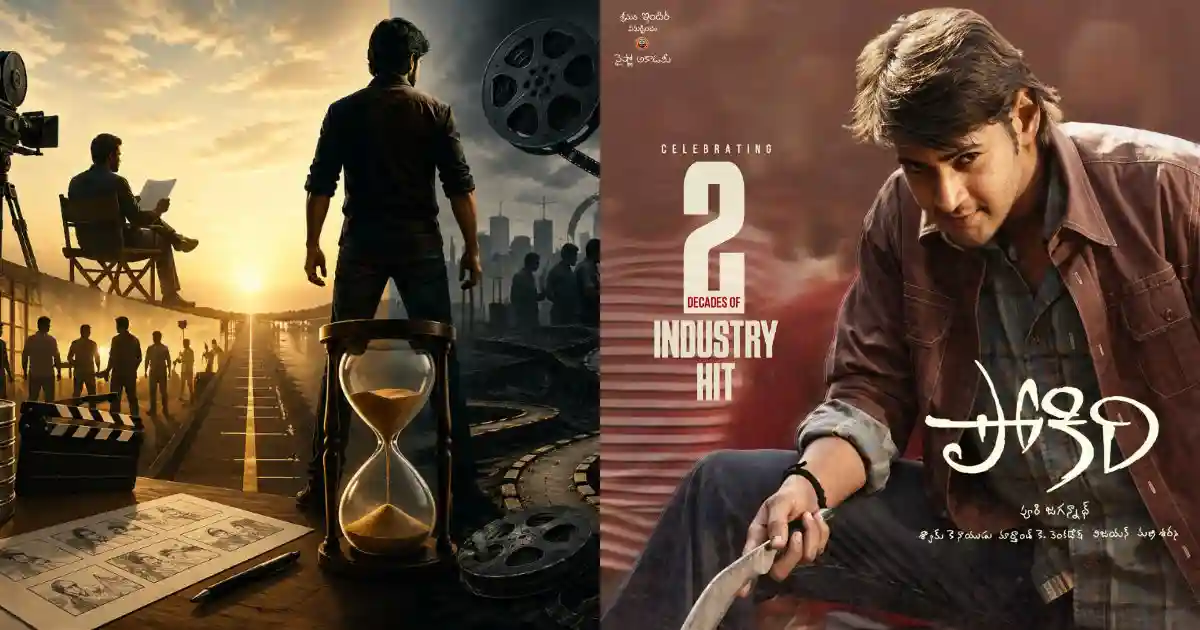
Pokiri at 20: A Telugu Cinema Landmark That Redefined Stardom, Yet Its Anniversary Goes Unmarked
Mahesh Babu's gritty 2006 blockbuster, shot in under 100 days, remains a benchmark of efficiency—but the muted 20-year celebration highlights a growing divide between past discipline and modern Tollywood's sprawling production timelines.

INDIA —
Key facts
- Pokiri, directed by Puri Jagannadh and starring Mahesh Babu and Ileana D'Cruz, released in 2006.
- The film was completed in less than 100 days, with some accounts citing around 66 active shooting days.
- Pokiri shattered existing box-office records and became an industry hit in Telugu cinema.
- The film elevated Mahesh Babu from a notable actor to a bankable superstar with unmatched mass appeal.
- Ileana D'Cruz gained immense popularity from Pokiri and secured multiple subsequent opportunities.
- Neither Puri Jagannadh nor Mahesh Babu made significant public acknowledgements for the 20-year milestone.
- Puri Jagannadh is reportedly busy with upcoming projects; Mahesh Babu is occupied with a film directed by S. S. Rajamouli.
A Cultural Phenomenon Turns 20, But the Silence Is Deafening
Two decades after its release, Pokiri remains one of the most sensational films in the history of Telugu cinema. Directed by Puri Jagannadh and starring Mahesh Babu alongside Ileana D'Cruz, the film shattered existing box-office records and emerged as an industry hit. It not only redefined commercial cinema in Tollywood but also cemented Mahesh Babu’s status as a leading star. Despite this monumental milestone, the buzz around the 20-year celebration has remained surprisingly muted. While fans have been actively celebrating the occasion on social media, there has been little to no response from the core team. Neither Puri Jagannadh nor Mahesh Babu made significant public acknowledgements, leaving fans slightly disappointed. One possible reason could be their current commitments. Puri Jagannadh is reportedly busy with his upcoming projects, while Mahesh Babu is occupied with a high-profile film directed by S. S. Rajamouli. Still, many believe that a film of Pokiri’s stature deserved a grand celebration, considering its historic impact on Telugu cinema.
The Making of a Blockbuster: Speed as a Virtue
Beyond the nostalgia, Pokiri deserves to be looked at from a different lens today—not just as a blockbuster, but as a benchmark in filmmaking discipline. It is a striking fact that Pokiri was completed in less than 100 days, with some accounts suggesting even fewer, around 66 active shooting days. Despite having a top-tier star, the film moved with remarkable speed and clarity. This efficiency was not an accident. It reflected a system where the script was locked, the director was decisive, and the execution was clean. The same approach was later seen in films like Businessman, reinforcing that this efficiency came from preparation, not compromise. What Pokiri proved is simple: speed in filmmaking is not about rushing, it is about certainty.
Modern Tollywood: Longer Schedules, Blurred Decisions
Today, even mid-range films are stretching beyond expected schedules, while big-budget projects like Kalki 2898 AD, Salaar, and Devara: Part 1 span years in production. Yes, scale has increased. Visual effects, pan-India releases, and multi-language shoots naturally demand more time. But scale alone does not explain the entire delay. A significant part of the slowdown comes from shifting decisions into the production phase. Scripts evolve during shoots, schedules expand, and clarity often arrives late instead of early. What was once pre-production work is now happening on set. And in filmmaking, uncertainty is expensive. Every additional day adds to interest, logistics, and operational costs, quietly inflating budgets before the film even reaches the audience.
The Sequel Gap: Momentum Lost Between Installments
Alongside long production schedules, another clear trend has emerged: the widening gap between sequels. Franchises are now announced with massive hype, but the follow-ups take years to materialize. Telugu cinema has several examples. Films like Baahubali, Pushpa, Karthikeya, and HIT built strong foundations, yet their continuations came after significant gaps. While some sustained momentum, the delay still forced the audience to reconnect rather than continue the experience seamlessly. At the same time, there are rare attempts to do the opposite. The Hindi film Dhurandhar and its sequel Dhurandhar: The Revenge were planned in a way that allowed both parts to release within a very short gap. Whether one calls it an experiment or an exception, it showed one important thing: momentum can be preserved when planning is done in advance.
Announced but Stalled: The Cost of Extended Timelines
What we are now seeing is an even more concerning pattern. Sequels such as They Call Him OG 2, Salaar 2: Shouryaanga Parvam, Pushpa 3, and Devara 2 are announced early, but remain stuck in extended production timelines or planning stages. When the gap stretches too long, the emotional continuity weakens. The audience no longer carries the same immediate connection, and the hype has to be rebuilt instead of being sustained. This is not about forcing sequels to release within months. It is about avoiding unnecessary delay. And once again, the root issue is planning. When filmmakers approach a story with long-term clarity, sequels feel like a continuation. When they are developed step by step, gaps grow longer, and momentum fades.
Tollywood’s Crossroads: Growth Without Discipline
Tollywood’s growth in scale is undeniable, but growth without discipline brings its own challenges. What the industry risks losing is not speed, but decisiveness. Pokiri, completed in under 100 days, stands as a testament to what can be achieved when a script is locked, a director is decisive, and execution is clean. Two decades later, the film remains a cultural phenomenon—but its milestone celebration feels like a missed opportunity. As the industry grapples with bloated schedules and fading momentum, the lesson of Pokiri is more relevant than ever: certainty, not haste, is the true driver of efficiency.
The bottom line
- Pokiri was completed in under 100 days (around 66 shooting days), a stark contrast to modern Tollywood films that often take years.
- The film's 20-year anniversary saw no public acknowledgement from director Puri Jagannadh or star Mahesh Babu, disappointing fans.
- Pokiri redefined commercial cinema in Telugu and elevated Mahesh Babu to superstar status, with Ileana D'Cruz also gaining major popularity.
- Modern Tollywood faces production delays due to shifting decisions to the shoot phase, inflating budgets and timelines.
- Sequels in Telugu cinema (e.g., Baahubali, Pushpa, Salaar) suffer from long gaps that weaken audience momentum, unlike rare exceptions like Dhurandhar.
- The industry's core challenge is not speed but decisiveness and pre-production planning, as exemplified by Pokiri's efficient production.

Kerala Lottery Karunya KR-752 Draws ₹1 Crore Winner; 30% Tax Applies
Riyan Parag fined 25% of match fee for vaping in IPL dressing room

India’s Census 2027 Begins House-to-House Enumeration in Six States as Digital Self-Reporting Tops 8 Million