NTPC Activates 100 MW Solar Unit at Ramagundam, Inks Nuclear MoU with EDF
The state-owned giant's latest solar commissioning and a non-binding pact with France's EDF signal a dual-pronged push into renewables and atomic energy, even as grid bottlenecks and debt linger.
INDIA —
Key facts
- NTPC began commercial operation of a 100 MW solar PV unit at Ramagundam, Telangana.
- NTPC Green Energy commissioned 90 MW at the Khavda-II project in Gujarat, raising its operational capacity to 10,453.90 MW.
- NTPC signed a non-binding MoU with Electricite de France (EDF) to explore nuclear power development.
- India's total installed power capacity exceeded 533 GW by March 2026, with renewables accounting for over 50%.
- NTPC's P/E ratio stands at 24.37, compared to Adani Green Energy's 128.62 and Tata Power's 31.79.
- The company targets 149 GW total capacity by 2032, including 60 GW from renewables.
- NTPC's Debt to EBITDA ratio was 4.81 times in early April 2026.
Solar Additions at Ramagundam and Khavda-II
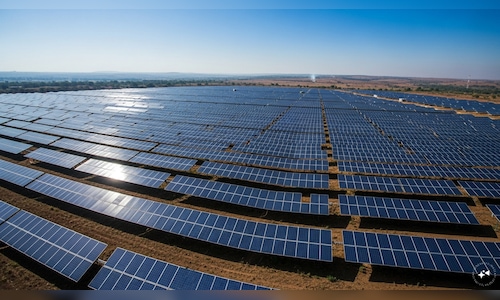
NTPC Limited has started commercial operation of a 100 MW solar photovoltaic unit at its Ramagundam project in Telangana, boosting the group's total installed capacity and renewable energy portfolio. The commissioning comes alongside a separate 90 MW solar capacity addition by NTPC Green Energy under the 1,200 MW Khavda-II Solar PV Project in Gujarat. The Khavda-II installation, which became operational from 00:00 hours on April 25, 2026, represents the seventh operational phase of the project. It was executed by NTPC Renewable Energy Limited, a wholly owned subsidiary of NTPC Green Energy Limited. Following this addition, NTPC Green Energy's operational capacity rose from 10,363.90 MW to 10,453.90 MW. The company disclosed the development in compliance with SEBI (Listing Obligations and Disclosure Requirements) Regulations, 2015, submitting updates to both the National Stock Exchange and BSE Limited. The phased commissioning underscores a structured approach to expanding renewable capacity.
Nuclear Exploration via MoU with EDF
In a parallel strategic move, NTPC has signed a non-binding Memorandum of Understanding with Electricite de France (EDF) to explore nuclear power development. This exploration follows the passage of the SHANTI Act in December 2025, which opened India's nuclear sector to private participation and supports a national target of 100 GW nuclear capacity by 2047. The MoU signals NTPC's ambition to diversify beyond thermal and solar generation into atomic energy, a sector historically dominated by the state-owned Nuclear Power Corporation of India Limited. The partnership with EDF, a global nuclear operator, could provide technical expertise and reactor technology for future projects.
Valuation Gap with Pure-Play Renewables
NTPC's push into renewables and nuclear power creates a unique investment picture. As of April 2026, NTPC's P/E ratio stood at approximately 24.37, with a market capitalization around ₹3.87 lakh crore. This valuation appears conservative when contrasted with pure-play renewable companies: Adani Green Energy trades at a P/E ratio of roughly 128.62 with a market cap of approximately ₹2.02 lakh crore, while Tata Power commands a P/E of around 31.79 with a market cap of approximately ₹1.42 lakh crore. The gap suggests the market may not fully value NTPC's green energy shift, possibly because its large thermal power base still dominates actual generation. Despite this, analysts largely rate NTPC a 'Strong Buy,' with average 12-month price targets around ₹424.88, pointing to over 6% potential upside. This optimism reflects confidence in its long-term strategy, even as current market doubts about valuation persist.
Grid Limitations and the Challenge of Integration
India's rapid growth in renewable capacity is meeting significant grid limitations. Even with over 533 GW of installed capacity by March 2026, renewables account for only about 20-26% of actual power output. This highlights the need for better grid flexibility and modernization to handle the capacity effectively. Transmission upgrades and energy storage solutions are crucial to bridge the gap between where power is generated and where it is needed. NTPC's plans include many renewable projects and investments in battery storage, vital for managing power supply consistency and grid stability. The company's diversification into green hydrogen, battery storage, and nuclear power demonstrates awareness of these evolving sector needs. However, the pace of grid expansion has not always kept up with generation growth, potentially leading to curtailment and impacting the full utilization of renewable assets.
Debt, Thermal Reliance, and Execution Risks
Despite NTPC's strategic moves and operational wins, risks remain. The company has considerable debt; its Debt to EBITDA ratio was 4.81 times in early April 2026. This could limit financial flexibility for its capital-intensive new energy projects. While NTPC's thermal assets provide stable cash flows, the global energy transition poses risks of stranded assets and increased regulatory scrutiny for such infrastructure. The valuation discount compared to renewable-focused rivals signals market concerns about the speed and profit of its green projects, or that its large thermal base weakens its green image. While many analysts rate NTPC a 'Strong Buy,' some recommend 'Hold' or 'Sell' due to financial metrics or market volatility, showing investor sentiment isn't universally positive. Challenges like regulatory delays and energy curtailment in renewable generation also persist, impacting the financial performance of subsidiaries such as NTPC Green Energy Limited.
Ambitious Capacity Targets and Policy Backdrop
NTPC has set an ambitious target to reach 149 GW of total capacity by 2032, with 60 GW from renewable energy sources. The company currently has approximately 32 GW under construction, including 15 GW from renewables. Its strategy involves expanding into nuclear power, green hydrogen, and battery storage solutions. Analysts generally view NTPC's diverse strategy favorably, with a consensus 'Strong Buy' rating and price targets indicating potential upside. The Indian government's ongoing policy support for renewables and nuclear energy, outlined in documents like the Draft National Electricity Policy 2026 and the Union Budget 2026, creates a favorable regulatory environment for NTPC's long-term growth. The company's ability to navigate grid integration challenges and effectively leverage its diversified portfolio will be key to realizing its ambitious capacity expansion goals.
The bottom line
- NTPC added 190 MW of solar capacity in April 2026 across two projects, raising its green energy operational capacity to over 10.45 GW.
- A non-binding MoU with EDF positions NTPC to enter nuclear power, leveraging India's newly opened private sector participation under the SHANTI Act.
- NTPC's P/E of 24.37 trails pure-play renewables, suggesting the market discounts its thermal legacy despite a 'Strong Buy' consensus.
- Grid bottlenecks limit renewable output to 20-26% of generation, underscoring the need for transmission and storage investments.
- The company's Debt to EBITDA ratio of 4.81x poses financial risk for capital-intensive expansion into nuclear and green hydrogen.
- NTPC targets 149 GW total capacity by 2032, with 60 GW from renewables, backed by favorable government policies.



/saur-energy/media/media_files/2026/04/23/hindustan-power-wins-100-mw-solar-project-in-punjab-with-25-year-ppa-2026-04-23-12-37-46.jpg)

NEET 2026 Answer Key Released by Coaching Institutes as NTA Prepares Official Cutoffs

Wasim Jaffer calls for Aiden Markram to replace Rishabh Pant as LSG captain amid losing streak
Powerball and Mega Millions Live Draws Draw Global Audiences as Digital Streaming Transforms Lottery Viewing
