US Gas Prices Surge Past $4.30 as Strait of Hormuz Crisis Tightens Supply
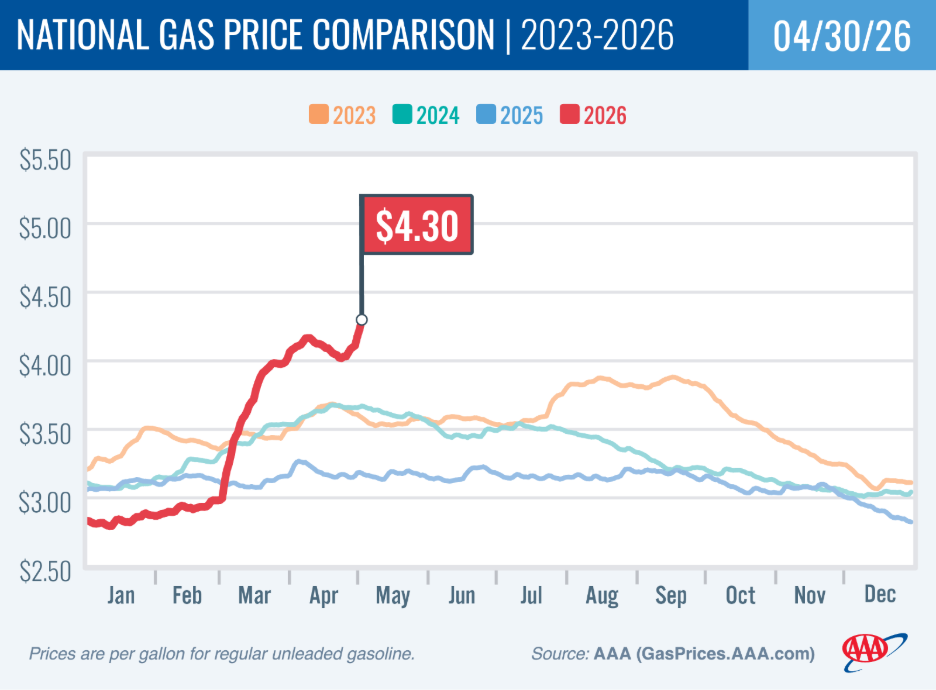
National average jumps 27 cents in a week to $4.30, with California topping $6 a gallon, as oil prices breach $106 a barrel amid the Hormuz closure.

INDIA —
Key facts
- National average gas price rose to $4.30 per gallon on April 30, 2026, up 27 cents in one week.
- Oil prices surged above $100/barrel; WTI settled at $106.88 a barrel on April 30.
- California has the most expensive gas at $6.01 per gallon; Oklahoma the cheapest at $3.70.
- Gasoline demand increased to 9.10 million b/d from 9.05 million; supply fell to 222.3 million barrels.
- Crude oil inventories decreased by 6.2 million barrels to 459.5 million barrels.
- Diesel prices hit new records in the Great Lakes region, touching $6 per gallon in some areas.
- National average for public EV charging rose 1 cent to 41 cents per kWh.
- Gas prices are the highest in four years since late July 2022.
National Average Hits $4.30 as All 50 States See Increases
Gasoline prices are climbing across the United States, with the national average reaching $4.30 per gallon on April 30, a 27-cent increase in just one week. decline and pushes prices $1.12 higher than the same period last year. All 50 states recorded rises, with the most dramatic jumps concentrated in the Great Lakes region. Patrick De Haan, head of petroleum analysis at GasBuddy, noted that states like Michigan, Indiana, Ohio, and Illinois saw sharp spikes, while Wisconsin experienced more modest gains. Diesel prices also surged to new records in parts of the region, with some areas touching the $6-per-gallon mark. The national average now stands at its highest level in four years, since late July 2022.
Oil Above $106 a Barrel as Strait of Hormuz Remains Closed
The rally at the pump is driven by crude oil prices that have breached $100 a barrel, with West Texas Intermediate crude settling at $106.88 on April 30, up $6.95 in a single session. The surge reflects ongoing disruption in the Strait of Hormuz, a critical chokepoint for global oil shipments, which remains closed with no indication of reopening. crude oil inventories fell by 6.2 million barrels to 459.5 million barrels, now about 1% above the five-year average. De Haan said markets are digesting a wave of new developments, including OPEC+ raising production for June and President Trump outlining a plan to free stranded ships, which could help restore some supply. However, he cautioned that with so many moving pieces, the outlook remains highly fluid, and broader price volatility is likely to persist in the near term.
Gasoline Demand Rises While Supply Tightens
Gasoline demand increased last week to 9.10 million barrels per day from 9.05 million, while total domestic gasoline supply dropped from 228.4 million barrels to 222.3 million. Gasoline production also decreased, averaging 9.8 million barrels per day. The combination of rising demand and falling supply is putting upward pressure on prices at the pump. The American Petroleum Institute explained that gasoline prices reflect costs across the fuel supply chain, from crude oil production to refining, distribution, and retail sales. The largest factor is the price of crude oil, traded in global markets. Refining costs, distribution and marketing expenses, and federal and state taxes also contribute. According to the EIA, distribution and marketing account for 20% of the pump price.
California Tops $6 a Gallon; Oklahoma Cheapest at $3.70
The nation's most expensive gasoline markets are led by California at $6.01 per gallon, followed by Hawaii ($5.64), Washington ($5.57), Oregon ($5.15), and Nevada ($5.12). At the other end, the cheapest gas is found in Oklahoma ($3.70), Kansas ($3.75), Georgia ($3.75), Mississippi ($3.77), and Arkansas ($3.79). The wide spread reflects regional differences in refining capacity, taxes, and distribution costs. For electric vehicle owners, the national average cost of public charging rose one cent to 41 cents per kilowatt hour. West Virginia has the most expensive public charging at 53 cents per kWh, while Kansas offers the cheapest at 29 cents. Drivers can find current gas and electric charging prices along their route using the AAA TripTik Travel planner.
Great Lakes Region Hit Hardest by Diesel and Gasoline Spikes
The Great Lakes region is experiencing some of the most significant and fastest increases in gasoline prices, with Michigan, Indiana, Ohio, and Illinois seeing sharp spikes. Diesel prices have surged to new records, with some areas touching the $6-per-gallon mark.xpensive for gas at $4.66, Michigan ninth at $4.58, and Ohio tenth at $4.46. The regional pinch is compounded by the fact that the Great Lakes area relies heavily on pipelines and refineries that are sensitive to crude oil supply disruptions. With the Strait of Hormuz closed, refineries in the region face higher input costs, which are passed on to consumers. The volatility is expected to persist until global supply routes stabilize.
Outlook Remains Highly Fluid as OPEC+ and White House Act
De Haan noted that while some localized relief may emerge, broader price volatility is likely to persist in the near term. OPEC+ has agreed to raise production for June, and President Trump has outlined a plan to free stranded ships, which could help restore some supply. However, the effectiveness of these measures depends on the reopening of the Strait of Hormuz and the resolution of geopolitical tensions. shows that total domestic gasoline supply has fallen by 6.1 million barrels in a week, and crude oil inventories are declining. If demand continues to rise and supply remains constrained, prices could climb further. Analysts are watching for any signs of de-escalation in the Hormuz crisis, which would likely bring immediate relief to oil markets.
Four-Year Highs Underscore Fragility of Fuel Supply Chain
Gas prices are now at their highest in four years, since late July 2022, a reminder of how quickly the fuel supply chain can tighten. The current crisis echoes the 2022 spike following Russia's invasion of Ukraine, but the trigger this time is the closure of the Strait of Hormuz, through which about 20% of global oil passes. The combination of rising demand, falling supply, and geopolitical uncertainty has created a perfect storm for consumers. For now, drivers face a landscape of rising costs at the pump and no clear timeline for relief. The actions of OPEC+, the White House, and regional powers will determine whether prices stabilize or continue their upward march. As De Haan put it, the outlook remains highly fluid, and the only certainty is continued volatility.
The bottom line
- National average gas price hit $4.30 on April 30, up 27 cents in a week, the highest in four years.
- Oil prices surged above $106/barrel due to the ongoing closure of the Strait of Hormuz.
- All 50 states saw price increases; Great Lakes region experienced the sharpest spikes.
- Diesel prices reached new records, touching $6 per gallon in some Great Lakes areas.
- Gasoline demand rose while supply fell, with crude inventories dropping 6.2 million barrels.
- OPEC+ production increase and White House ship-freeing plan may offer relief, but volatility persists.

Gujarat Board to Release SSC Results at 8 AM Today; Over 15 Lakh Students Await Scores

NEET 2026 Answer Key Released by Coaching Institutes as NTA Prepares Official Cutoffs

Punjab Kings Remain Top Despite Back-to-Back Losses, Says Captain Shreyas Iyer After Narrow Defeat to Gujarat Titans
