New Simulations Reveal Circumbinary Planets May Form Commonly on Wide Orbits
Research by Matthew Teasdale and Dimitris Stamatellos suggests that gravitational instability in outer discs enables gas giants to emerge despite chaotic stellar environments.

IRAQ —
Key facts
- Over 50 circumbinary exoplanets have been detected in recent years.
- New simulations focus on disc fragmentation as a formation pathway for gas giants on orbits wider than 10 AU.
- The study is published in Monthly Notices of the Royal Astronomical Society by Matthew Teasdale and Dimitris Stamatellos.
- Two types of discs are modeled: circumstellar discs around each star and circumbinary discs surrounding both stars.
- Discs around wider binary separations fragment earlier and more efficiently than those around closer binaries.
- Many circumbinary planets are ejected and become rogue planets.
- The research suggests that circumbinary planets are not rare but are often on wide orbits, limiting transit detection.
Chaos Near the Stars, Stability at a Distance
Binary stars are abundant in the Milky Way, yet for decades astronomers assumed that their complex gravitational fields would prevent planet formation. The competing pulls from two stars warp and sometimes destroy protoplanetary discs, making it nearly impossible for gas and dust to coalesce into planets. Even when rare planetesimals form, they are prone to gravitational kicks that eject them into interstellar space. However, recent observations have confirmed the existence of over 50 circumbinary exoplanets, challenging the long-held belief that such worlds are rare. A new study led by Dr. Matthew Teasdale and Dr. Dimitris Stamatellos of the Jeremiah Horrocks Institute at the University of Lancashire offers a compelling explanation: while the inner regions of binary systems remain too violent for planet formation, the outer reaches may be surprisingly hospitable.
Two Pathways to Planet Formation
Planets can form through two primary mechanisms. The first, core accretion, is a slow bottom-up process where dust grains stick together to form pebbles, then rocks, then planetesimals, eventually growing large enough to attract an atmosphere. This process is easily disrupted in binary systems. The second mechanism, disc fragmentation or gravitational instability, is a top-down process where instabilities in a protoplanetary disc cause regions to collapse under their own gravity, forming gas giants in just a few thousand years. The researchers focused on this pathway, simulating how discs behave in binary systems under different conditions.
Simulating Circumbinary Discs
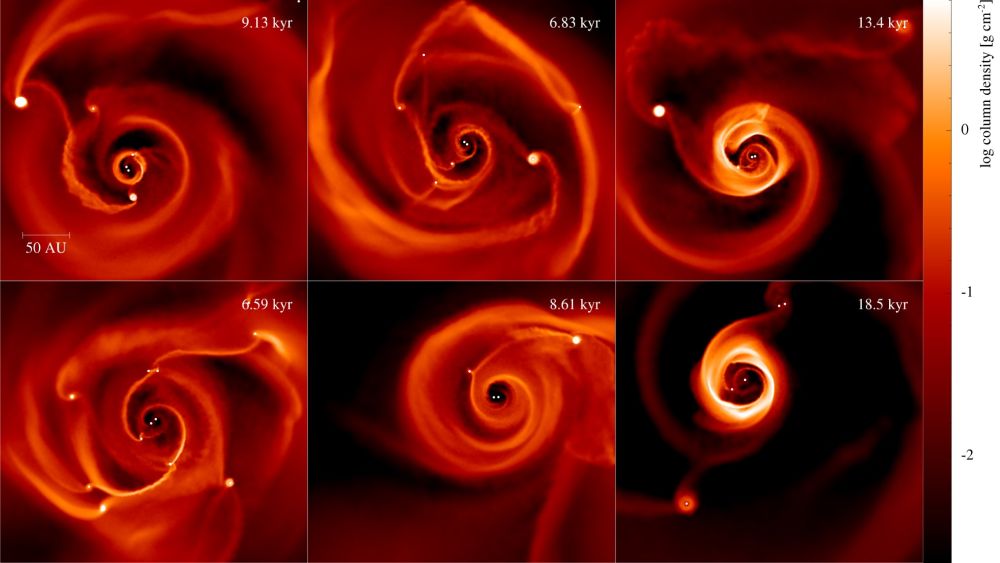
Teasdale and Stamatellos performed hydrodynamic simulations of three types of discs: circumstellar discs (around each star individually), circumbinary discs with the same temperature profile as circumstellar discs (a fiducial model), and realistic circumbinary discs heated individually by each star. They varied binary separation and mass ratios to explore how these factors affect planet formation. The simulations showed that discs around binaries with wider separations fragment earlier and more efficiently than those around closer binaries. This suggests that planets can form at distances beyond about 10 astronomical units (AU), where the gravitational influence of the binary pair is weaker and the disc remains cool enough to fragment.
Implications for Exoplanet Detection
The findings help explain why only about 50 circumbinary planets have been detected despite the abundance of binary stars. Most detection methods, particularly the transit method, favor planets on close-in orbits. If circumbinary planets preferentially form on wide orbits, they are much less likely to be observed transiting their host stars. Additionally, many of these planets may be ejected from their systems entirely, becoming rogue planets wandering interstellar space. This could mean that the number of circumbinary planets is far higher than current observations suggest, with a significant fraction lost to gravitational instability.
A New Perspective on Planetary Systems
The research does not overturn the idea that the inner regions of binary systems are hostile to planet formation. As Dr. Teasdale noted, "Close to a binary star it’s simply too violent for planets to form. But move farther out and the disc becomes an ideal environment for planet formation." This dual nature — chaos near the stars, stability at a distance — suggests that circumbinary planets may be common, but their wide orbits and frequent ejection make them challenging to detect. The study provides a framework for understanding the population of such planets and their role in the broader galaxy.
What Comes Next
The simulations open new questions about the diversity of planetary systems. Future observations with telescopes like the James Webb Space Telescope or the Nancy Grace Roman Space Telescope may be able to directly image wide-orbit circumbinary planets, testing the predictions of disc fragmentation models. Understanding the formation of these planets also has implications for the study of rogue planets, which may be more numerous than previously thought. If a significant fraction of circumbinary planets are ejected, they could constitute a substantial population of free-floating worlds.
A Universe of Hidden Worlds
The study by Teasdale and Stamatellos challenges the assumption that binary stars are barren of planets. Instead, it paints a picture of a universe where planets can form even in the most chaotic environments, albeit in unexpected places. The discovery that circumbinary planets may be common but hidden on wide orbits reshapes our understanding of planetary system formation and the potential for life in the galaxy. As detection methods improve, astronomers may uncover a vast population of worlds that have been overlooked, orbiting pairs of stars at great distances or wandering alone through the cosmos.
The bottom line
- Circumbinary planets may be common, but they form on wide orbits (>10 AU) where disc fragmentation is possible.
- Discs around wider binary separations fragment more efficiently, leading to earlier planet formation.
- Many circumbinary planets are ejected and become rogue planets, contributing to a large population of free-floating worlds.
- The study explains why only 50 circumbinary planets have been detected despite the abundance of binary stars.
- Core accretion is disrupted in binary systems, but disc fragmentation offers a viable alternative for gas giant formation.
- Future direct imaging missions may confirm the existence of wide-orbit circumbinary planets predicted by these simulations.


Orlando City Stuns Inter Miami 4-3 After Messi's Hat-Trick Lead Evaporates

Shedge's 57 and Holder's Four-Wicket Haul Define Low-Scoring Thriller as Gujarat Titans Beat Punjab Kings by Four Wickets

Peshawar Zalmi End Nine-Year Title Drought with Clinical Win Over Hyderabad Kingsmen