New simulations suggest circumbinary exoplanets are common, not rare
Researchers find that binary star systems can host planets on wide orbits, with many eventually ejected as rogue worlds.

KUWAIT —
Key facts
- Over 50 circumbinary exoplanets have been discovered in recent years.
- New research published in Monthly Notices of the Royal Astronomical Society by Matthew Teasdale and Dimitris Stamatellos.
- Simulations show circumbinary discs can fragment via gravitational instability at wide separations.
- Planets form more efficiently around binaries with wider separations than closer ones.
- Circumbinary planets are often gas giants on orbits greater than 10 astronomical units.
- Many circumbinary planets are ejected and become rogue planets.
A new view of planet formation in binary systems
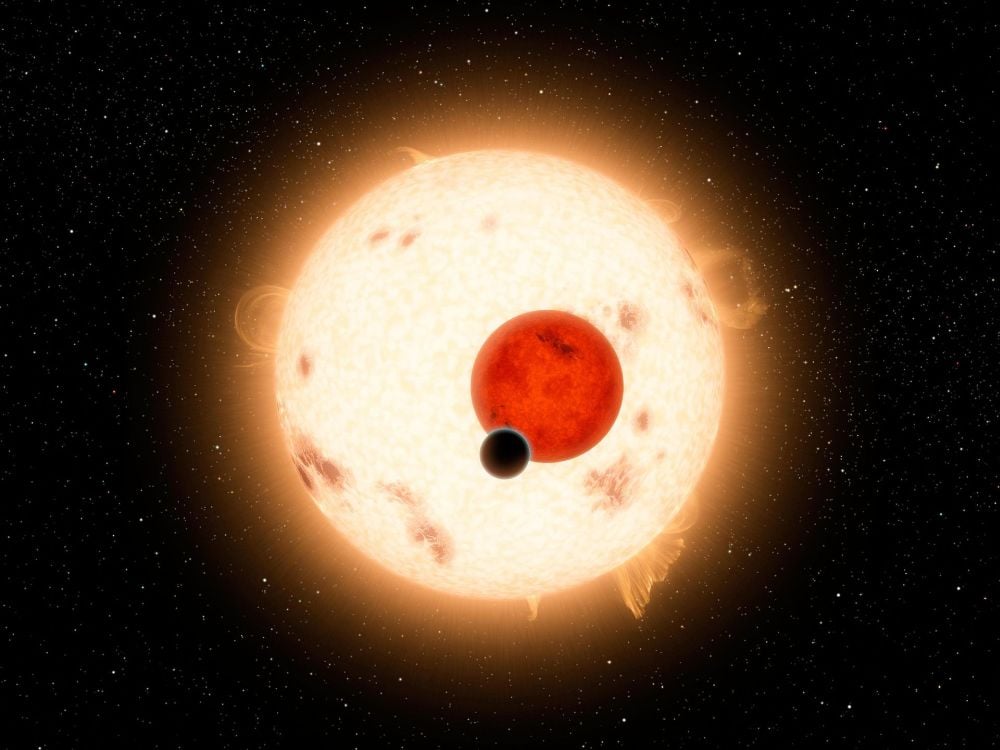
Binary stars are common in the Milky Way, but astronomers have long believed that their complex gravitational environments would disrupt planet formation. The competing pulls from two stars can warp or destroy protoplanetary discs, preventing gas and dust from clumping into planets. Yet recent observations have detected several dozen exoplanets orbiting binary stars, challenging that assumption. New simulations by researchers at the University of Lancashire suggest that circumbinary planets may be far more common than previously thought. The study, led by Matthew Teasdale and Dimitris Stamatellos of the Jeremiah Horrocks Institute, shows that under the right conditions, planet formation can proceed even in these chaotic systems.
Two paths to planet formation
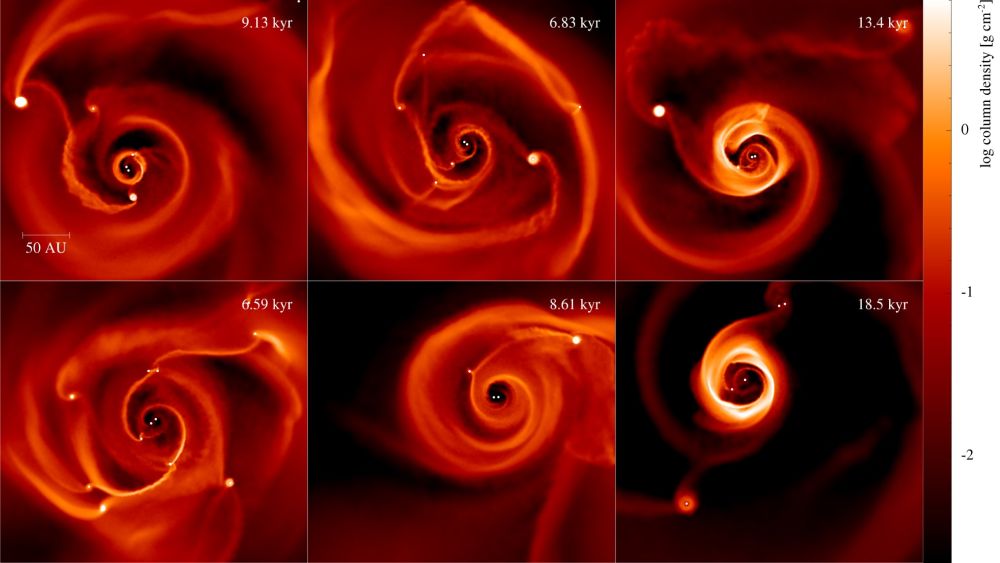
Planets form through two primary mechanisms. The first, core accretion, is a slow bottom-up process where dust grains stick together to form pebbles, then rocks, then planetesimals, eventually growing large enough to attract an atmosphere. This process is disrupted in binary systems near the stars. The second mechanism, disc fragmentation, is a top-down process where instabilities in the protoplanetary disc cause regions to collapse under their own gravity, forming gas giants in just a few thousand years. The researchers focused on this pathway, simulating both circumstellar discs (around each star) and circumbinary discs (surrounding both stars) under different temperature conditions.
Simulations reveal efficient planet formation at wide orbits
The team performed hydrodynamic simulations of marginally unstable discs, comparing three scenarios: circumstellar discs, circumbinary discs with the same temperature profile (fiducial model), and realistic circumbinary discs heated individually by each star. They found that discs around binaries with wider separations fragment earlier and more efficiently than those around closer binaries, and even earlier than circumstellar discs. “Close to a binary star it’s simply too violent for planets to form,” said Dr. Matthew Teasdale, who led the research as part of his PhD project. “But move farther out and the disc becomes an ideal environment for planet formation.” The simulations indicate that gas giants on wide orbits—greater than 10 astronomical units—are the typical outcome.
Implications for the population of rogue planets
The research also sheds light on the fate of many circumbinary planets. The gravitational interactions in binary systems can give planetesimals and fully formed planets a gravitational kick, ejecting them into interstellar space. This suggests that a significant fraction of rogue planets—those wandering the galaxy without a host star—may originate from binary systems. With over 50 circumbinary exoplanets already detected, the new findings imply that the actual number is much higher. The difficulty in observing transits for planets on wide orbits has likely led to an undercount. As telescopes improve, astronomers expect to find many more such worlds.
A paradigm shift in understanding planetary systems
The study challenges the long-held view that binary stars are inhospitable to planets. While the region near the stars remains too violent for planet formation, the outer reaches of circumbinary discs can be surprisingly fertile. This expands the potential for habitable worlds, though the gas giants produced by disc fragmentation are unlikely to support life as we know it. The research also highlights the importance of disc fragmentation as a planet formation mechanism, which may be more common than previously appreciated. As the authors note, the aim was to investigate whether circumbinary planets can form through disc fragmentation due to gravitational instability—and the answer is a clear yes.
The bottom line
- Circumbinary planets are common, not rare, and form via disc fragmentation on wide orbits.
- Binary systems with wider separations produce planets more efficiently than closer binaries.
- Many circumbinary planets are ejected to become rogue planets roaming interstellar space.
- Over 50 circumbinary exoplanets have been detected, but the true number is likely much higher.
- The study was published in Monthly Notices of the Royal Astronomical Society by Teasdale and Stamatellos.
- Future observations should focus on wide orbits to find more circumbinary planets.


Peshawar Zalmi Defeat Hyderabad Kingsmen by Five Wickets to Win Second PSL Title

Smaran Ravichandran Makes IPL Debut for Sunrisers Hyderabad After Year-Long Wait

Messi's brace sends Inter Miami to Leagues Cup final after 3-1 win over Orlando City