Latvia’s President Rinkēvičs warns coalition to end infighting or face replacement
Edgars Rinkēvičs tells Prime Minister Siliņa that the government’s fate hinges on next week’s budget vote, as he calls for a focus on security, demography, healthcare and education.

LATVIA —
Key facts
- President Edgars Rinkēvičs met Prime Minister Evika Siliņa at Riga Castle on Wednesday.
- Rinkēvičs said the government should set aside harsh rhetoric and focus on security, demography, healthcare and education.
- The president warned that public debt cannot grow indefinitely and that Latvia’s fiscal deficit is already high.
- The 2025 national budget is expected to be submitted to the Saeima next week.
- Rinkēvičs stated he saw no reason for emergency consultations on the government’s performance.
- Prime Minister Siliņa acknowledged coalition tensions but insisted the defense budget is the top priority.
- Rinkēvičs spoke on the 36th anniversary of the Restoration of Independence of Latvia on 4 May 2026.
- The president reviewed 15 clemency requests.
A warning from the castle
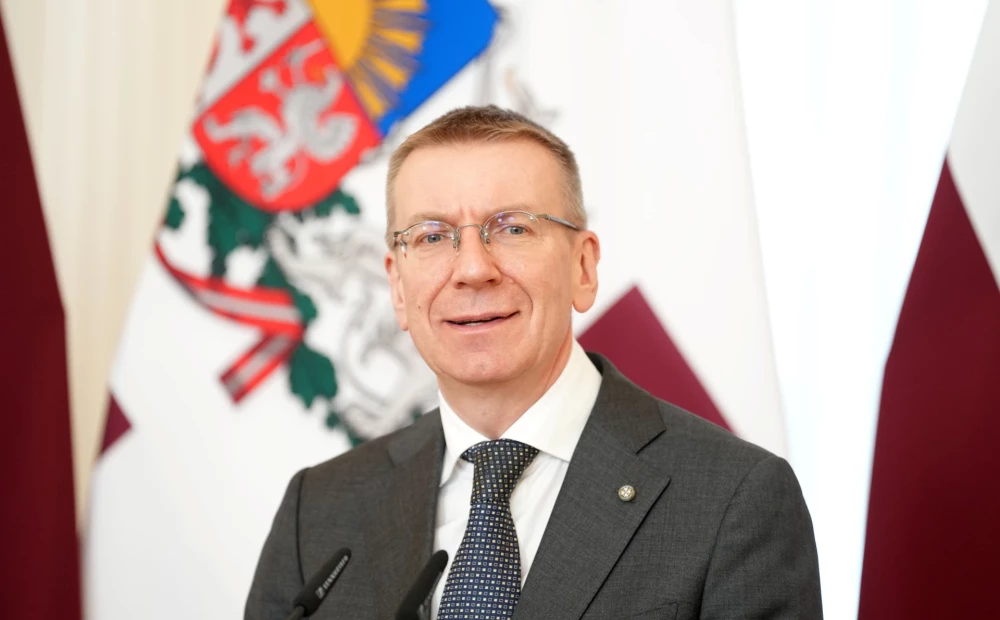
President Edgars Rinkēvičs has told Prime Minister Evika Siliņa that if the current government cannot function effectively, it may be time to give others a chance. The blunt assessment came after a meeting at Riga Castle on Wednesday, as the president urged both the government and parliament to drop sharp rhetoric and concentrate on the country’s core priorities. “I would urge everyone to put aside the sharp rhetoric that periodically surfaces in parliament and government, and focus on security matters — there is still a lot to be done,” Rinkēvičs said. He warned that public debt cannot grow indefinitely, noting that Latvia’s fiscal deficit is already high.
The budget as a test of unity
The president made clear that the government’s survival will largely be judged by the 2025 national budget, which the Cabinet is expected to submit to the Saeima next week. “The way budget discussions unfold and the final decision on its adoption will reveal whether the coalition parties are willing — or unwilling — to work together,” he noted. Rinkēvičs said he saw no reason for emergency consultations on the government’s performance, having recently met with all parliamentary factions, the Speaker of the Saeima and the Prime Minister. “We are not in a situation where every Monday, Tuesday, and Wednesday should bring political drama over issues the public doesn’t fully understand,” he added.
Coalition tensions acknowledged
Prime Minister Evika Siliņa, leader of New Unity, acknowledged that tensions exist within the coalition, which includes New Unity, the Progressives, and the Union of Greens and Farmers (ZZS). She insisted that the coalition’s main priority remains the adoption of the defense budget and the fulfillment of promises made to society. “We have clearly entered pre-election rhetoric in parliament. I remind my colleagues and partners that the top priority must be passing the defense budget,” Siliņa said. She noted that she had held meetings with partners and urged them to avoid adding divisive topics unrelated to the budget. Siliņa emphasized that ideological differences between the coalition parties are natural in a democracy.
A call for national unity on Independence Day
Rinkēvičs’s remarks came against the backdrop of the 36th anniversary of the Restoration of Independence of Latvia on 4 May 2026. In a separate address at the highest Latvian state awards ceremony at Riga Castle, the president also participated in a regional military parade in Aizkraukle and laid flowers at the stele “Lāčplēša cīņa.” In a greeting on the anniversary, Rinkēvičs said that Latvia’s story must be built by Latvians themselves. He drew a parallel to the country’s first parliament, which he described as “as colorful as a woodpecker’s belly in terms of nationalities and opinions, just like today’s Latvia.” Despite its diversity, he noted, the Constitutional Assembly managed to agree on the fundamental law of the state within two years, answering three questions: what Latvia is, what kind of Latvia it is, and why Latvia exists.
Security and regional commitments
Beyond domestic politics, Rinkēvičs has been active on security and international fronts. He addressed the command change ceremony for NATO’s Multinational Division North, underscoring Latvia’s commitment to alliance obligations. In the Three Seas region, he argued for stronger logistics, better digital connectivity and a coordinated energy strategy. The president also discussed the state reimbursement system for medicines and medical devices with the Minister for Health, and presented letters of credence to ambassadors extraordinary and plenipotentiary of the Republic of Latvia abroad. He reviewed 15 clemency requests and spoke at the commemoration ceremony for the victims of the Chernobyl nuclear power plant accident.
What comes next
The coming weeks will determine whether the coalition can hold together. The submission of the 2025 budget to the Saeima next week will be the first major test. Rinkēvičs has signaled that he is watching closely, and that failure to cooperate could lead to a change in government. For now, the president has ruled out emergency consultations, but the pressure is on Prime Minister Siliņa to manage the coalition’s internal divisions while pushing through the defense budget and other priorities. The public, Rinkēvičs suggested, expects results, not drama.
A president’s balancing act
Edgars Rinkēvičs has positioned himself as both a stern critic and a unifying figure, urging politicians to focus on the nation’s long-term challenges. His references to the historical precedent of the Constitutional Assembly serve as a reminder that Latvia has overcome political fragmentation before. Whether the current coalition can emulate that success remains an open question. The president’s words carry weight, and his warning that others may be given a chance if the government falters adds a tangible consequence to the political infighting. For now, all eyes are on the budget debate.
The bottom line
- President Rinkēvičs has warned that the coalition may be replaced if it cannot govern effectively, with the 2025 budget vote as a key test.
- The president urged an end to harsh rhetoric and a focus on security, demography, healthcare and education.
- Prime Minister Siliņa acknowledged coalition tensions but stressed the defense budget as the top priority.
- Latvia’s fiscal deficit is already high, and public debt cannot grow indefinitely, Rinkēvičs warned.
- On the 36th anniversary of independence, Rinkēvičs invoked the Constitutional Assembly’s success as a model for unity.
- Rinkēvičs has engaged in multiple security and diplomatic activities, including NATO and Three Seas initiatives.
Latvia lifts airspace alert after suspected drone incursion near eastern border
Estonia Proposes Lifetime Schengen Ban for Russian Soldiers Amid Security Fears
:format(webp)/nginx/o/2026/05/01/17607107t1h2e73.jpg)