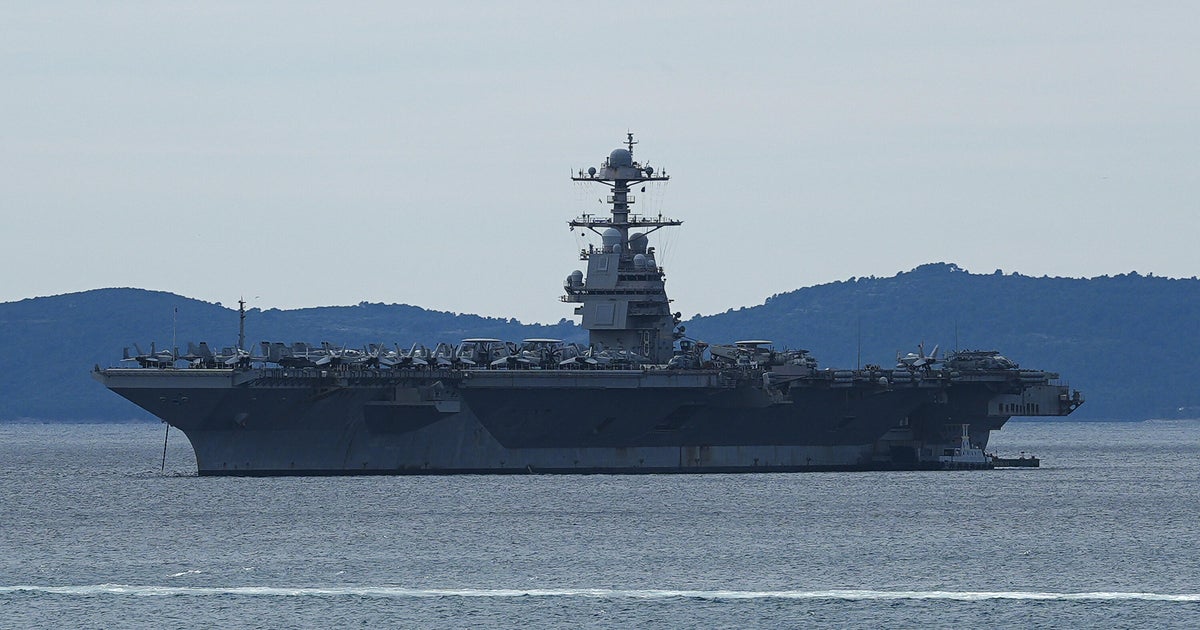
USS Gerald R. Ford heads home after record 295-day deployment, reducing US firepower as Iran talks stall
The world's largest aircraft carrier, which participated in the capture of Nicolás Maduro and the opening days of the Iran war, is leaving the Middle East after a deployment that strained crew and equipment.

NIGERIA —
Key facts
- USS Gerald R. Ford deployed for 295 days, the longest post-Vietnam War deployment for a US aircraft carrier.
- The carrier participated in the capture of Venezuelan leader Nicolás Maduro and the opening days of the Iran war.
- A fire in a laundry space forced the Ford to return to the Mediterranean for repairs, leaving hundreds of sailors without sleeping quarters.
- The Ford's departure leaves two US carriers in the region: USS George HW Bush and USS Abraham Lincoln.
- Defense Secretary Pete Hegseth acknowledged readiness and maintenance tradeoffs due to operational demands.
- The Ford broke the previous record of 294 days set by USS Abraham Lincoln in 2020.
- The carrier's home port is Naval Station Norfolk, Virginia; it is expected to arrive in mid-May.
A record deployment ends amid strategic tradeoffs
The USS Gerald R. Ford, the world's largest aircraft carrier, is set to leave the Middle East in the coming days and return to its home port in Norfolk, Virginia, by mid-May, according to two US officials who spoke on condition of anonymity. The departure ends a 295-day deployment — the longest for any US carrier since the Vietnam War — but reduces American naval firepower in a region where peace talks with Iran have stalled. The Ford's exit comes as three US carriers were simultaneously deployed to the Middle East for the first time since 2003, a show of force during a tenuous ceasefire in the Iran war. The USS George HW Bush arrived last week, and the USS Abraham Lincoln has been in the region since January. With the Ford leaving, two carriers remain.
From the Caribbean to the Middle East: a carrier's journey
The Ford began its deployment in June, departing Naval Station Norfolk for the Mediterranean Sea. It was then rerouted to the Caribbean in October as part of the largest naval buildup in that region in generations, where it took part in the military operation to capture Venezuelan President Nicolás Maduro. After Maduro's capture, the carrier headed to the Middle East as tensions with Iran escalated. It participated in the opening days of the Iran war from the Mediterranean Sea before transiting the Suez Canal into the Red Sea in early March. However, a fire in one of its laundry spaces forced the carrier to turn around and return to the Mediterranean for repairs, leaving hundreds of sailors without places to sleep.
Human and material costs of extended operations
The 295-day deployment has raised concerns about the impact on service members and the strain on the ship and its equipment. The carrier already endured a fire that required lengthy repairs. Defense Secretary Pete Hegseth, testifying before the House Armed Services Committee, said he consulted Navy officials who mentioned readiness and maintenance tradeoffs. “Multiple times the operational requirements — whether it was down in Southcom or up to Centcom — demanded additional assets in real time, which through a tough decision-making process led to an extension,” Hegseth said, referring to US Southern Command and US Central Command. The deployment surpassed the previous record of 294 days set by the USS Abraham Lincoln in 2020 during the Covid-19 pandemic, according to data from US Naval Institute News.
War costs and diplomatic efforts
At the same House hearing, a Pentagon official estimated the costs of the Iran war so far at $25 billion. President Trump told reporters he discussed the war with Russian President Vladimir Putin, who reiterated an offer to help remove Iran's enriched uranium from the country — a condition Trump has demanded. Meanwhile, Hezbollah, the Iran-backed militant group in Lebanon, has introduced a new weapon: fiber-optic drones controlled by cables the width of dental floss, which are immune to electronic jamming. The drones have been used against Israeli soldiers in southern Lebanon, exploiting a gap in Israeli air defenses that have been effective against larger rockets and missiles.
Historical context and future outlook
The Ford's 295-day deployment falls short of the Cold War record of 332 days set by the now-decommissioned USS Midway in 1972-1973. But it is the longest in the post-Vietnam era, reflecting the high operational tempo demanded by simultaneous crises in Latin America and the Middle East. As the Ford sails home, questions remain about the sustainability of such deployments. The carrier's departure reduces the firepower available to US Central Command at a time when peace talks with Iran are stagnating. The US Navy will need to balance maintenance and readiness against the unpredictable demands of global hotspots.
The bottom line
- The USS Gerald R. Ford set a post-Vietnam record of 295 days at sea, surpassing the previous record by one day.
- The carrier participated in two major operations: the capture of Nicolás Maduro and the opening of the Iran war.
- A fire in a laundry space caused a setback, forcing the carrier to return to the Mediterranean for repairs.
- The departure leaves two US carriers in the Middle East, reducing firepower as Iran talks stall.
- Defense Secretary Hegseth acknowledged that operational demands led to tough decisions on maintenance and readiness.
- Hezbollah's use of fiber-optic drones presents a new challenge to Israeli and US forces in the region.


HSV Escape Relegation Scare with 2–1 Win at Frankfurt, Open Eight-Point Gap

China Opens Zero-Tariff Door to 53 African Nations, Excluding Taiwan Ally Eswatini

Why Air Peace is making news
