UAE to quit OPEC in May, dealing blow to Saudi-led cartel
The move strips OPEC of a key member with spare capacity and signals a shift in oil-market dynamics as the UAE seeks to boost output.

NIGERIA —
Key facts
- UAE will leave OPEC and OPEC+ on May 1.
- UAE holds spare capacity of nearly 4.8 million barrels per day.
- Current UAE output under quotas is 3.2-3.6 million bpd.
- UAE plans to increase output to 5 million bpd by 2025.
- Energy Minister Suhail Al Mazrouei said UAE wants to be 'unconstrained by any groups'.
- Analyst Jorge Leon called the exit 'a real tool out of the group's hands'.
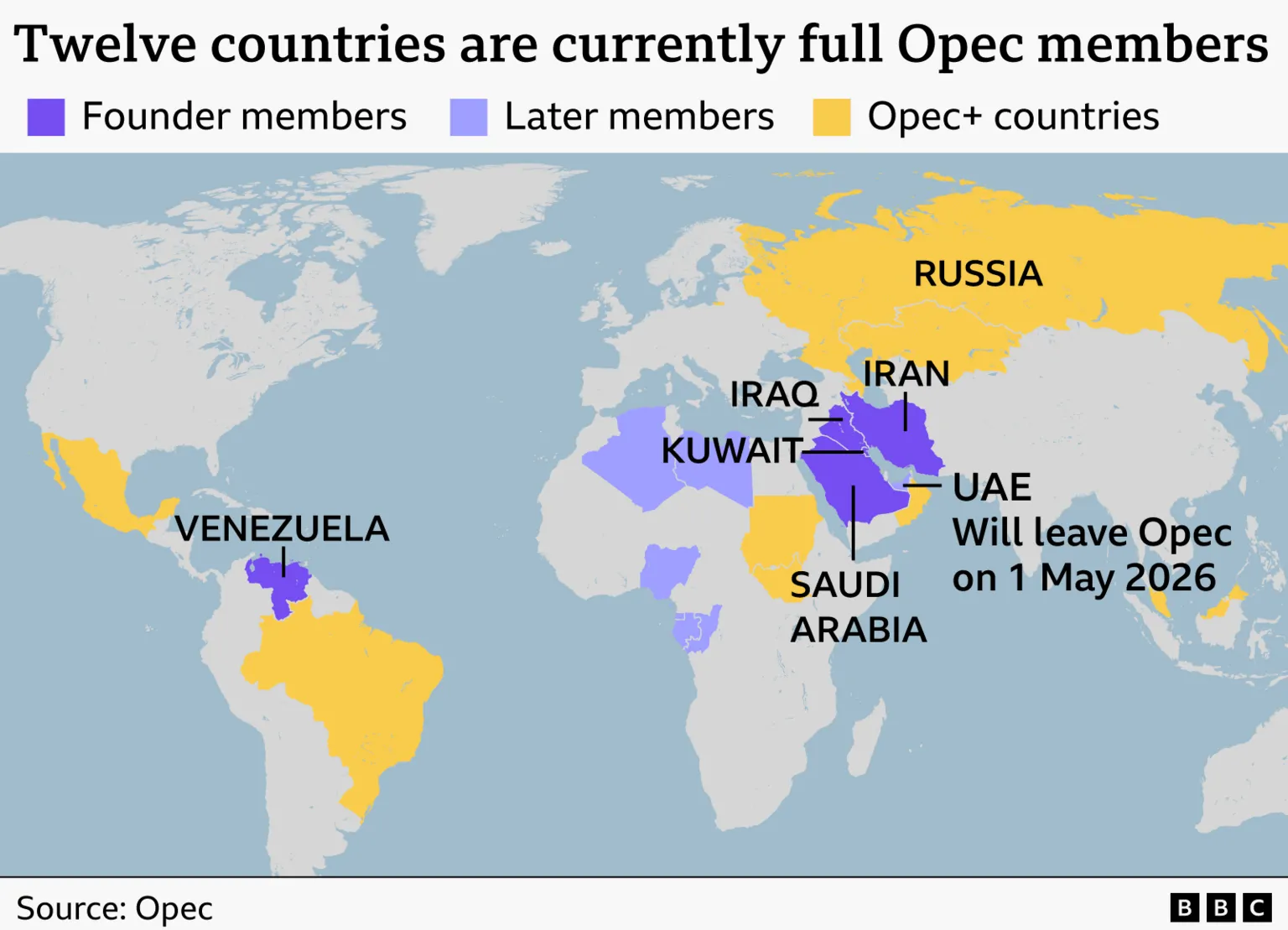
- OPEC was founded in 1960 by Iran, Iraq, Kuwait, Saudi Arabia and Venezuela.
- OPEC+ includes Russia and 10 other producers.
UAE's exit strips OPEC of a key partner and spare capacity
The United Arab Emirates will leave the Organization of the Petroleum Exporting Countries on May 1, ending a 56-year membership and dealing a significant blow to the cartel's cohesion. The departure, which also covers the wider OPEC+ alliance that includes Russia, removes one of the few members with meaningful spare oil capacity. Saudi Arabia, OPEC's de facto leader, has long relied on the UAE to help manage global oil prices through coordinated production cuts. With the UAE gone, Riyadh will have to shoulder a greater share of output adjustments alone, making price defense more expensive and less effective.
Clash over quotas drove the decision
For years, the UAE has chafed under OPEC's quota system, which limits how much each member can produce. The country has invested heavily to expand its oil industry and grow its market share, but OPEC limits repeatedly held it back. Energy Minister Suhail Al Mazrouei told The New York Times on Tuesday: 'The world needs more energy. The world needs more resources, and [the] UAE wanted to be unconstrained by any groups.' The statement underscores the UAE's frustration with a system that it believes leaves money on the table.
UAE bets on independent output expansion
The UAE currently produces roughly 3.2 to 3.6 million barrels per day under quotas but holds spare capacity of nearly 4.8 million bpd. Plans call for a hike in output toward 5 million bpd by next year. Analysts see the move as a calculated step by a producer ready to act independently. 'Losing a member with 4.8 million barrels per day of capacity, and the ambition to produce more, takes a real tool out of the group's hands,' said Jorge Leon, head of geopolitical analysis at Rystad Energy.
OPEC's influence wanes amid shifting market dynamics
The UAE's exit comes at a time of significant volatility in the oil market, with the US-Israel war with Iran triggering the biggest loss of oil supply on record, according to the World Bank. Critics, including US President Donald Trump, have long argued that OPEC uses its influence to keep prices higher than they otherwise might be by limiting supplies. David Oxley, chief climate and commodities economist at Capital Economics, called the move 'the thin end of the wedge,' warning that 'the ties binding OPEC members together have loosened.' The departure adds to growing uncertainty over the cartel's future.
What comes next for OPEC and global oil markets
With the UAE gone, Saudi Arabia will have to rely much more on its own production cuts to stabilize prices. This weakens the Kingdom's ability to manage and discipline the wider OPEC group. with demand nearing a peak, the calculation for producers with low-cost barrels is changing fast. 'Waiting your turn inside a quota system starts to look like leaving money on the table,' said Jorge Leon. The UAE's exit may encourage other members to reconsider their commitments.
The bottom line
- The UAE will leave OPEC and OPEC+ on May 1, ending 56 years of membership.
- The exit removes a key member with spare capacity, weakening Saudi Arabia's ability to manage oil prices.
- The UAE plans to increase output to 5 million bpd by 2025, up from current quotas of 3.2-3.6 million bpd.
- Energy Minister Suhail Al Mazrouei cited a desire to be 'unconstrained' by any group.
- Analysts describe the move as 'the thin end of the wedge' for OPEC's cohesion.
- The departure adds uncertainty to OPEC's future amid volatile oil markets and shifting demand.

HSV Escape Relegation Scare with 2–1 Win at Frankfurt, Open Eight-Point Gap

China Opens Zero-Tariff Door to 53 African Nations, Excluding Taiwan Ally Eswatini

Why Air Peace is making news
