BMW Group Surpasses Two Million Electric Vehicle Production Milestone
The German automaker's Dingolfing plant marks a significant achievement in its e-mobility ramp-up, with future models poised to accelerate growth.
NEW ZEALAND —
Key facts
- BMW Group has produced its two-millionth all-electric vehicle.
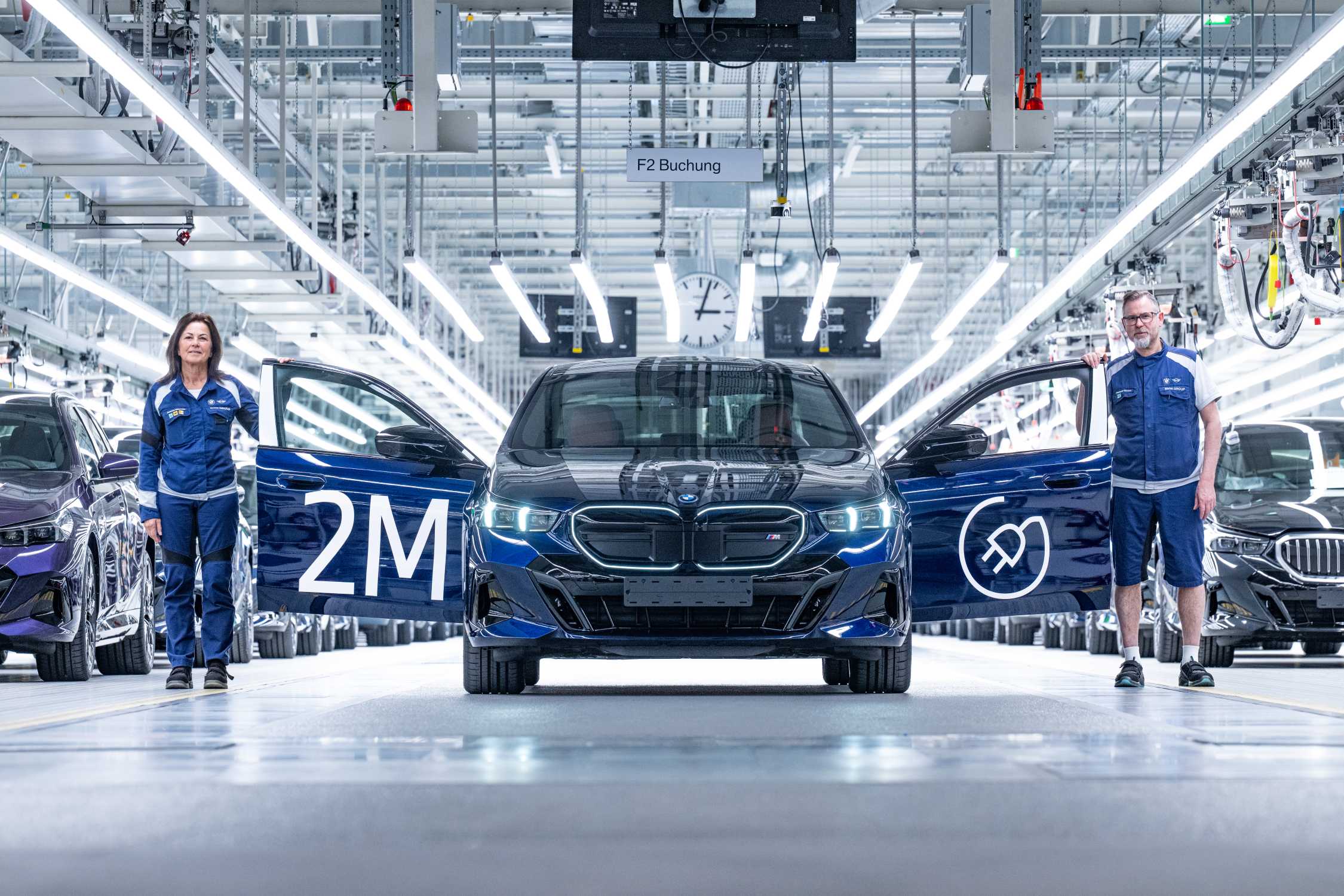
- The milestone vehicle is a Tanzanite Blue BMW i5 M60 xDrive sedan.
- Plant Dingolfing has produced over 320,000 all-electric vehicles since 2021.
- The BMW Group began large-scale EV production in 2013 with the i3 hatchback.
- By 2025, over a quarter of vehicles produced at Plant Dingolfing are expected to be all-electric.
- BMW Group aims for EVs to represent at least 50% of its annual sales by 2030.
- In 2023, vehicles without combustion engines accounted for 17.9% of total BMW Group deliveries.
Anniversary EV Rolls Out of Dingolfing
A Tanzanite Blue BMW i5 M60 xDrive sedan, destined for a customer in Spain, marks a significant production milestone for the BMW Group: the two-millionth all-electric vehicle to roll off its assembly lines. This achievement underscores the company's rapid acceleration in e-mobility, a transition that has seen production volumes surge dramatically in recent years. The anniversary vehicle is a testament to the capabilities of Plant Dingolfing, the company's largest production facility. This Lower Bavarian site began series production of all-electric models in 2021 with the BMW iX and now manufactures the widest range of battery electric vehicles (BEVs) within the group, including the iX, the i5 sedan and touring, and the i7. Since 2021, Plant Dingolfing alone has produced over 320,000 all-electric vehicles, meaning nearly one in every six of the BMW Group's total two million BEVs originates from this single location. The facility operates under the BMW iFACTORY philosophy, emphasizing a technology-open approach that allows for flexible production of vehicles with different powertrains on a single line.
A Decade of Electric Vehicle Development
The journey to two million electric vehicles began over a decade ago. The BMW Group initiated large-scale EV production in 2013 with the launch of the i3 hatchback in Leipzig. While the original i3 has since been retired, its nameplate has been revived for an electric 3 Series sedan, part of the expansive "Neue Klasse" initiative. This ambitious strategy encompasses a full-scale electric offensive, including models like the iX3, the upcoming i3 Touring, and an as-yet-unannounced iX4. The company is also planning for future growth with models such as the iX5 and a larger, three-row iX7 slated for 2027. Furthermore, the introduction of more affordable EVs, such as the i1 hatchback and i2 compact sedan, is anticipated later this decade, offering electric alternatives to the 1 Series and 2 Series Gran Coupe. This rapid expansion is not confined to the BMW brand. The two-million vehicle count also includes fully electric cars from its MINI and Rolls-Royce subsidiaries, highlighting a comprehensive electrification strategy across its portfolio.
Doubling EV Output in Just Over Two Years
The pace of electrification has been remarkable. It has been just over two years since the BMW Group celebrated the delivery of its one-millionth electric vehicle. By May 2026, that number has already doubled, showcasing an exponential increase in production and customer adoption. This surge in volume is partly driven by the success of specific models. The iX3 electric crossover, for instance, has garnered significant attention, accumulating over 50,000 orders in Europe since its launch last September. With a U.S. launch on the horizon, demand is expected to climb further. The i5 sedan, the anniversary vehicle's body style, also contributes to this growth, with a more practical Touring variant also being produced at Dingolfing. The company's commitment to expanding its EV lineup is evident in its forward-looking plans, which aim to significantly increase the proportion of electric vehicles in its sales mix.
Ambitious Targets for the Coming Decade
Looking ahead, the BMW Group remains steadfast in its commitment to e-mobility, setting ambitious targets for the next decade. The company is confident that electric vehicles will constitute at least 50% of its annual sales by 2030. This represents a substantial increase from current figures, with non-combustion engine vehicles making up 17.9% of total deliveries in the past year. To achieve this goal, BMW is investing heavily in production capacity and technological innovation. The company's "technology-open" production principle, allowing for flexible manufacturing of different powertrains on the same lines, is crucial to this strategy. This adaptability ensures that BMW can efficiently scale up EV production as demand grows. Germany's position as the world's second-largest production location for electric cars is partly attributed to the BMW Group's significant contributions. The ongoing ramp-up of e-mobility across all its German plants, where at least one all-electric model is now produced at each site, solidifies its role in the global transition to electric transport.
Future Models and Market Expansion
The future product pipeline is robust, designed to cater to a wider range of market segments and customer needs. Beyond the immediate rollout of the i3 sedan in Europe this year and its subsequent arrival in the United States in 2027, the company is preparing for the next wave of electric vehicles. Anticipated models include the iX5 and iX7, which will bolster the premium SUV segment. The iX3, while not being directly renewed, will see its role indirectly fulfilled by the first-ever iX5. The company is also exploring long-wheelbase versions of the i3 and iX3 for markets like China. Further down the line, the next generation of the iX1 crossover, spotted testing ahead of a potential 2027 launch, is expected to drive significant sales volume. These strategic product introductions are key to the BMW Group's objective of achieving its 2030 electrification targets and solidifying its position in the evolving automotive landscape.
The bottom line
- The BMW Group has now produced two million fully electric vehicles, including those from MINI and Rolls-Royce.
- The milestone vehicle, a BMW i5 M60 xDrive sedan, was produced at the company's Dingolfing plant.
- Plant Dingolfing has become a major hub for EV production, manufacturing the iX, i5, and i7 models.
- BMW Group's EV production has doubled in just over two years, from one million to two million vehicles.
- The company aims for electric vehicles to comprise at least 50% of its total sales by 2030.
- Future product plans include a range of new EVs, from compact models like the i1 and i2 to larger SUVs like the iX7.



LeBron James Faces Largest Underdog Spread of Career as Lakers Enter Game 1 Against Thunder Without Doncic

Georgia Begins Issuing Up to $500 Tax Refunds for Fourth Time in Five Years

Police Commissioner Richard Chambers Demands 60-Day Resolution for Employment Cases Amid Senior Officer Probe
