Philippines Orders Online Sellers to Display BIR Registration Seal Badge
The Bureau of Internal Revenue issues a circular requiring digital economy participants to post a free seal on their platforms, replacing the full Certificate of Registration to address data privacy concerns.
PHILIPPINES —
Key facts
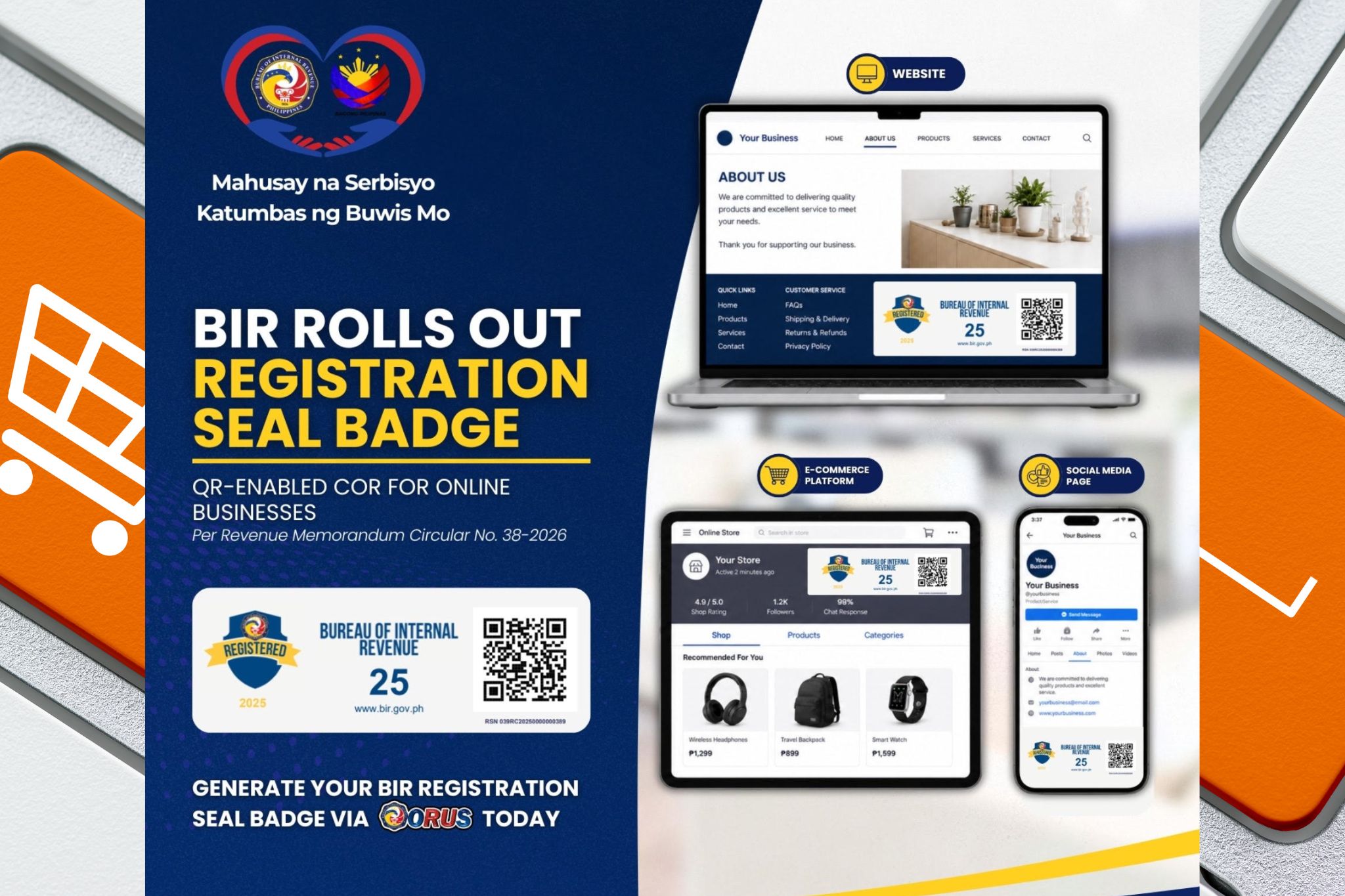
- BIR issued Revenue Memorandum Circular No. 038-2026 requiring online sellers, freelancers, vloggers, and influencers to display the Registration Seal Badge.
- The seal replaces the need to publicly post the full Certificate of Registration (COR), addressing data privacy concerns.
- The seal is issued free of charge via the BIR's Online Registration and Update System (ORUS) or manually at Revenue District Offices.
- BIR Commissioner Charlito Martin Mendoza stated the measure protects legitimate sellers and helps buyers verify business registration.
- The BIR and PAOCC are exploring blockchain analytics and data sharing to address tax compliance gaps in the digital space.
- BIR revenue collections for Q1 2026 reached ₱719.2 billion, a 4.2% increase year-on-year, representing 23.2% of the ₱3.102 trillion annual target.
- The Philippines is among 27 jurisdictions committed to implementing the OECD's Crypto-Asset Reporting Framework (CARF) by 2028.
- 48 jurisdictions began enforcing CARF reporting rules on January 1, 2026, requiring crypto exchanges to report user transaction data.
New Rule Mandates Registration Seal for Digital Economy Participants
Online sellers and digital earners in the Philippines must now display a Registration Seal Badge on their platforms, the Bureau of Internal Revenue (BIR) announced on Tuesday. The requirement, outlined in Revenue Memorandum Circular No. 038-2026, covers a broad range of participants in the digital economy, including online sellers, freelancers, professionals, vloggers, influencers, and others earning income through digital platforms. The seal must be posted on websites, e-commerce pages, or social media business accounts in easily accessible sections such as “About Us” or “Business Permits.” The BIR emphasized that the seal replaces the need to publicly display the full Certificate of Registration (COR), a move that addresses data privacy concerns while still allowing customers and regulators to verify a business’s legitimacy.
BIR Commissioner Highlights Consumer and Seller Protections
BIR Commissioner Charlito Martin Mendoza underscored the dual purpose of the new requirement. “Revenue base protection is not only about enforcement after violations happen. It is also about ensuring that businesses operating in the digital marketplace are properly registered, visible, and accountable from the start,” he said in a news release. Mendoza added that the seal helps protect legitimate online sellers who comply with the law and provides buyers with a simple, reliable way to verify if a business is registered with the BIR. The seal is issued free of charge and can be obtained electronically through the BIR’s Online Registration and Update System (ORUS) or manually at the taxpayer’s Revenue District Office.
BIR and PAOCC Explore Blockchain Analytics to Enhance Tax Compliance
In a parallel development, the BIR and the Presidential Anti-Organized Crime Commission (PAOCC) met to discuss using data and blockchain analytics to address tax compliance gaps among online sellers and emerging payment channels. The meeting included BIR Commissioner Mendoza, PAOCC Undersecretary Benjamin Acorda Jr., and Assistant Commissioner James Roldan. The BIR stated that the two agencies are exploring advanced tools such as data and blockchain analytics while coordinating with the Bureau of Customs (BOC), the Anti-Money Laundering Council, and the Department of Trade and Industry. Mendoza said the measures aim to close enforcement gaps, enhance intelligence-sharing, and strengthen joint operations to protect government revenues and ensure a level playing field for compliant taxpayers.
Q1 2026 Revenue Collections Rise 4.2% to ₱719.2 Billion
According to data from the Bureau of the Treasury, BIR revenue collections for the first three months of 2026 reached ₱719.2 billion, a 4.2 percent increase from the previous year. This amount represents 23.2 percent of the ₱3.102 trillion collection target for 2026. The figures underscore the government’s push to broaden the tax base and capture revenue from the rapidly growing digital economy.
Philippines Commits to OECD Crypto-Asset Reporting Framework by 2028
The Philippines is listed among 27 jurisdictions that have committed to implementing the Crypto-Asset Reporting Framework (CARF), with data exchanges scheduled to commence by 2028. Developed by the Organization for Economic Co-operation and Development (OECD), CARF is a global standard requiring crypto service providers to collect and report user transaction information to tax authorities. On January 1, 2026, an initial group of 48 jurisdictions began enforcing CARF reporting rules. Under the framework, cryptocurrency exchanges in participating jurisdictions collect transaction records that include user identities, tax residencies, transaction values, and profits. Then Finance Secretary Ralph Recto expressed support for the initiative, which aims to enhance transparency in the crypto space.
New Rules Aim to Level Playing Field for Compliant Taxpayers
The BIR’s circular and the collaboration with PAOCC signal a broader strategy to bring the digital economy under the tax net. By requiring a visible registration seal and exploring blockchain analytics, the BIR seeks to deter noncompliance and protect government revenues. Commissioner Mendoza emphasized that the measures are not solely punitive but also supportive of legitimate businesses that follow the rules. The registration seal requirement, in particular, addresses a long-standing concern among online sellers about data privacy when displaying their COR. The move is expected to increase trust between buyers and sellers while making it easier for regulators to identify unregistered operators.
Outlook: Enforcement and International Cooperation Ahead
With the CARF implementation deadline set for 2028, the Philippines is aligning its domestic tax policies with global standards. The BIR’s exploration of blockchain analytics and data sharing with other agencies indicates a shift toward more sophisticated enforcement methods. However, the success of these measures will depend on effective implementation and taxpayer cooperation. For now, online sellers and digital earners must secure and display their registration seal promptly. The BIR has not announced penalties for noncompliance, but the circular makes clear that the requirement is mandatory. As the digital economy continues to expand, the BIR’s actions this week represent a significant step toward integrating it into the formal tax system.
The bottom line
- Online sellers, freelancers, vloggers, and influencers must display a free BIR Registration Seal Badge on their platforms, replacing the full COR to protect data privacy.
- The BIR and PAOCC are exploring blockchain analytics and inter-agency data sharing to close tax compliance gaps in the digital economy.
- BIR Q1 2026 revenue collections rose 4.2% to ₱719.2 billion, reaching 23.2% of the annual target of ₱3.102 trillion.
- The Philippines has committed to the OECD’s Crypto-Asset Reporting Framework, with data exchanges starting by 2028.
- The new rules aim to protect legitimate sellers and buyers while ensuring a level playing field for compliant taxpayers.

No Earthquakes Recorded Near Montreal in Past 24 Hours as Seismic Activity Remains Low

Raptors Face Elimination as Barnes and Ingram Injuries Mount

TNT and Magnolia Face Do-or-Die Clash as PBA Commissioner's Cup Eliminations Wind Down