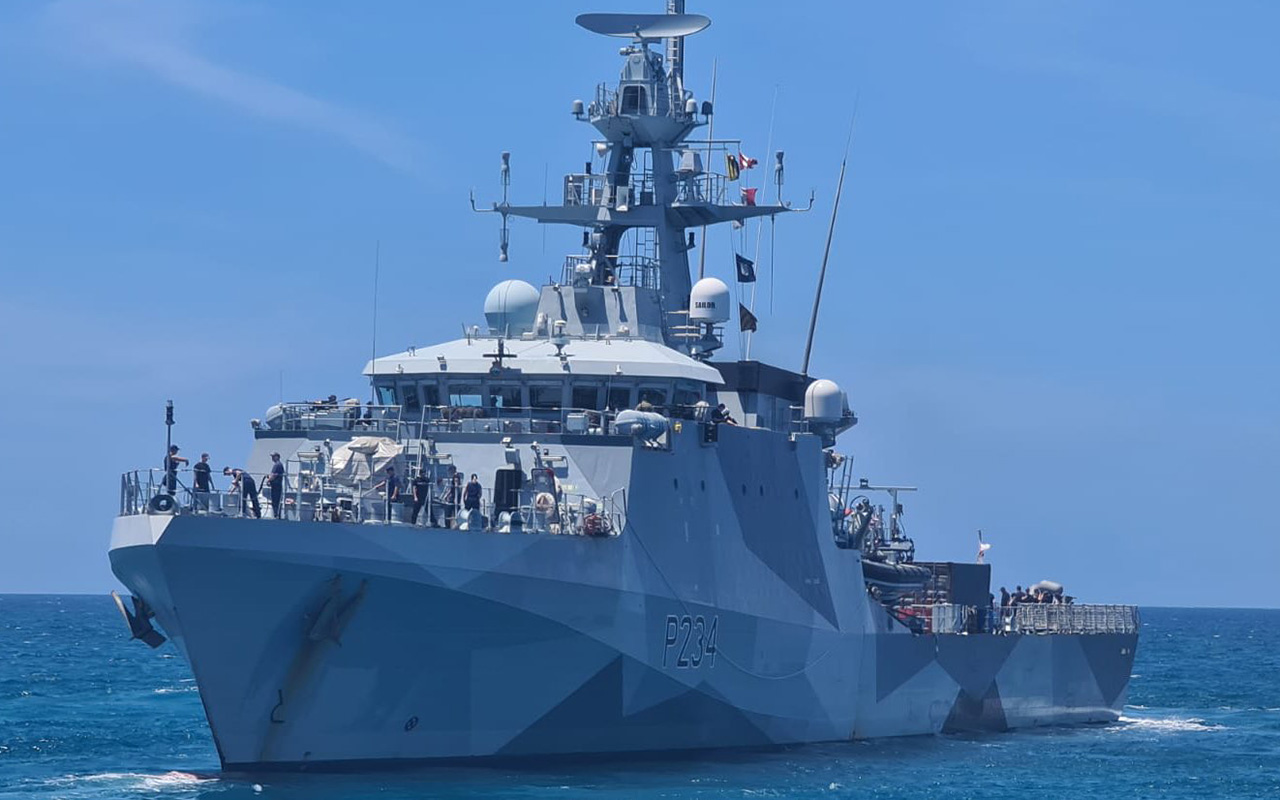
HMS Spey Conducts Freedom of Navigation Operation in Spratly Islands
Royal Navy vessel challenges disputed maritime claims in the South China Sea amid heightened regional tensions.

PHILIPPINES —
Key facts
- HMS Spey conducted a freedom of navigation operation around the Spratly Islands.
- The operation exercised navigation rights and freedoms in the South China Sea.
- The Spratly Islands are a site of volatile territorial disputes involving China, Taiwan, Vietnam, Malaysia, the Philippines, and Brunei.
- China has built artificial islands and military outposts in the Spratlys since 1988.
- A 2016 international tribunal ruled Chinese claims in the South China Sea have no legal basis.
- HMS Spey previously transited the Taiwan Strait in June 2025.
- The Royal Navy conducts Freedom of Navigation Operations (FONOPs) in accordance with UNCLOS.
Royal Navy Challenges Disputed Claims in South China Sea
The Royal Navy’s offshore patrol vessel, HMS Spey, has conducted a freedom of navigation operation around the strategically vital and heavily disputed Spratly Islands in the South China Sea. The move asserts navigation rights and freedoms in a region marked by overlapping territorial claims and significant geopolitical friction. This operation underscores the UK's commitment to upholding international maritime law in one of the world's most contested waterways. The Spratly Islands, a sprawling archipelago of reefs, atolls, and islets covering approximately 409,000 square kilometres, represent a focal point for intense territorial disputes. Nations including China, Taiwan, Vietnam, Malaysia, the Philippines, and Brunei all assert competing claims, drawing on historical occupation, proximity, and exclusive economic zone rights. This latest operation by HMS Spey follows a series of similar deployments by the Royal Navy in the region. In June 2025, the vessel made a notable transit of the Taiwan Strait, an action that drew a sharp response from Beijing. Subsequently, in September 2025, HMS Richmond undertook a similar passage, accompanied by warships from the United States and Australia.
China's Assertive Stance and Artificial Island Building
China's approach to the Spratly Islands has been particularly assertive. Since 1988, Beijing has established a significant military presence, undertaking extensive dredging and artificial island construction. This has resulted in the creation of approximately 3,200 acres of new land, upon which military outposts have been developed. The three largest of these artificial structures, located at Mischief Reef, Subi Reef, and Fiery Cross Reef, are now equipped with advanced military capabilities. These include anti-ship and anti-aircraft missile systems, jamming equipment, and facilities for fighter aircraft. Despite these developments, a landmark 2016 international tribunal ruling rejected China’s expansive territorial claims as lacking any legal basis. However, China continues to disregard this verdict, asserting control over vast swathes of the South China Sea, including areas that overlap with the exclusive economic zones of several Southeast Asian nations. Satellite imagery indicated that Chinese construction activities persisted as late as 2025, with no apparent diplomatic mechanism currently in place to constrain further development.
Freedom of Navigation Operations: Legal Basis and Intent
Freedom of Navigation Operations (FONOPs), such as the one conducted by HMS Spey, are carried out in strict accordance with the United Nations Convention on the Law of the Sea (UNCLOS). Under UNCLOS, all warships are afforded the right of innocent passage through territorial seas and full freedom of navigation on the high seas. When a state makes maritime claims that extend beyond what is permitted by UNCLOS, diplomatic protest alone is often deemed insufficient to challenge such assertions. A FONOP is designed to be a non-aggressive act. The warship transits the area without committing any hostile acts, while simultaneously making no concessions regarding the disputed claims. The legal and political significance of a FONOP derives entirely from the act of passage itself, serving as a clear assertion of rights under international law. This principle is central to maintaining open sea lanes and respecting the maritime entitlements of all nations.
Royal Navy Resource Allocation and Operational Priorities
The deployment of HMS Spey to the Indo-Pacific region reflects a strategic allocation of naval assets. An offshore patrol vessel (OPV) like HMS Spey is considered to have greater utility and potential in the Indo-Pacific compared to its role in the North Atlantic or escorting more heavily armed vessels in the English Channel. However, the Royal Navy is currently operating within a challenging context, stemming from decades of underinvestment. This has led to a situation where vessels must be carefully allocated based on priority until new frigates become operational. The Navy faces significant crewing challenges, with entire ships having been decommissioned or placed in reserve due to insufficient personnel. Sending a single OPV to the other side of the world is a decision weighed against these broader resource constraints. The presence or absence of such a vessel is considered in light of its overall impact and the Navy's capacity to maintain its global commitments.
Regional Reactions and International Law
China has reacted strongly to perceived challenges to its claims in the South China Sea. In response to past operations, Beijing has issued condemnations, asserting that actions questioning its claims are attempts to undermine its territorial sovereignty and maritime rights. China has labelled the 2016 international arbitration award as 'illegal, null and void.' Conversely, the international community, including the Permanent Court of Arbitration in The Hague, has reaffirmed the 2016 ruling. This ruling unequivocally rejected China’s expansive territorial claims, emphasizing that the South China Sea is governed by international maritime law, including the fundamental principle of freedom of navigation. The ongoing tension highlights the persistent gap between China's assertions and the international legal framework governing maritime activities. The continued assertion of control by China over large parts of the region, despite the tribunal's decision, poses a significant challenge to regional stability and the established norms of international law.
The bottom line
- HMS Spey conducted a freedom of navigation operation in the disputed Spratly Islands, asserting international maritime rights.
- The operation challenges China's expansive territorial claims in the South China Sea, which were ruled to have no legal basis in 2016.
- China has significantly militarized artificial islands in the Spratlys, despite international legal opposition.
- The Royal Navy's deployment highlights strategic resource allocation amidst broader investment challenges.
- Freedom of Navigation Operations are conducted in accordance with UNCLOS to uphold international maritime law.
- The Spratly Islands remain a flashpoint for geopolitical tensions due to overlapping national claims.


Anthony Edwards cleared for Game 1 against Spurs after nine-day recovery from knee injury

Magnitude 6 Earthquake Rattles Eastern Samar, Causing Minor Damage and Injuries

NLEX faces four-way tie scenario that could cost No. 1 seed against Titan Ultra
