China’s J-35 Stealth Fighter Named ‘Blue Shark’ as Carrier Integration Accelerates
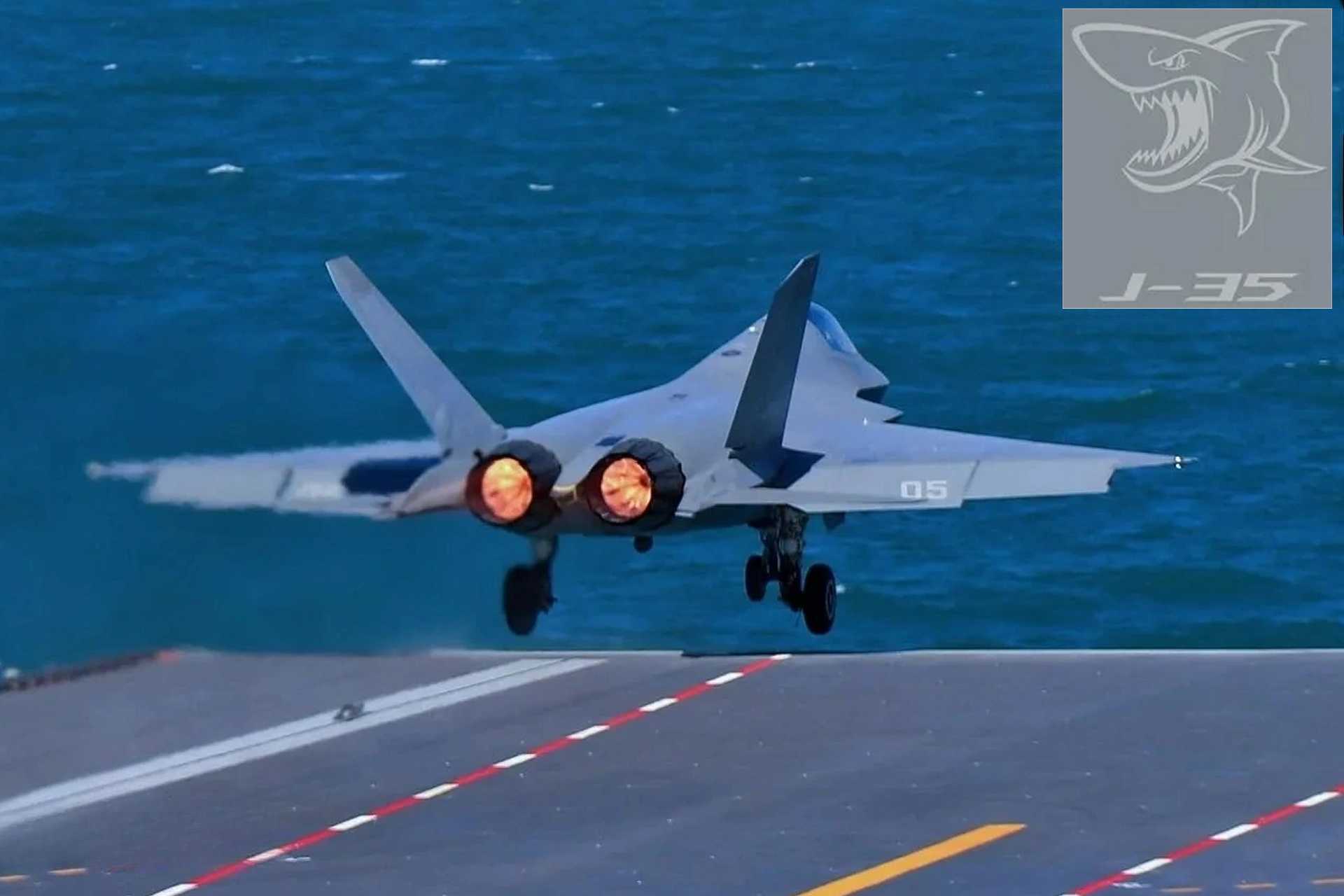
The naval variant’s formal designation and successful catapult trials aboard the Fujian signal a transition from development to early operational capability.
RUSSIA —
Key facts
- China has formally named the carrier-based J-35 stealth fighter ‘Blue Shark’.
- The J-35 prototype first flew on October 29, 2021, with a catapult launch bar, folding wings, and reinforced landing gear.
- The land-based variant J-35A, designated ‘Yunlong’, first flew on September 26, 2023, and was publicly displayed at Zhuhai in November 2024.
- On September 22, 2025, the PLA Navy confirmed successful catapult launch and recovery trials aboard the Type 003 aircraft carrier Fujian.
- The J-35 has a maximum takeoff weight of 30,000 kg and a combat radius of about 1,200 km on internal fuel.
- Production indicators include serial numbers 61820 and 61821 linked to a PLA Air Force test brigade in May 2025, and multiple airframes on assembly lines in July 2025.
- The intended production engine, the WS-19, is projected to deliver 110–116 kN of thrust but had not been confirmed on production aircraft as of late 2025.
Formal Naming and Public Disclosure
China has officially designated its carrier-based J-35 stealth fighter as “Blue Shark,” a name that first surfaced on a unit patch at the Zhuhai air show in 2024 and had been in informal circulation since 2022. The confirmation signals that the aircraft is moving from development into early operational integration within the People’s Liberation Army Naval Aviation. The naming follows an established pattern: the J-15 is called “Flying Shark,” and the electronic warfare J-15D is “Electric Shark.” The land-based variant, designated J-35A, is named “Yunlong” (Cloud Dragon), distinguishing it from the naval version despite shared design origins. This phased disclosure approach, with the name appearing first on a patch rather than through formal channels, reflects a deliberate strategy to gradually expose the program.
Development Timeline and Variant Differentiation
The J-35 program traces its roots to the FC-31 prototype 31001, which first flew on October 31, 2012. A second prototype, incorporating structural redesigns, a single-piece canopy, and WS-13E engines producing about 87 kN of thrust, followed on December 23, 2016. The navalized J-35 prototype conducted its first flight on October 29, 2021, featuring a catapult launch bar, folding wings, and a reinforced landing gear configuration optimized for carrier operations. The land-based J-35A first flew on September 26, 2023, with a single-wheel nose landing gear and reduced wing area. It was publicly displayed and flown at Zhuhai in November 2024, marking its first official demonstration. On September 3, 2025, both variants were included in the PLA inventory during the V-Day parade in Beijing, indicating formal entry into service.
Carrier Integration and Trials
On September 22, 2025, the PLA Navy confirmed successful catapult launch and recovery trials aboard the Type 003 aircraft carrier Fujian, which is equipped with electromagnetic launch systems. The J-35’s twin-wheel nose landing gear and catapult launch bar are specifically designed for such systems, while folding wings and an arrestor hook enable carrier recovery. The aircraft has also been evaluated for operation on STOBAR carriers such as Liaoning and Shandong, indicating dual compatibility across all three Chinese aircraft carriers. This flexibility allows the J-35 to be deployed from any of China’s existing carriers, extending the reach of its naval air arm.
Design Features and Capabilities
The J-35 is a medium-weight stealth fighter with a twin-engine layout, single-seat cockpit, and internal weapons carriage designed to reduce radar cross-section. The airframe incorporates diverterless supersonic intakes, serpentine inlet ducts to obscure engine faces, and canted twin vertical stabilizers. at 30,000 kg, with a combat radius of about 1,200 km on internal fuel, placing it in the same class as the F-35C. The internal weapons bay has six hardpoints, capable of carrying PL-10 short-range and PL-15 beyond-visual-range air-to-air missiles, as well as the developing PL-21 long-range missile. Internal strike configurations include small-diameter precision-guided bombs and up to four 500 kg-class penetration munitions. Externally, six pylons enable a combined payload capacity of about 8,000 kg, though external carriage increases radar signature.
Engine Development and Production Status
Engine development has progressed through multiple stages. Early prototypes used the Russian RD-93, later replaced by the Chinese WS-13E delivering about 87 kN of thrust. Subsequent prototypes incorporated WS-21 or WS-13 derivatives with thrust near 93 kN as interim solutions. The intended production engine, the WS-19, is projected to deliver 110–116 kN of thrust, but as of late 2025, there was no confirmed operational deployment on production J-35s. Differences in exhaust nozzle appearance across observed aircraft suggest multiple engine types remain in use. Production indicators point to a transition from prototype development to early manufacturing. In May 2025, J-35s with serial numbers 61820 and 61821 were identified and linked to a PLA Air Force test brigade in Shenyang. In July 2025, multiple airframes were observed on assembly lines within Shenyang facilities. The absence of standardized tactical numbering on naval-marked aircraft suggests they have not yet been assigned to operational squadrons, consistent with a low-rate initial production phase.
Strategic Implications and Outlook
The J-35’s formal naming and successful carrier trials underscore Beijing’s push to field a stealth-capable carrier fighter that can extend air superiority and strike reach from its expanding fleet. The aircraft’s development alongside a land-based variant reflects a broader strategy to accelerate fifth-generation capability, improve survivability at sea, and strengthen China’s ability to project power across maritime theaters. Full operational capability will depend on sustained production, pilot training, and carrier integration. Engine maturity remains a critical variable affecting readiness, with the WS-19 still unconfirmed on production aircraft. The phased introduction of engines, where newer types are likely validated on land-based variants first, suggests a cautious approach to ensuring reliability under the high-stress conditions of carrier operations.
Naming Lineage and Fleet Identity
The “Blue Shark” designation places the J-35 within a consistent naming lineage for carrier aircraft in PLA Naval Aviation, following the J-15 “Flying Shark” and J-15D “Electric Shark.” This continuity supports fleet aviation identity and corresponds with the navalized J-35’s transition into early operational integration. The land-based J-35A, named “Yunlong” (Cloud Dragon), indicates a separation in identity between naval and air force configurations despite shared design origins. This dual-naming approach allows each service to maintain its own branding while leveraging a common airframe, streamlining production and logistics.
The bottom line
- China’s J-35 carrier-based stealth fighter has been formally named ‘Blue Shark’, with the land-based variant designated ‘Yunlong’.
- The aircraft successfully completed catapult launch and recovery trials aboard the Type 003 carrier Fujian in September 2025.
- Production is in a low-rate initial phase, with multiple airframes observed on assembly lines and linked to test units.
- The intended WS-19 engine, projected to deliver 110–116 kN of thrust, had not been confirmed on production aircraft as of late 2025.
- The J-35 is designed for dual compatibility with both electromagnetic catapult and STOBAR carriers, enabling deployment across all three Chinese aircraft carriers.
- The naming lineage aligns with existing PLA Naval Aviation conventions, reinforcing fleet identity as the aircraft approaches initial operational capability.

Utair launches 23 new routes, tightens loyalty thresholds as summer schedule begins

С 1 мая 2026 года в России вырастут пособия по временной нетрудоспособности и пенсионные выплаты
Copy Fail: 10-Line Python Exploit Grants Root on Linux Systems Since 2017