NASA chief Jared Isaacman wants to make Pluto a planet again, citing new research
Twenty years after the International Astronomical Union reclassified Pluto as a dwarf planet, the head of NASA is openly pushing for a scientific revisitation of the decision.
UKRAINE —
Key facts
- NASA Administrator Jared Isaacman told a Senate hearing he is 'very much in the camp of making Pluto a planet again'.
- Isaacman said NASA is working on papers to 'revisit this discussion' and escalate it through the scientific community.
- Pluto was reclassified as a dwarf planet by the IAU in 2006 after failing to clear its orbit of debris.
- Pluto was discovered in 1930 by Clyde Tombaugh using images from Lowell Observatory in Arizona.
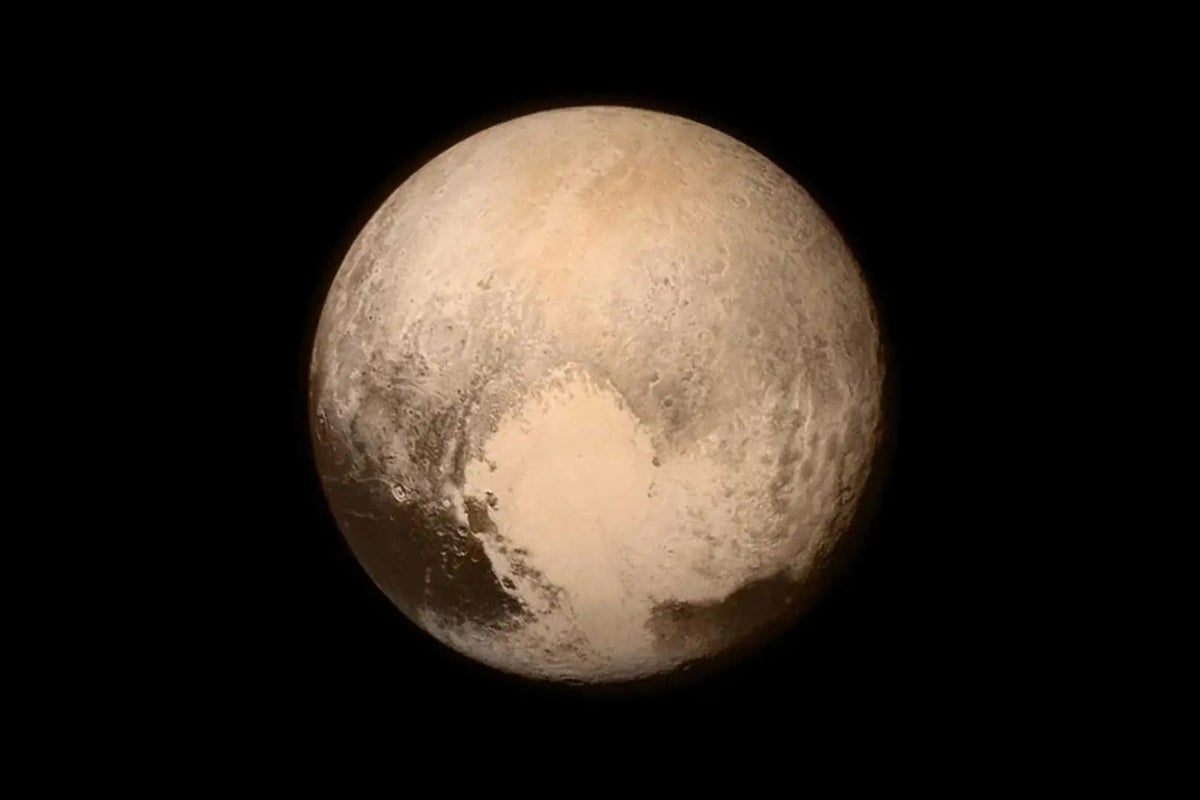
- NASA's New Horizons spacecraft flew by Pluto in July 2015, revealing mountains, glaciers, and a heart-shaped region named Tombaugh Regio.
- The IAU maintains its definition of a planet is accurate and can only be changed if evidence evolves.
- Mike Brown, the Caltech astronomer who helped demote Pluto, opposes reinstatement, calling it nostalgic.
- Pluto is about 1,400 miles wide, orbits 3.6 billion miles from the Sun, and has five moons.
Isaacman declares his position on Capitol Hill
NASA Administrator Jared Isaacman, a billionaire private astronaut who took the helm of the space agency in December, told a U.S. Senate hearing on April 28 that he wants Pluto reinstated as a full planet. Responding to a question from Kansas Senator Jerry Moran — whose home state produced Pluto's discoverer, Clyde Tombaugh — Isaacman said, 'I am very much in the camp of make Pluto a planet again.' Isaacman added that NASA is 'doing some papers right now on, I think, a position that we would love to escalate through the scientific community to revisit this discussion and ensure that Clyde Tombaugh gets the credit he received once and rightfully deserves to receive again.' The remarks came during a hearing on the White House's 2027 NASA budget request before the Senate Committee on Appropriations.
The 2006 decision that demoted Pluto
In 2006, the International Astronomical Union (IAU) established three criteria for planethood: an object must orbit the Sun, be massive enough to be spherical, and clear its orbit of debris. Pluto satisfied the first two but failed the third because it shares the distant Kuiper Belt with many other icy bodies of similar size, such as Eris, Haumea, Makemake, Quaoar, and Orcus. The IAU reclassified Pluto as a dwarf planet, a move that sparked lasting controversy. Earth and Jupiter also share orbital space with asteroids, arguing the third criterion is inconsistently applied. The union's press and media coordinator, Ramasamy Venugopal, stated that Pluto became 'the leading object of a new family of solar system bodies' and that scientific classifications are 'determined through international consensus and evidence-based processes.'
Scientific divide over Pluto's status
Experts remain sharply divided. Mike Brown, a professor of planetary astronomy at the California Institute of Technology who announced evidence for a ninth planet in 2016 and wrote a 2011 book about Pluto's demotion, dismissed Isaacman's stance. 'While NASA administrators are free to wax nostalgic for the days when Pluto was a planet, the actual scientists working in the field will continue to try to explain and classify objects in the solar system in the way that actually helps us understand the world in which we live,' Brown said. Adam Frank, a professor of astrophysics at the University of Rochester, called the science behind demoting Pluto 'really important and really exciting,' noting that Pluto is part of the outer solar system's 'construction debris' that was unknown 30 years ago. But Bill McKinnon, director of the McDonnell Center for the Space Sciences at Washington University in St. Louis, argued that Pluto is 'round, has an atmosphere, active geology and five (!) moons' and that the debate over dwarf planets being a subspecies of planet is 'a waste of time.'
New Horizons and Pluto's complex geology
In July 2015, NASA's New Horizons spacecraft performed the first-ever flyby of Pluto, returning imagery that revealed a stunningly diverse world. The photos showed towering mountains, vast nitrogen-ice glaciers, and a now-famous heart-shaped landform that mission scientists named Tombaugh Regio in honor of the discoverer. Pluto lies about 3.6 billion miles from the Sun, with frigid temperatures reaching -387 degrees Fahrenheit (-232 degrees Celsius). It measures roughly 1,400 miles (2,253 kilometers) across — about half the width of the United States. Despite the flyby's revelations, the IAU did not reconsider Pluto's classification.
The emotional attachment to an underdog planet
Pluto's demotion struck a chord far beyond scientific circles. Discovered in 1930 by American astronomer Clyde Tombaugh, Pluto was the only planet found by a U.S. citizen, and its small size and distant orbit made it a cultural underdog. The heart-shaped feature on its surface only deepened public affection. For many who grew up learning about nine planets, the reclassification felt like a loss. Isaacman's public push taps into that sentiment, but the ultimate decision rests with the IAU, a global society of professional astronomers that defines celestial objects and assigns official names. The union has acknowledged that its decision 'continues to fuel intense emotions' but maintains its definition is accurate.
What comes next for Pluto's planethood
Isaacman's advocacy does not give NASA authority to change Pluto's status; the agency can only escalate the discussion. The NASA chief hinted that ongoing research might provide a scientific basis for revisiting the IAU's definition. 'We are doing some papers right now on, I think, a position that we would love to escalate through the scientific community,' he said. Former NASA Administrator Jim Bridenstine also supported reinstatement. However, the IAU's Venugopal emphasized that classifications 'can be amended if the supporting evidence changes.' Whether the new papers will sway the astronomical community remains uncertain. For now, Pluto remains a dwarf planet — but the debate, as always, is far from settled.
The bottom line
- NASA Administrator Jared Isaacman publicly supports making Pluto a planet again and says NASA is preparing scientific papers to revisit the IAU classification.
- Pluto was demoted to dwarf planet in 2006 because it failed to clear its orbit of debris in the Kuiper Belt, a criterion critics say is inconsistently applied.
- The IAU retains sole authority over Pluto's status and says it will only change if evidence evolves.
- New Horizons' 2015 flyby revealed Pluto's complex geology, including mountains, glaciers, and a heart-shaped region, but did not restore its planethood.
- Scientists remain divided: some argue Pluto's geophysical characteristics qualify it as a planet, while others say the dwarf planet classification is scientifically accurate.
- The emotional attachment to Pluto, especially in the U.S., continues to fuel public and political pressure to reinstate its planetary status.




З 1 травня в Україні змінюються правила субсидій, декларування доходів і програма «Доступні ліки»

Четверта атака дронів на Туапсе: пожежа на морському терміналі, 128 рятувальників задіяно

Львів відзначає 770-річчя: культурна програма, зміни в русі транспорту та виставка про тил