FBI Boston Recovers 17th-Century Reliquary Urn Stolen from Italian Church
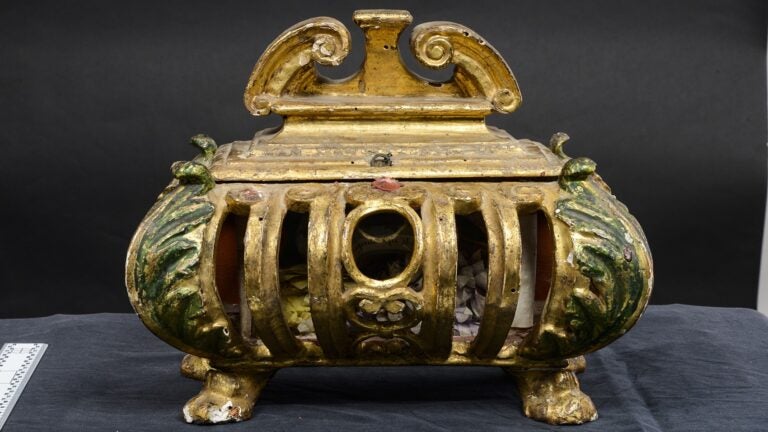
The gilded wooden artifact, one of 17 ecclesiastical items taken from a church in Cangiano, was voluntarily surrendered by a Northeast antiques dealer and repatriated in a formal ceremony.
UNITED STATES —
Key facts
- The urn was stolen from the Church of San Michele Arcangelo di Cangiano between August 2012 and August 2022.
- The FBI's Boston division recovered the urn in coordination with its Art Crime Team, the Law Enforcement Attaché in Rome, and the Italian Carabinieri.
- An antiques dealer based in the Northeast voluntarily turned over the urn on February 11 after purchasing it from an Italian dealer.
- The urn is one of 17 artifacts stolen from the church.
- The FBI began investigating the urn's location in fall 2025.
- A formal repatriation ceremony was held on Wednesday, returning the urn to the Italian Republic.
- The urn is registered in the Italian Dioceses’ inventory of Historical Artistic Heritage Items, protected by the Italian State and Vatican City State.
A Stolen Relic Returns Home
A 17th-century reliquary urn, carved in gilded wood and stolen years ago from an Italian church, has been recovered by the FBI’s Boston division and returned to Rome in a formal repatriation ceremony on Wednesday. The artifact is believed to be one of 17 ecclesiastical items taken from the Church of San Michele Arcangelo di Cangiano, a theft that occurred sometime between August 2012 and August 2022, according to officials. The urn’s recovery marks a significant victory in the fight against cultural property crime, highlighting the power of international cooperation.
Investigation and Recovery
The FBI began investigating the urn’s whereabouts in fall 2025, deploying its specialized Art Crime Team alongside the Law Enforcement Attaché in Rome and the Italian Carabinieri. Agents discovered that an antiques dealer based in the Northeast had purchased the urn from an Italian dealer. The dealer voluntarily relinquished the artifact to federal agents on February 11, paving the way for its repatriation. The agency worked closely with the Italian Ministry of Culture to ensure the urn’s return to the church from which it was stolen.
A Tangible Link to Faith and History
“It’s incredibly exciting when the FBI can recover a piece of history that carries such deep emotional and cultural significance,” said Ted Docks, special agent in charge of the FBI’s Boston division. Docks emphasized that the case demonstrates a collective commitment to safeguarding the world’s cultural treasures, no matter where they may be located. The urn, he said, “is a tangible link to intense religious devotion and a connection to the generations who lived and prayed with it,” representing the intersection of faith, history, and art.
Protected Heritage Under Italian and Vatican Law
The reliquary urn holds a registered spot in the Italian Dioceses’ inventory of Historical Artistic Heritage Items, a designation that affords it protection under both the Italian State and the Vatican City State. Such items are legally safeguarded, making their theft and illicit trafficking a matter of international concern. The FBI’s recovery underscores the importance of these registries in tracking and reclaiming stolen cultural property.
International Cooperation in Action
The operation involved multiple agencies across two continents, including the FBI’s Art Crime Team, its legal attaché in Rome, and the Italian Carabinieri, Italy’s national police force dedicated to protecting cultural heritage. The formal repatriation ceremony on Wednesday marked the culmination of these efforts, with the urn handed over to the Italian Republic. Officials praised the voluntary cooperation of the Northeast antiques dealer, whose decision to surrender the artifact facilitated a swift resolution.
Ongoing Search for Remaining Artifacts
While the recovery of the urn is a success, 16 other ecclesiastical artifacts from the Church of San Michele Arcangelo di Cangiano remain missing. The FBI and Italian authorities continue to investigate the theft, which spanned a decade, and are working to locate the other stolen items. The case serves as a reminder of the persistent threat to cultural heritage and the need for vigilance in protecting historical treasures.
A Victory for Cultural Preservation
The return of the reliquary urn represents more than the recovery of a single object; it reaffirms the principle that stolen cultural heritage must be restored to its rightful owners. As Docks noted, such artifacts are invaluable to the people of Italy and to humanity as a whole. The successful repatriation sets a precedent for future cases, demonstrating that even years after a theft, international collaboration can bring history back home.
The bottom line
- The FBI Boston division recovered a 17th-century gilded wooden reliquary urn stolen from an Italian church between 2012 and 2022.
- The urn was voluntarily surrendered by a Northeast antiques dealer on February 11 after being purchased from an Italian dealer.
- The FBI began its investigation in fall 2025, working with the Art Crime Team, Rome attaché, and Italian Carabinieri.
- The artifact is one of 17 stolen items; 16 remain missing.
- The urn is registered in the Italian Dioceses’ inventory of Historical Artistic Heritage Items, protected by Italian and Vatican law.
- A formal repatriation ceremony was held on Wednesday, returning the urn to the Italian Republic.



Taylor Swift and Travis Kelce Set $10 Million Budget for Pre-Wedding Parties

Trump's Presence Looms Over Cadillac Championship as Cameron Young Leads by Five

In Trump's Florida Rally, a Retirement Utopia Grapples With Political Division
