Flower Moon Rises Tonight as Rare Blue Moon Looms Later This Month
May’s first full moon, a micromoon, peaks at 1:23 p.m. ET Friday, with a second full moon — a calendrical blue moon — set to rise on May 31.
UNITED STATES —
Key facts
- The Flower Moon reaches 100% illumination at 1:23 p.m. EDT (1723 GMT) on May 1.
- The moon will be 249,180 miles (401,017 km) from Earth, a micromoon, compared to the average 238,855 miles (384,399 km).
- A second full moon, a Blue Moon, will peak at 4:45 a.m. ET on May 31.
- Two full moons in one month occur every 2.5 years on average; the next calendar blue moon after May 2026 will be on December 31, 2028.
- The Flower Moon name originates from the Comanche tribe, reflecting abundant spring blooms in North America.
- Other indigenous names include strawberry moon (Potawatomi, Shawnee), mulberry moon (Choctaw, Creek), and 'moon before pregnancy' (Tlingit).
- The May 1 full moon also marks May Day, the midpoint between the March equinox and June solstice.
A Micromoon at Sunset
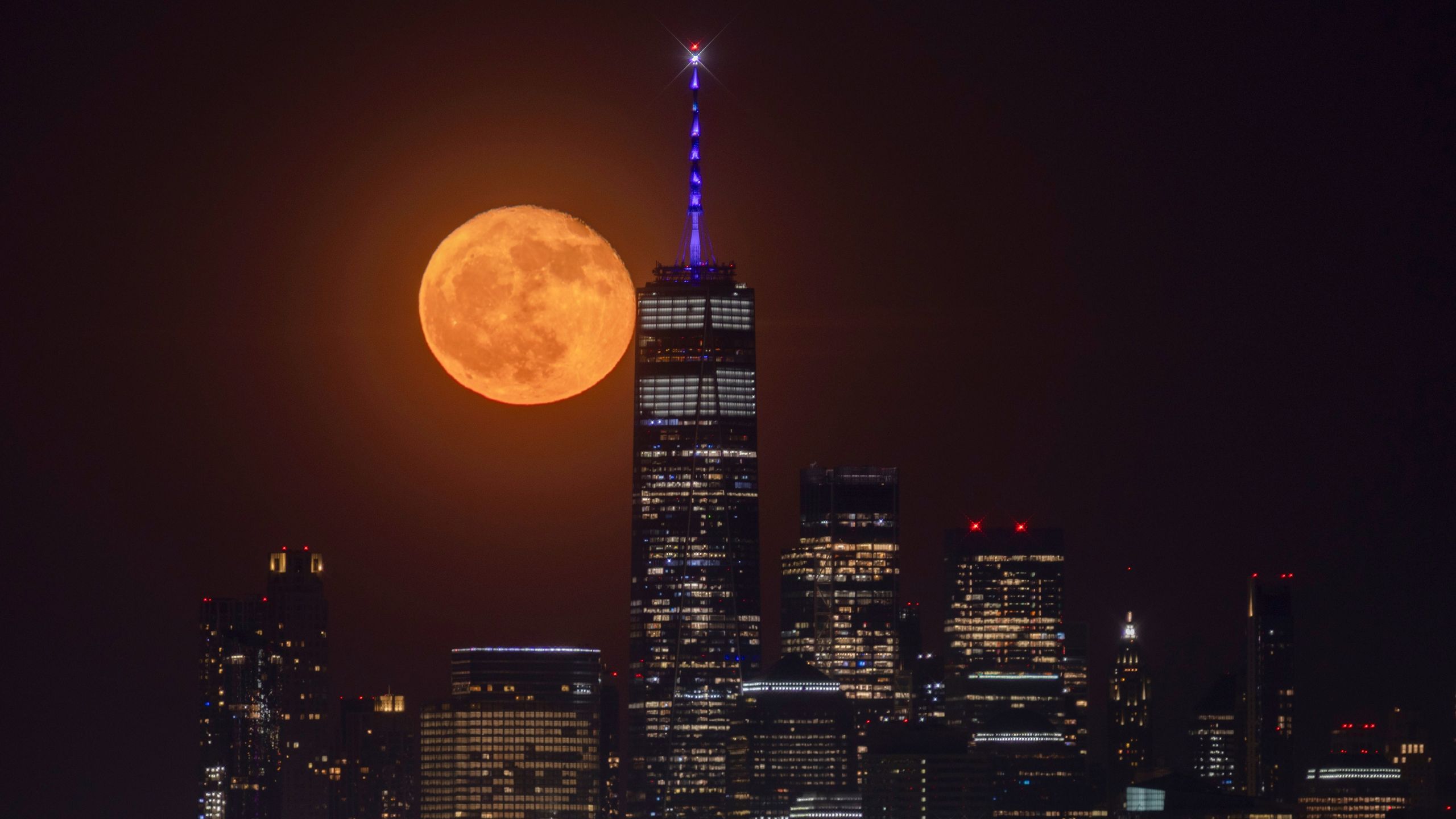
Tonight’s full moon — the Flower Moon — will rise at sunset, appearing subtly smaller than average as it reaches apogee, its farthest point from Earth in its elliptical orbit. At 249,180 miles (401,017 kilometers) distant, the lunar disk will span 29.72 arcminutes, compared to its typical 31 arcminutes, according to the Las Cumbres Observatory. Sky-gazers should look southeast after sunset to catch the moon climbing low, tinted a yellow-orange hue by Rayleigh scattering as sunlight passes through the densest layer of Earth’s atmosphere. The moon will appear full to the naked eye from Thursday night through Saturday, though its precise peak illumination occurs at 1:23 p.m. EDT (1723 GMT) on Friday, May 1. Noah Petro, project scientist for NASA’s Artemis III mission, advised patience: “It’s going to rise right around sunset, so just have a little bit of patience and you’ll be treated to the spectacular view.” He recommended avoiding bright streetlights, tall buildings, and trees for the best observation.
Two Full Moons in One Month
May 2026 is a rare calendrical event: two full moons within a single calendar month. The first, the Flower Moon, occurs on May 1; the second, a Blue Moon, will rise on May 31, peaking at 4:45 a.m. ET. This phenomenon happens roughly every 2.5 years, when the moon’s 29.5-day cycle aligns to produce 13 full moons in a year. the upcoming Blue Moon is also a micromoon, the second in a series of three. The next calendar blue moon after May 31, 2026, will occur on December 31, 2028. The term “blue moon” does not refer to the moon’s color; it is purely a calendrical designation for the second full moon in a month.
Cultural Roots of the Flower Moon
The name “Flower Moon” comes from the Comanche tribe, reflecting the profusion of wildflowers blooming across North America, especially in the Great Plains. The Old Farmer’s Almanac also lists names such as budding moon, leaf budding moon, and planting moon. Indigenous tribes have diverse names for May’s full moon. The Potawatomi and Shawnee call it the strawberry moon, aligning with strawberry ripening; the Choctaw and Creek refer to it as the mulberry moon, tied to mulberry harvests. The Tlingit people call it the “moon before pregnancy,” with the following June moon named the birth moon.
Celestial Companions in the Night Sky
As the Flower Moon rises, bright stars and planets will be visible. Spica and Arcturus — the third brightest star in the night sky — will shine above the moon’s glow, while fainter stars in Libra are washed out. On the western horizon, Venus glows brightly at sunset, with Jupiter just above it. Higher up, the stars Castor and Pollux in the constellation Gemini are also visible. Through the night, the moon will track a low, arcing path across the southern sky, setting in the southwest at dawn on May 2. The moon’s low trajectory means it will remain close to the horizon for much of the night, offering prolonged viewing opportunities.
Scientific and Seasonal Significance
The May 1 full moon coincides with May Day, the midpoint between the March equinox and the June solstice — marking the transition from spring to summer in the Northern Hemisphere. This astronomical alignment underscores the moon’s role as a seasonal marker. Petro, who leads the Artemis III mission aiming to land humans on the moon for the first time since 1972, emphasized the value of simply observing: “There’s a moment on May 1 where the moon will be at its fullest in the moment, but 24 hours before and 24 hours later, to the human eye it’s going to look full.” The Artemis program, while not directly related to this lunar event, highlights ongoing scientific interest in Earth’s satellite.
What to Expect for the Blue Moon
The Blue Moon on May 31 will be a micromoon, appearing slightly smaller than average as it reaches apogee again. It will appear full from Saturday night, May 30, through Sunday night, May 31, with peak illumination at 4:45 a.m. ET on May 31. Sky-gazers can expect similar viewing conditions: a low arc across the southern sky, rising at sunset and setting at dawn. This second full moon will complete a rare month of double lunar events. After May 2026, the next calendrical blue moon will not occur until December 31, 2028, making this month’s occurrence a notable opportunity for both casual observers and dedicated astronomers.
The bottom line
- The Flower Moon peaks at 1:23 p.m. EDT on May 1 but appears full from April 30 to May 2.
- It is a micromoon, 249,180 miles from Earth, appearing slightly smaller than average.
- A second full moon, a Blue Moon, rises on May 31, peaking at 4:45 a.m. ET.
- Two full moons in one month occur every 2.5 years; the next such event is December 31, 2028.
- The Flower Moon name derives from the Comanche tribe; other indigenous names include strawberry moon and mulberry moon.
- Bright planets Venus and Jupiter, and stars Spica, Arcturus, Castor, and Pollux are visible alongside the moon.






Underwater Explorer Discovers 1974 Camaro Z28 at Bottom of Maine's Sebago Lake, Sparking Investigation

Zach Cregger Reinvents Resident Evil with Original Story Set in Raccoon City

Stanley Tucci — and what comes next
