Mortgage Rates Surge to 6.50% as Iran Tensions Drive Bond Yields Higher
The average 30-year fixed rate hit its highest level since late March, fueled by fears of a prolonged Strait of Hormuz blockade and a hawkish Fed dissent.

UNITED STATES —
Key facts
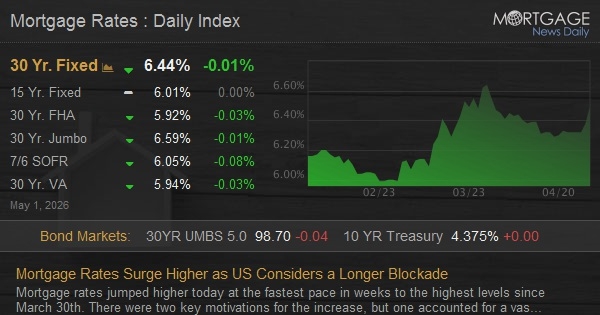
- Average 30-year fixed mortgage rate rose to 6.50% on Wednesday, up from 6.38% the previous day.
- Rate spike was the fastest in weeks, reaching highest levels since March 30.
- More than 80% of the increase occurred before the Federal Reserve's announcement.
- Three Fed voters opposed the statement's wording, favoring a neutral stance on rate direction.
- Mortgage applications to buy a home surged 21% year-over-year last week.
- President Trump said he would maintain the naval blockade against Iran until a nuclear deal is reached.
Lede: Rates Jump as Geopolitical Fears Return
Mortgage rates climbed sharply on Wednesday, with the average 30-year fixed loan reaching 6.50% — the highest level since March 30 — as renewed tensions between the United States and Iran rattled bond markets. The increase, the steepest in weeks, erased a period of relative calm that had briefly encouraged homebuyers. The move followed President Trump's declaration that he would sustain the U.S. naval blockade against Iran until a nuclear agreement is reached, a stance that sent oil prices higher and pushed bond yields upward. Mortgage rates loosely track the yield on the 10-year Treasury note, which rose in tandem.
The Strait of Hormuz Factor
The primary catalyst for the rate surge was overnight news about the possibility of a prolonged blockade of the Strait of Hormuz, a critical chokepoint for global oil shipments. emerged that White House officials had consulted with oil executives to assess the impact of a sustained blockade on domestic energy markets and fuel prices. A White House official later corroborated the overnight reports, amplifying the sell-off in bonds and pushing yields higher. By midday, most mortgage lenders had adjusted rates upward again as the underlying bond market continued to weaken.
Fed Dissent Adds Pressure
The Federal Reserve's latest policy announcement played a supporting role in the day's rate drama. While the central bank held interest rates steady, three voting members dissented from the statement's language, arguing that it implicitly signaled a greater inclination to cut rates rather than raise them. The dissenting voters preferred language that would leave the door open to either direction, depending on inflation and economic data. Markets interpreted the dissent as a minor negative for rates, though more than 80% of the day's spike in 10-year Treasury yields had already occurred before the Fed's statement was released. The average mortgage lender moved from 6.38% to 6.50% for top-tier 30-year fixed loans, with some lenders making additional mid-day adjustments.
Homebuyers Return Despite Higher Rates
Despite the recent upward drift in mortgage costs, homebuyers have shown renewed appetite. Mortgage applications to purchase a home rose 1% for the week and stood 21% higher than the same period a year ago, according to the Mortgage Bankers Association. The increase suggests that some buyers are adjusting to the higher rate environment and the ongoing economic uncertainty stemming from the conflict. More supply has been entering the market, and home prices in certain regions have begun to ease. higher buyer traffic, indicating that consumers may be digesting the elevated rates and the broader geopolitical risks.
Outlook: Spring Market at a Crossroads
The question now is whether this latest rate surge will persist and what it means for the spring housing market. Earlier this month, rates had been positioning for de-escalation in the Iran conflict, but that hope has evaporated. As Matthew Graham, chief operating officer at Mortgage News Daily, put it: "De-escalation hopes have been replaced by re-escalation fears." The Federal Reserve, which is not expected to change rates at its next meeting, faces an increasingly complex backdrop. With inflation still a concern and geopolitical risks mounting, the path of mortgage rates remains uncertain. For now, the spring market hangs in the balance, with buyers weighing higher borrowing costs against improving inventory and easing prices.
The bottom line
- Mortgage rates hit 6.50%, the highest since March 30, driven by Iran blockade fears and a hawkish Fed dissent.
- More than 80% of the rate increase occurred before the Fed's announcement, underscoring the dominance of geopolitical factors.
- Three Fed voters opposed the statement's dovish tilt, signaling internal division over future rate policy.
- Homebuyer demand remains strong, with mortgage applications up 21% year-over-year despite higher rates.
- The spring housing market faces uncertainty as re-escalation fears replace hopes for de-escalation in the Iran conflict.


Pistons Rally from 24-Point Deficit to Force Game 7 Against Magic

Houston Braces for More Storms After Flood Watch Canceled, Hail Reported
Houston Braces for Friday Flooding as Cooler Weekend Follows
