OpenAI Shifts ChatGPT Ads to Cost-Per-Click After Launch Pricing Collapses
The pivot to a performance-based model puts the company in direct competition with Google and Meta as it projects $2.5 billion in ad revenue by 2026.
SOUTH AFRICA —
Key facts
- OpenAI switched ChatGPT advertising from CPM to cost-per-click pricing with bids between $3 and $5.
- The initial $60 CPM dropped to as low as $25 within ten weeks of launch.
- OpenAI projects $2.5 billion in ad revenue for 2026, scaling to $100 billion by 2030.
- The company expects $14 billion in losses this year and an $852 billion valuation.
- Sam Altman had publicly opposed advertising, calling it a 'momentary industry' in 2024.
- OpenAI hired Shivakumar Venkataraman, a 21-year Google veteran, as VP in June 2024.
- A boycott campaign called QuitGPT has gathered over 200,000 sign-ups since late January.
- OpenAI released GPT-5.5 and ChatGPT Images 2.0, improving multi-step tasks and image generation.
From Experiment to Ad Platform in Ten Weeks
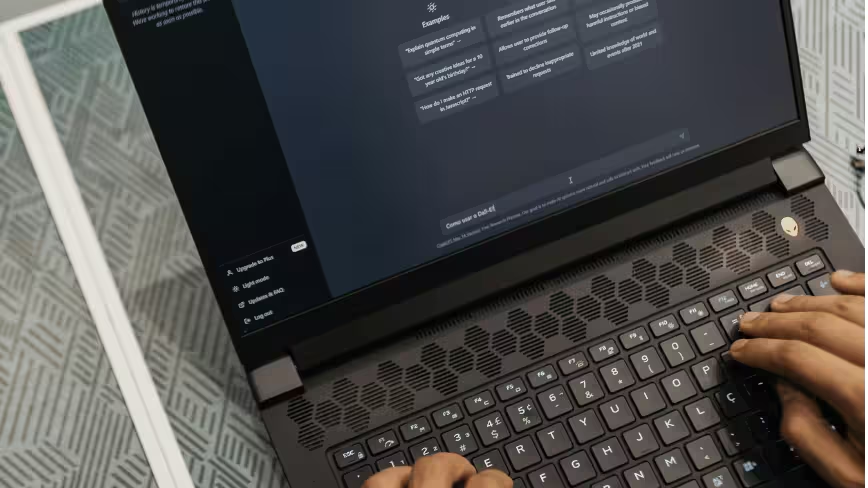
OpenAI has shifted ChatGPT’s advertising model from cost-per-thousand impressions to cost-per-click, a change that puts the company in direct competition with Google and Meta for performance advertising budgets. The pivot, reported on 15 April, was driven by a practical problem: the $60 CPM that OpenAI charged at launch in February had eroded to as low as $25 in some cases, making a volume-dependent impressions model unsustainable for a company projecting $14 billion in losses this year. Advertisers can now set bids between $3 and $5 per click, according to screenshots of OpenAI’s new ads manager, while the minimum spend has been cut from $250,000 to $50,000. The shift ties revenue to demonstrable user engagement rather than passive exposure, aligning OpenAI’s model with how advertisers already evaluate performance on Google and Meta.
The Rapid Buildout and Financial Pressure
OpenAI first introduced advertising into ChatGPT on 9 February with a CPM model, a $200,000 to $250,000 minimum spend, and a roster of early advertisers that included Target, Ford, Adobe, Mrs. Meyer’s, and Expedia. Within two months, the pilot topped $100 million in annualised revenue with several hundred advertisers participating. OpenAI projects $2.5 billion in advertising revenue for 2026, scaling to $11 billion by 2027 and $100 billion by 2030. The speed of the buildout has been striking. OpenAI hired Shivakumar Venkataraman, a 21-year Google veteran who led Google’s search ads business, as vice president in June 2024. Since February, the company has partnered with StackAdapt for programmatic placement, built a conversion tracking pixel supporting events including lead creation, order creation, and subscription starts, and launched a self-serve ads manager that opened to global advertisers on 15 April. International expansion to Australia, New Zealand, and Canada followed within 48 hours. OpenAI has also partnered with Smartly and Criteo to build conversational ad formats that go beyond static placements, connecting to Criteo’s network of 17,000 advertisers.
Altman’s Reversal and the Competitive Landscape
Sam Altman spent two years building a public position against advertising. He called it a “momentary industry” in 2024. At Harvard, he described ads as a “last resort.” He told interviewers that “ads-plus-AI is sort of uniquely unsettling to me” and that he liked “that people pay for ChatGPT and know the answers they’re getting are not influenced by advertisers.” In a Stratechery interview, he said Instagram changed his mind, arguing that its ads “added value” to him. On 9 February, as ads went live, Altman posted on X: “We are starting to test ads in ChatGPT free and Go tiers. Most importantly, we will not accept money to influence the answer ChatGPT gives you, and we keep your conversations private from advertisers.” Chris Lehane, OpenAI’s vice president of global affairs, defended the move by arguing that advertising helps “expand democratic access” to ChatGPT. In response to Anthropic’s Super Bowl commercials, which ran spots titled “Deception,” “Betrayal,” “Treachery,” and “Violation” with the tagline “Ads are coming to AI. But not to Claude,” Altman argued that Anthropic “serves an expensive product to rich people” while OpenAI needs to bring AI to “billions of people who can’t pay for subscriptions.”
The Split in AI Monetization Strategies
The major AI companies are now pursuing divergent monetisation strategies in a way that would have seemed unlikely a year ago. Google is weaving advertising into 25.5% of AI-generated search results, extending its existing ad infrastructure into AI Overviews. OpenAI is building a parallel ad platform from scratch. And the rest of the market is running the other way. Perplexity tested sponsored follow-up questions in 2024 and 2025, then abandoned advertising altogether, citing user trust concerns. It is now targeting $500 million in subscription revenue as the explicitly ad-free alternative. Anthropic positioned Claude as ad-free before OpenAI even launched its programme, spent millions on Super Bowl spots attacking ChatGPT’s ad decision, and saw an 11% jump in daily active users and a climb to seventh on the App Store as a result.
User Trust and Internal Backlash
The split matters because it tests a foundational question about AI products: whether users treat a chatbot more like a search engine, where ads are tolerated, or more like a therapist, where they are not. An Ipsos survey found that nearly two-thirds of US adults say ads in AI search make them trust the results less. A boycott campaign called QuitGPT has gathered more than 200,000 sign-ups since late January. The day ads launched, Zoe Hitzig, a researcher at OpenAI, resigned. Writing in the New York Times, she described ChatGPT’s conversation logs as “an archive of human candor that has no precedent” and warned that OpenAI risks following “the same path as Facebook.” Her concern was specific: while advertisers do not see user conversations, OpenAI must process conversation content internally to serve contextually relevant ads. Queries about health conditions, financial distress, relationship problems, and personal struggles are being analysed and categorised by the system to determine which ads to show.
GPT-5.5 and Images 2.0: Improving the Core Product
OpenAI has released GPT-5.5, incorporating its newest AI model into ChatGPT, and while the naming and CEO Sam Altman's post on X hint at a modest update, GPT-5.5 is actually a notable upgrade to OpenAI's offerings. The update improves reasoning, consistency, and the ability to handle longer, more complex tasks. It is designed to reduce the need for back-and-forth by better understanding context and intent, making the system more reliable for everyday use. Separately, ChatGPT Images 2.0 brings an unprecedented level of specificity and fidelity to image creation. It can render fine-grained elements that often break image models: small text, iconography, UI elements, dense compositions, and subtle stylistic constraints, all at up to 2K resolution. The new model has “thinking capabilities,” allowing it to search the web, make multiple images from one prompt, and double-check its creations. OpenAI also says that Images has a stronger understanding of non-Latin text rendering in languages like Japanese, Korean, Hindi, and Bengali.
The Financial Stakes and What Comes Next
The financial pressure behind the pivot is not subtle. OpenAI generated $13 billion in revenue in 2025, a 236% increase from $3.7 billion in 2024, and is currently producing roughly $2 billion per month. It closed a $122 billion funding round at an $852 billion valuation on 31 March, led by Amazon, Nvidia, and SoftBank. But the company is projected to lose approximately $14 billion in 2026 on compute, research, and infrastructure costs. It does not expect to reach profitability until 2030. Internal targets include an IPO filing in the second half of this year and a 2027 listing at a potential valuation of up to $1 trillion. As OpenAI races to monetize its user base, the success of its ad business will depend on whether users accept ads in a conversational interface. The company is betting that performance-based pricing and improved AI capabilities will attract advertisers and sustain growth, but the trust deficit and competitive pressure from ad-free rivals pose significant risks.
The bottom line
- OpenAI's shift to cost-per-click advertising puts it in direct competition with Google and Meta for performance ad budgets.
- The $60 CPM at launch fell to $25 within ten weeks, forcing a pivot to CPC pricing with bids of $3 to $5.
- OpenAI projects $2.5 billion in ad revenue for 2026, but faces $14 billion in losses this year.
- Sam Altman reversed a long-standing anti-advertising stance, citing the need to reach users who cannot pay for subscriptions.
- Rivals Perplexity and Anthropic have positioned themselves as ad-free alternatives, with Anthropic seeing an 11% user increase after attacking OpenAI's ad decision.
- Nearly two-thirds of US adults say ads in AI search reduce trust, and a boycott campaign has over 200,000 sign-ups.





Jet fuel prices surge over 100% at South African airports, airlines add surcharges
Ballard’s hair-pull red card costs Sunderland as Wolves snatch 1-1 draw
Bandile Shandu to leave Orlando Pirates as agent confirms exit after limited game time