Macquarie Bank embeds Gemini Enterprise across 80% of staff, reclaims 130,000 hours
The Australian lender’s enterprise AI director reveals how a pilot with risk teams and an innovation lab turned employees into solution builders.
AUSTRALIA —
Key facts
- close to 80% of its 5,000 staff use Google’s Gemini Enterprise daily.
- The bank has reclaimed 130,000 productivity hours by automating manual tasks.
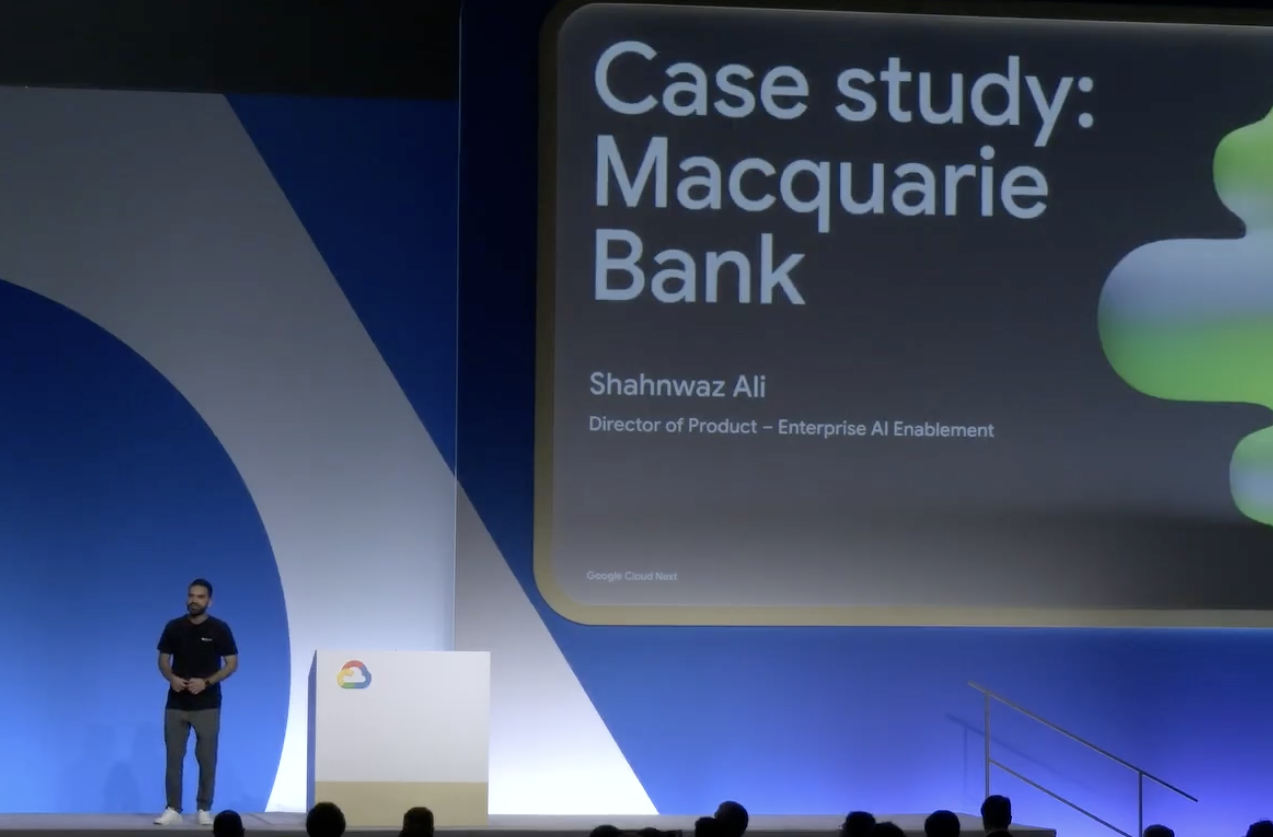
- Director Shahnwaz Ali detailed the adoption at Google Cloud Next ‘26 in Las Vegas.
- An innovation lab hackathon produced hundreds of solutions built by non-tech staff.
- Macquarie and Commonwealth Bank declined to join an ABA-led free ATM trial in regional areas.
- Macquarie posted the fastest housing-loan growth among major banks in March 2026.
- APRA data shows Macquarie and ING outpacing the big four in investor lending.
- The ATM trial, if approved, would involve Westpac, ANZ, NAB and Bank of Queensland.
A bank that let its staff build their own AI tools
Seven months after signing up for Google’s Gemini Enterprise, Macquarie Bank says nearly 80 percent of its 5,000 employees use the generative AI platform daily. The adoption has already returned 130,000 hours of productivity to the workforce, the bank’s director of product for enterprise AI enablement. Speaking at the Google Cloud Next ‘26 conference in Las Vegas, Ali explained that the bank deliberately avoided a top-down deployment. Instead, it offered Gemini Enterprise to all staff, trained and certified them, and then asked employees — as subject matter experts in their own domains — to identify use cases and test solutions. “They now can focus on what matters the most to us, which is delivering exceptional digital experiences to our clients,” Ali said.
From hackathon to production: how non-tech teams built enterprise agents
Weeks after launching Gemini Enterprise, Macquarie ran an innovation lab hackathon. The result, Ali said, was “hundreds of solutions” built not by the tech or AI teams but by “the experts in legal, marketing, compliance, and sales.” Ali demonstrated two enterprise agents onstage. One assists a team of 30 people handling sensitive matters, collating information and suggesting appropriate wording for responses. Ali hinted at a future Outlook integration that would allow emails to be sent directly from the AI-assisted workflow. The second agent helps the legal team assess exposure during incident response. Ali described the current process as involving “a lot of manual processes” and a team “heavily under pressure” with workload. With the agent, he said, “what they need to do is just put a small amount of information into that chatbot and it'll bring up everything.”
Winning over the risk gatekeepers with a targeted pilot
To smooth internal adoption, Macquarie ran a pilot specifically for the personnel who would have to sign off on the risks of adopting the technology. Ali did not name the team, but the approach reflects a deliberate strategy to address compliance and risk concerns head-on. Google supported the bank throughout the rollout, helping iron out challenges as they emerged. The structured training and certification program, combined with the pilot, ensured that even the most cautious stakeholders were brought into the fold before the bank scaled the tool across the entire organisation.
Meanwhile, Macquarie leads mortgage growth as rivals slow
While Macquarie’s AI story grabbed headlines in Las Vegas, its core lending business continues to outpace the market. According to the Australian Prudential Regulation Authority’s March 2026 statistics, Macquarie Bank delivered the fastest housing-book growth among major-tier players, consolidating a step-change seen through late 2025 and early 2026. The country’s 10 largest banking groups collectively held about $2.26 trillion in housing loans. The big four — Commonwealth Bank, Westpac, NAB and ANZ — all expanded at measured rates below 0.6 percent monthly growth, constrained by tighter macroprudential settings. Macquarie and ING, by contrast, set the pace, particularly in investor lending.
A divide over regional banking services deepens
Macquarie’s appetite for technology adoption does not extend to every industry initiative. The bank, along with Commonwealth Bank, has declined to participate in an industry trial of free ATMs in regional areas. The five-year pilot, led by Westpac, ANZ, National Australia Bank and the Bank of Queensland, aims to install fee-free cash machines in 20 key regional locations where bank branches have closed. The Australian Banking Association is seeking ACCC authorisation for the trial, which would also involve ATM operators and the Australian Payments Network. If approved, the pilot would test demand for cash withdrawal and eventually deposit services, with the goal of alleviating strain on small businesses. Macquarie’s refusal to join signals a growing divide among Australia’s largest banks over how to serve regional customers, as government pressure mounts for the industry to provide its own solutions — or have one imposed.
What the AI adoption and ATM snub say about Macquarie’s strategy
Macquarie’s twin moves — embracing generative AI across nearly its entire workforce while opting out of a collaborative regional banking trial — paint a picture of a lender that picks its battles carefully. The bank is willing to invest heavily in technology that directly improves internal efficiency and client experience, but it is less inclined to participate in industry-wide efforts that do not align with its commercial priorities. Ali’s presentation in Las Vegas made clear that Macquarie sees AI as a competitive advantage, not just a cost-saving tool. By empowering non-technical staff to build their own solutions, the bank has turned its entire workforce into a source of innovation. Whether that bet pays off in the long run will depend on how well the bank manages the risks that its own pilot was designed to address.
The bottom line
- Macquarie Bank has achieved near-universal daily use of Gemini Enterprise among its 5,000 staff, reclaiming 130,000 hours of productivity.
- The bank’s adoption strategy relied on training all employees and letting them build use cases, not on top-down mandates.
- A pilot with risk-signoff teams helped overcome internal resistance to the technology.
- Macquarie’s housing-loan growth remains the fastest among major Australian banks, especially in investor lending.
- The bank declined to join an industry trial of free ATMs in regional areas, deepening a split among the majors over regional service obligations.
- Macquarie’s selective approach to collaboration suggests it prioritises proprietary technology investments over collective industry initiatives.





Young's three goals and Bolton's dagger lift Fremantle to 12-point win over Western Bulldogs

Brisbane Lions' leaked whiteboard notes expose brutal player assessments ahead of Essendon clash

Bulldogs' Bontempelli injury crisis deepens after 12-point loss to Fremantle