Asteroid Data Reveals Hidden Shortcut to Mars, Slashing Round Trip to 153 Days
A cosmologist studying near-Earth asteroids stumbled on a geometric trick that could cut a three-year Mars mission to just five months.
CANADA —
Key facts
- Marcelo de Oliveira Souza, cosmologist at State University of Northern Rio de Janeiro, published study in Acta Astronautica (April 2026).
- Asteroid 2001 CA21's early orbital data showed a path crossing both Earth's and Mars' orbital zones.
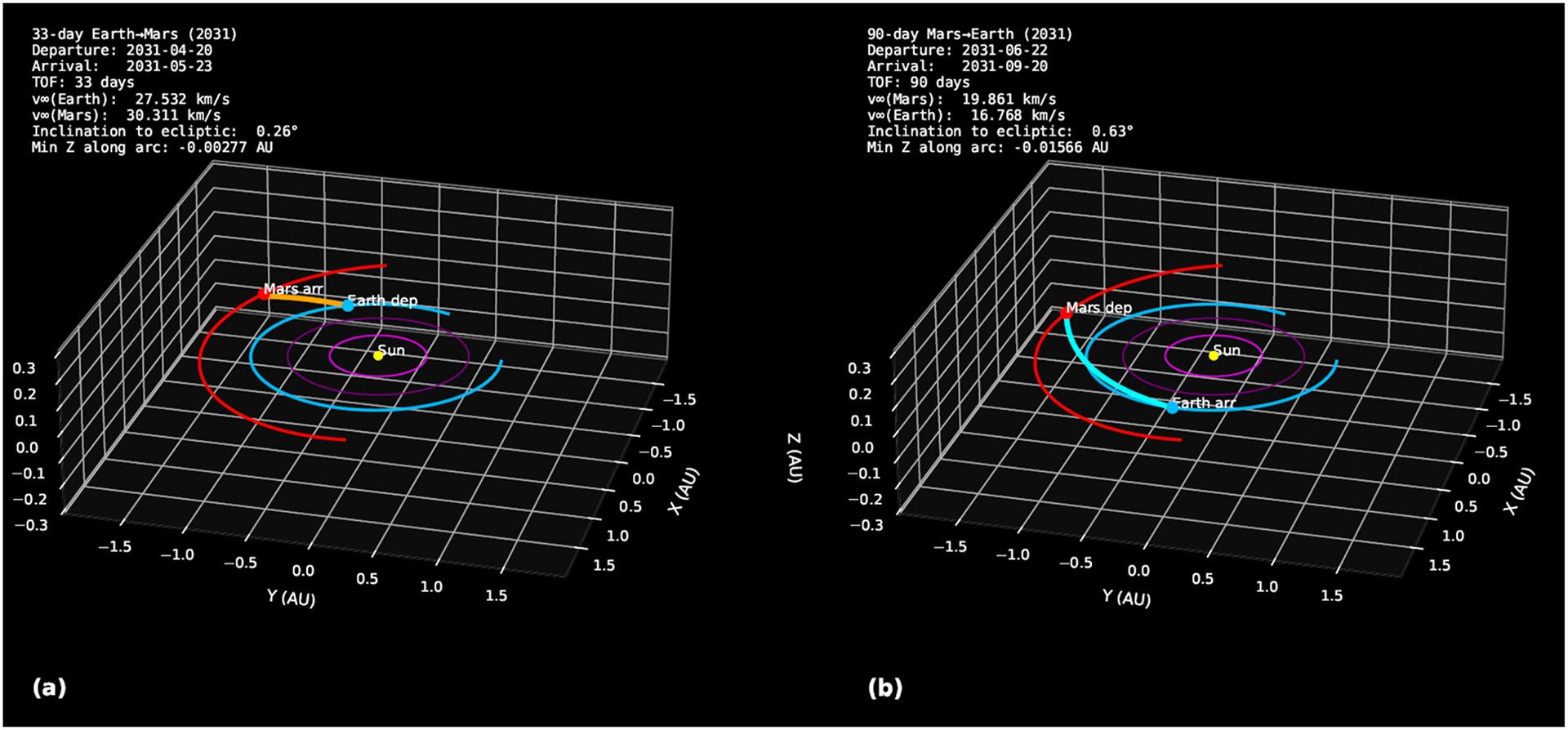
- Using that geometry, a 2031 round-trip mission could last 153 days: depart April 20, arrive May 23, spend 30 days on surface, return by Sept. 20.
- Current round trips take nearly three years due to 26-month alignment windows and 7-10 month transfers.
- The 2031 opportunity requires departure speed of ~27 km/s and return leg of ~90 days.
- A 34-day one-way trip is geometrically possible but requires speeds beyond current rocket capabilities (32.5 km/s) and arrival speed too high for landing systems.
- Souza's method uses preliminary asteroid orbits as a screening tool for rapid interplanetary transfers.
A Chance Discovery in Asteroid Data
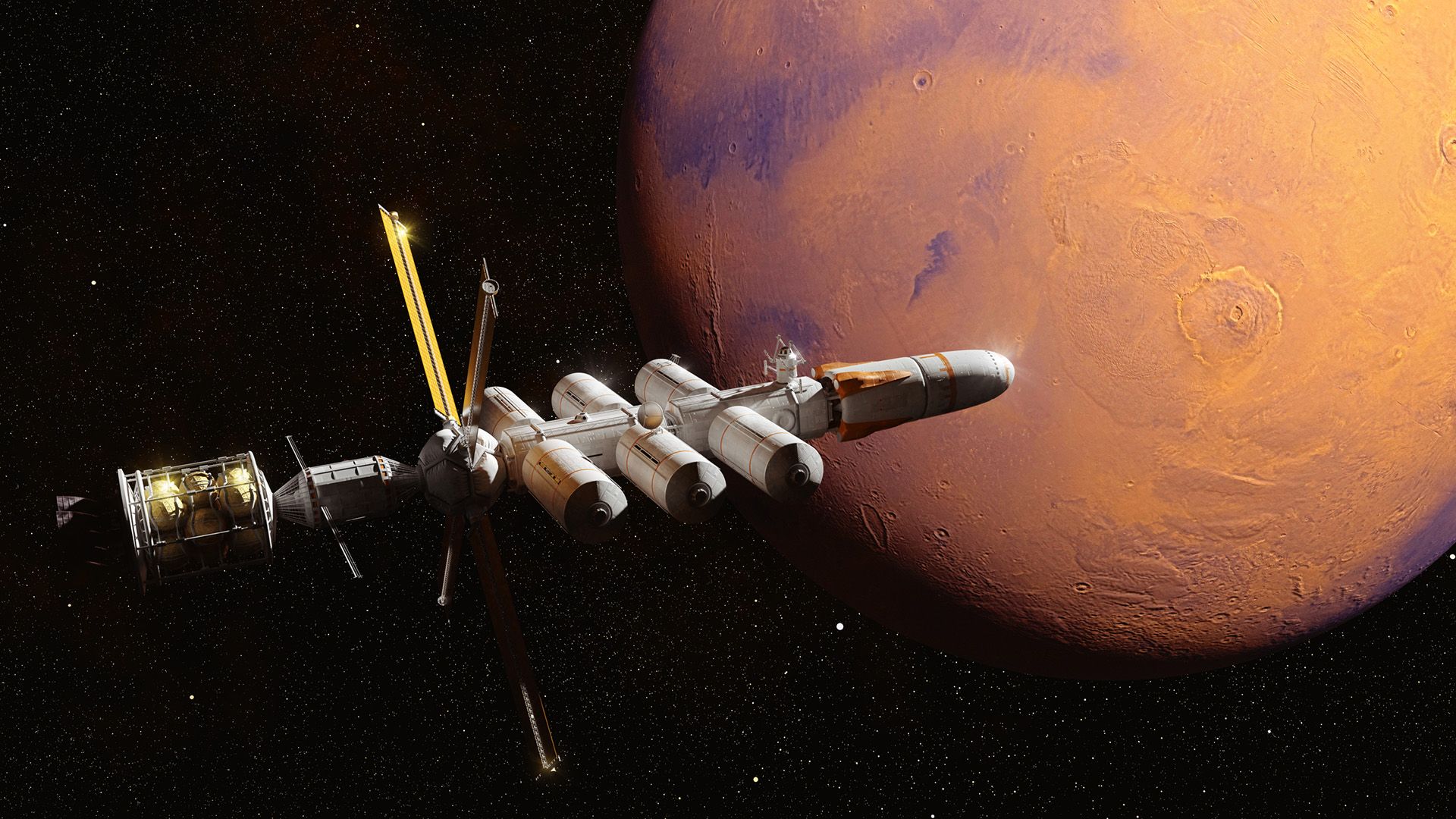
In 2015, Marcelo de Oliveira Souza was studying near-Earth asteroids when one object, 2001 CA21, caught his eye. Early estimates suggested it followed a rare path that crossed both Earth's and Mars' orbital zones. Although later observations refined its true trajectory, the initial geometry hinted at something extraordinary: ultra-short routes between the two planets. "This was a surprise for me — I was not looking for this," Souza told reporters. The cosmologist at the State University of Northern Rio de Janeiro (UENF) realized that early, imprecise orbital estimates — often discarded once better data arrives — might contain valuable geometric clues for designing faster interplanetary missions. Souza published his findings in the journal Acta Astronautica in April 2026, proposing a method that could cut a round-trip Mars mission from nearly three years to just over five months.
The Geometry of Shortcuts
Souza focused on the asteroid's orbital plane during the October 2020 Mars opposition, when Earth and Mars were aligned on the same side of the sun and at their closest. By constraining potential spacecraft paths to within about five degrees of the asteroid's tilt, he found a more direct route through space. "Maybe this can change the idea that we need more than two years to go to Mars and return," Souza said. The key insight is that preliminary small-body orbits, though later superseded, can act as a screening tool to identify rapid transfer opportunities that traditional methods might miss. "The 2031 Mars opposition supports two complete sub-year round-trip missions consistent with the CA21-anchored plane," in the paper, "illustrating how early small-body orbital data may contribute to the early identification of rapid interplanetary transfer opportunities."
A 153-Day Round Trip in 2031
Applying his method to future Mars oppositions in 2027, 2029, and 2031, Souza found that only the 2031 alignment offered a viable opportunity using near-term technology. The proposed mission would depart Earth on April 20, 2031, at about 27 kilometers per second, arriving at Mars after a 33-day journey on May 23. After spending 30 days on the surface, the crew would depart June 22 and return to Earth by September 20, with the return leg taking roughly 90 days. The total mission: 153 days, or about five months. This stands in stark contrast to current mission profiles, where reaching Mars takes seven to ten months one way, and astronauts must wait for a return window that opens only every 26 months, stretching a full round trip to nearly three years.
Current Limits and Future Potential
Souza's calculations also revealed an even faster possibility: a 34-day one-way trip during the October 2020 opposition, following the asteroid's early orbital plane. However, such a trajectory would require departure speeds of around 32.5 kilometers per second, well beyond current rocket capabilities. Moreover, the spacecraft would arrive at Mars traveling about 64,800 mph (108,000 km/h) — far too fast for existing landing systems to handle safely. "Maybe I was in the right place at the right time," Souza reflected, acknowledging that as more observations refine an asteroid's orbit, those early trajectories change, so someone analyzing it later wouldn't have seen the same path. The study does not suggest that future missions must follow this specific asteroid. Instead, it demonstrates a methodological approach: using preliminary orbital data as a "screening tool" to identify fast routes that traditional planning might overlook.
Implications for Mars Exploration
The potential to halve mission time could transform the economics and safety of human Mars exploration. Shorter trips reduce exposure to cosmic radiation, microgravity effects, and the psychological strain of isolation. They also simplify life-support and supply requirements. For mission planners, the 2031 window now presents a concrete target for further study. While the paper does not provide a complete mission design, it offers a geometric foundation that could be combined with advanced propulsion technologies, such as the ion engines currently being tested by NASA. Souza's work opens a new avenue for interplanetary trajectory design, one that leverages data often considered obsolete. As he put it, the early orbital estimates of asteroids — historically used only to assess impact risks — may hold the key to unlocking faster paths to the Red Planet.
A New Tool for Interplanetary Navigation
The study, published in Acta Astronautica with DOI 10.1016/j.actaastro.2026.04.018, represents a shift in how trajectory planners might approach mission design. Rather than relying solely on precise planetary ephemerides, they could incorporate preliminary asteroid orbits as a source of geometric shortcuts. Souza's method is not limited to Mars. Similar analyses could be applied to other destinations, potentially revealing hidden routes across the solar system. For now, the 2031 Mars opposition stands as a proof of concept — a chance to turn a serendipitous discovery into a practical pathway for human exploration. "This study illustrates how the well-defined plane geometry of a preliminary small-body orbit can be employed as a methodological screening tool for rapid interplanetary transfer identification," the paper concludes. The next step is for engineers and mission designers to assess whether the 153-day profile can be realized with existing or near-term technology.
The bottom line
- Early, imprecise asteroid orbital data can reveal faster interplanetary routes that precise data might hide.
- A round-trip Mars mission in 2031 could be completed in 153 days using the geometry of asteroid 2001 CA21.
- Current round trips take nearly three years; the proposed method cuts that by over 80%.
- The 2031 window is the only viable near-term opportunity for such a fast mission using current technology.
- The approach could serve as a general screening tool for rapid transfer identification across the solar system.




Pokémon Go Tests Branching Timed Research With 'Choose Your Path' Event

WHO Suspects Rare Human-to-Human Hantavirus Transmission on Cruise Ship Off Cape Verde
Pokémon Go Tests Branching Timed Research with 'Choose Your Path' Event
