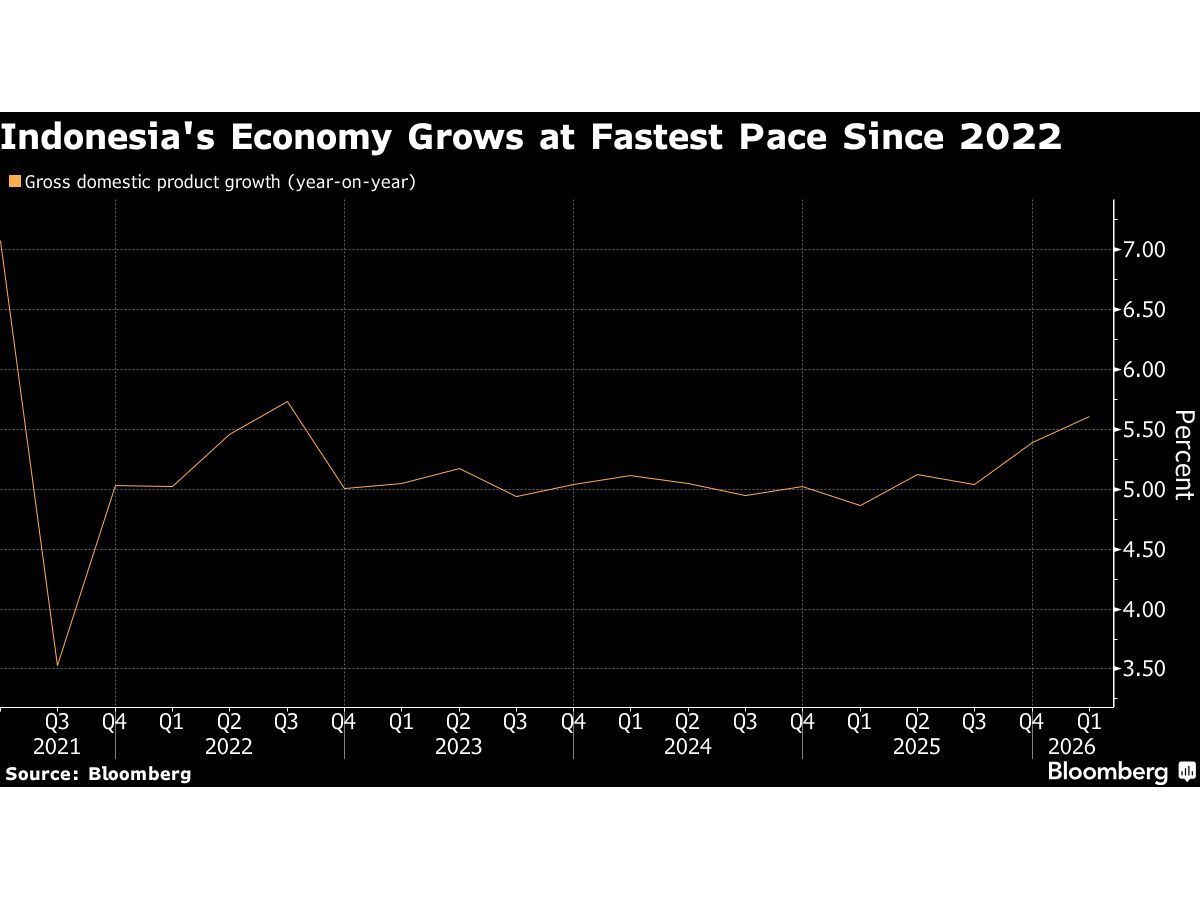
Indonesia’s GDP Surges 5.61% as Record State Spending Offsets Global Energy Crisis
Southeast Asia’s largest economy posts fastest growth in three years, fueled by government outlays and holiday spending, but risks loom from rupiah weakness and a potential El Niño.
CANADA —
Key facts
- Indonesia’s Q1 2026 GDP grew 5.61% year-on-year, beating the 5.4% median estimate.
- Government spending jumped a record 22% quarterly, the main driver of growth.
- Household consumption, over half of GDP, rose 5.52% — the fastest since 2022.
- Taiwan led Asia with 13.7% growth, driven by AI; Indonesia was second fastest.
- 10-year bond yields edged up 2 bps to 6.79%; rupiah weakened to 17,430 per dollar.
- Bank Indonesia raised SRBI rates from March to support the rupiah amid record lows.
- Finance Minister Purbaya Yudhi Sadewa took office in September 2025, prioritizing growth.
- Economist Hosianna Evalita Situmorang expects Q2 moderation due to El Niño risks.
Record State Spending Powers First-Quarter Boom
Indonesia’s economy expanded at its fastest pace in three years during the first quarter of 2026, propelled by an unprecedented surge in government expenditure that helped insulate households from the global energy crisis. Gross domestic product rose 5.61% in the January-to-March period compared with the same period a year earlier, the statistics agency reported on Tuesday, surpassing the 5.4% median forecast in a Bloomberg survey of economists. The acceleration from the previous quarter’s 5.39% growth places Indonesia among Asia’s best-performing economies, trailing only Taiwan’s stellar 13.7% expansion, which was fueled by the artificial-intelligence boom. The data underscores the effectiveness of fiscal stimulus under Finance Minister Purbaya Yudhi Sadewa, who took office in September 2025 with a mandate to boost growth.
Household Spending and Holiday Bonuses Lift Consumption
A record 22% quarterly increase in state spending provided the primary engine for Southeast Asia’s largest economy, while households ramped up outlays during the Eid al-Fitr holidays, aided by seasonal bonuses. Household consumption, which accounts for more than half of Indonesia’s GDP, grew 5.52% in the first quarter — the fastest pace since 2022, according to data compiled by Bloomberg. Statistics chief Amalia Adininggar Widyasanti noted that spending at restaurants and hotels, as well as electronic payments, strengthened during the period, even as export growth slowed significantly. The combination of fiscal firepower and festive spending created a potent short-term boost, but analysts warn that sustaining this momentum will be challenging.
Rupiah Pressure Forces Monetary Tightening
Despite the strong growth print, financial markets signaled caution. Indonesia’s 10-year government bond yields rose 2 basis points to 6.79%, while the rupiah weakened slightly to 17,430 against the U.S. dollar, which was gaining against most Asian currencies. The currency has been hitting record lows amid growing fiscal concerns and global volatility, prompting Bank Indonesia to step up support measures. From March onward, the central bank raised rates on its securities (SRBI) to prioritize the rupiah, a shift that could tighten monetary conditions. Hosianna Evalita Situmorang, an economist at Bank Danamon in Jakarta, said that “monetary conditions are tilting towards prioritizing the rupiah,” as shown by the higher SRBI rate. This pivot may temper the growth momentum in coming quarters.
Resilience Amid Global Headwinds and El Niño Threat
Indonesia’s economy proved remarkably resilient against a backdrop of high oil prices, conflict in the Middle East, and accelerating inflation globally. The government’s record spending helped offset external shocks that have roiled other emerging markets. However, the outlook for the second quarter is clouded by multiple risks. Situmorang predicted that “growth is expected to moderate in the second quarter,” noting that while fiscal spending on priority programs will provide some support, a potentially stronger El Niño dry spell could negatively affect agriculture. The agricultural sector, a key employer and source of rural income, is vulnerable to prolonged drought, which could dampen consumption and overall GDP.
Fiscal Strategy Under Finance Minister Purbaya Yudhi Sadewa
Since taking office in September 2025, Finance Minister Purbaya Yudhi Sadewa has pursued an aggressive fiscal expansion to revive growth. The first-quarter results suggest his strategy is paying off, with record state spending and robust household consumption driving the economy. Yet the reliance on government outlays raises questions about fiscal sustainability, especially as revenues may be squeezed by slowing exports and global uncertainty. The minister’s approach contrasts with the monetary tightening underway at Bank Indonesia, creating a potential policy tug-of-war. While fiscal stimulus supports demand, higher interest rates to defend the rupiah could choke off investment and credit. Balancing these twin objectives will be critical in the months ahead.
Outlook: Moderation Ahead as Policy Trade-Offs Intensify
offers a snapshot of an economy that has so far weathered the global energy crisis better than many peers, thanks to decisive fiscal action. But the underlying vulnerabilities — currency weakness, export slowdown, and climate risks — suggest the pace of growth is unlikely to be sustained. The second quarter is expected to see a moderation, with the central bank’s focus on the rupiah potentially dampening domestic demand. As the world grapples with the fallout from the Iran war and high oil prices, Indonesia’s experience highlights the delicate balancing act facing policymakers: using fiscal firepower to support growth while managing external pressures. The coming months will test whether the current resilience can be maintained or whether the trade-offs will force a slowdown.
The bottom line
- Indonesia’s Q1 2026 GDP grew 5.61%, the fastest in three years, driven by a record 22% quarterly increase in government spending.
- Household consumption rose 5.52% — the fastest since 2022 — boosted by Eid holiday spending and seasonal bonuses.
- Bank Indonesia has tightened monetary policy since March to support the rupiah, which hit record lows amid global volatility.
- Economists expect Q2 growth to moderate due to a potential El Niño dry spell and the drag from higher interest rates.
- Finance Minister Purbaya Yudhi Sadewa’s fiscal expansion has been effective so far, but sustainability concerns remain.
- Indonesia’s resilience contrasts with global headwinds from high oil prices, Middle East conflict, and accelerating inflation.


Cherie DeVaux Makes History as First Female Trainer to Win Kentucky Derby

Olivia Rodrigo Announces 65-Date 'Unraveled Tour' with Two-Night Stops in Pittsburgh, Philadelphia, and Hartford

CRA refunds $647 million from repealed digital services tax after U.S. threats
