King Charles wields soft power in masterful state visit, taming Trump while rebuking Trumpism
The British monarch's four-day trip to the US combined flattery and pointed warnings about checks on executive power, appealing to Republicans and Democrats alike.

UNITED KINGDOM —
Key facts
- King Charles III and Queen Camilla concluded a four-day state visit to the US on Thursday.
- The visit was the first by a British monarch since Queen Elizabeth II's in 2007.
- Charles presented a bell from HMS Trump, a Royal Navy submarine, at the White House state dinner.
- The king addressed Congress, citing Magna Carta as foundation for checks on executive power.
- Charles and Camilla visited Arlington National Cemetery, where the king laid a wreath of red poppies.
- The royals attended a block party in Front Royal, Virginia, with the state's governor.
- Queen Camilla visited Smitten Farm in Virginia to highlight horse racing welfare efforts.
- King Charles flew to Bermuda from Joint Base Andrews after the visit.
A bell named Trump and a masterstroke of diplomacy
At Tuesday's state dinner at the White House, King Charles III unveiled a polished brass bell that once hung from the conning tower of a Royal Navy submarine launched in 1944. Its name was HMS Trump. "And should you ever need to get hold of us," the king said, "well, just give us a ring." The gesture was an ego-flattering masterstroke that prompted groans in foreign capitals from Paris to Canberra to Tokyo, as diplomats wondered how they could ever match such a display. The bell, bearing the name "Trump," epitomized the king's ability to combine charm with subtle political messaging.
A historic visit wrapped in ironies
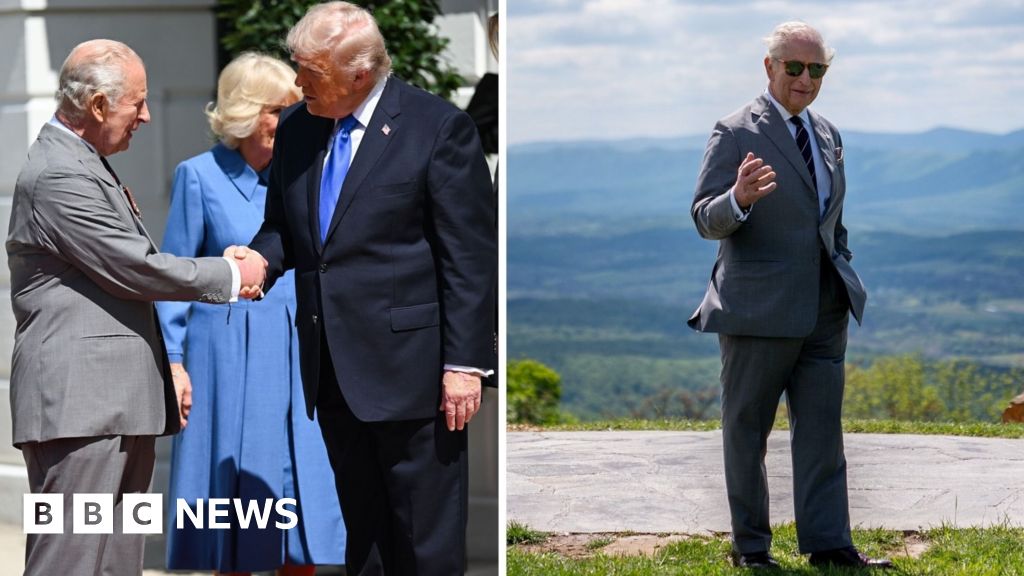
The four-day state visit, the first by a British monarch since Queen Elizabeth II's in 2007, was laced with ironies. At home, Charles is the ailing head of a tainted family that symbolizes class privilege and colonialism — an institution that would never be invented today. Yet in the United States, the country that unceremoniously expelled his great-great-great-great-great grandfather 250 years ago, he was hailed as a debonair defender of democracy. The king and queen bid farewell to Donald and Melania Trump at the White House on Thursday before traveling to Arlington National Cemetery. There, Charles paid his respects at the Tomb of the Unknown Soldier, laying a wreath composed of red poppies.
A rapier wrapped in ermine: taming Trump while rebuking Trumpism
Charles managed to tame Trump while rebuking Trumpism, like a rapier wrapped in ermine. His style appealed to Republicans' warm, fuzzy feelings about Britain; his content appealed to Democrats anxious about institutions and the rules-based order. He wrote a love letter to America while eviscerating the "Make America great again" movement. In his address to Congress, the king noted that Magna Carta has been cited in at least 160 Supreme Court cases since 1789, "not least as the foundation of the principle that executive power is subject to checks and balances." A decade ago, such remarks would have been boilerplate in their support for the NATO alliance and a western ally's war against Russian aggression. Now, they were seen as positively daring — speaking truth to superpower and impressing on the US body politic what it has lost.
A masterclass from someone above the fray
Jon Meacham, a presidential historian, described the king's address as "a kind of masterclass in how someone not tied to the minute-to-minute political realities of popular politics" can deliver a vivid warning and inspiration. "It's sort of like having a headmaster speak to a school," Meacham told the MS Now channel. "He has come over to remind us of what matters, of what's important, of what has endured not simply because it is old but because it is true and has been of utility." Meacham added that the king's remarks — about words mattering, deeds mattering, not looking inward, remembering checks on executive power, and noting the climate — served as a warning against losing oneself in a populist, isolationist, nationalistic moment.
Trump's anglophilia and the limits of soft power
Trump, for his part, eulogized the king's "beautiful accent," reminisced about his Scottish-born mother having a "crush" on the young prince, and indulged disturbing blood-and-soil nationalism, suggesting that the US is defined by Anglo-Saxon cultural and genetic heritage. The king's speechwriter may have calculated, probably rightly, that the political points would have sailed over Trump's head. But the king's remarks, leavened with quips and quotations, provided an ego boost to members of Congress and the Supreme Court who have been systematically marginalized by Trump's expansion of executive power. The coded message to them was: you matter too, now get your act together. However, British Prime Minister Keir Starmer would do well to remember the problem with soft power: it is soft, and can quickly scatter like blossom on the wind. Trump is notorious for blowing hot and cold; while the monarch bathed in the warmth of his anglophilia, Starmer can still expect the cold shoulder.
A tour that spanned history, horses, and national parks
After the official farewell, the royal couple traveled to Front Royal, Virginia — a town aptly named for the occasion — where they participated in a block party with the state's governor. They then went their separate ways: Queen Camilla visited Smitten Farm in Virginia to highlight the US horse racing industry's health and welfare efforts, while King Charles closed his visit at Shenandoah National Park. The king then flew to Bermuda from Joint Base Andrews, where the royals had initially touched down on April 27. The visit, which began with a state dinner and address to Congress, ended with a quiet departure, leaving behind a complex legacy of diplomatic finesse and unresolved tensions.
A warning from a descendant of George III
Paradoxically, it took a direct descendant of the tyrannical George III to warn the young nation that it is betraying George Washington. Britain separates its head of state from its political leader; America wraps them all into one. The danger of the latter approach has become all too evident when that person is a wannabe emperor. Like a billionaire who feels liberated to talk about inequality and taxes, Charles's exalted status above the fray seemingly gave him special license to speak candidly. His visit, while historic, served as a reminder that soft power, however elegantly wielded, cannot substitute for hard diplomatic action — and that the winds of political fortune can shift as quickly as a spring breeze.
The bottom line
- King Charles used a bell from HMS Trump as a flattering gift, blending charm with a pointed message about naval history.
- The king's address to Congress emphasized checks on executive power, a subtle rebuke of Trump's expansion of presidential authority.
- The visit highlighted the ironies of a British monarch, symbol of colonialism, being celebrated in the US as a defender of democracy.
- Trump's warm reception of Charles contrasted with his potential coldness toward UK Prime Minister Keir Starmer, illustrating the limits of soft power.
- The king's remarks provided a morale boost to marginalized members of Congress and the Supreme Court, urging them to reassert their roles.
- The state visit, the first by a British monarch in 18 years, ended with the king flying to Bermuda, leaving behind a complex diplomatic legacy.

Hull FC's Sam Lisone Out for Up to 18 Weeks, Deepening Injury Crisis Under New Coach Andy Last
King Charles Jokes About French Language at White House State Dinner as US Visit Ends

Supreme Court Hears Challenge to Trump's Termination of Temporary Protected Status for Haitians and Syrians