Thailand’s 108-Day Oil Buffer Tested as Hormuz Crisis Deepens and Fuel Subsidies Rise
Bangkok moves to shore up energy security with emergency loan plans and diesel price hikes while global crude volatility rattles the region.

SINGAPORE —
Key facts
- Thailand has oil reserves sufficient for 108 days of domestic demand as of May 1, 2026.
- The Oil Fuel Fund Committee approved an increase in compensation for high-speed diesel, raising retail prices.
- WTI crude fell $1.81 to $105.07 per barrel on April 30; Brent dropped $4.02 to $114.01.
- Dubai crude rose to $112.20 per barrel; Singapore diesel closed at ~$179/bbl, petrol at ~$138/bbl.
- Thailand produced 74.32 million litres of diesel and sold 54.91 million litres daily from April 1-29.
- Thailand plans a 400 billion baht emergency loan to recalibrate fiscal policy amid the Middle East shock.
- The Strait of Hormuz remains closed, with the UN warning the crisis is dragging down the global economy.
Energy Ministry Confirms 108-Day Reserve as Middle East Tensions Spike
Thailand has enough oil reserves to cover domestic demand for approximately 108 days, the Energy Ministry announced on May 1, as global energy markets remain volatile amid escalating tensions in the Middle East. The ministry’s assessment, based on data through May 1, 2026, comes as the Strait of Hormuz crisis deepens following US President Donald Trump’s signal that Washington might resume military action against Iran. Iran’s president condemned what he called a US maritime blockade and declared that Iran would no longer tolerate the situation. The United Nations secretary-general warned that the crisis was dragging down the global economy by the hour. The White House has begun considering regulatory changes to accelerate domestic oil production, while the United Arab Emirates, which has officially withdrawn from OPEC, may expand production in the long term — but the immediate market supply remains constrained because the strait is closed.
Oil Prices Swing as Markets Digest Geopolitical and Economic Risks
Oil prices remained volatile amid concerns over the economic impact and the possibility of slower energy demand. At the close on April 30, West Texas Intermediate crude fell $1.81 to $105.07 per barrel, while Brent crude dropped $4.02 to $114.01 per barrel. Dubai crude, a key benchmark for Asian imports, rose to $112.20 per barrel. Refined product prices in the Singapore market also surged. Diesel closed at around $179 per barrel, and petrol at about $138 per barrel. Just over a week earlier, on April 22, diesel had closed at roughly $167 per barrel and petrol at $129 per barrel, underscoring the rapid escalation in refined fuel costs.
Thailand Raises Diesel Subsidies and Retail Prices to Stabilize Fund
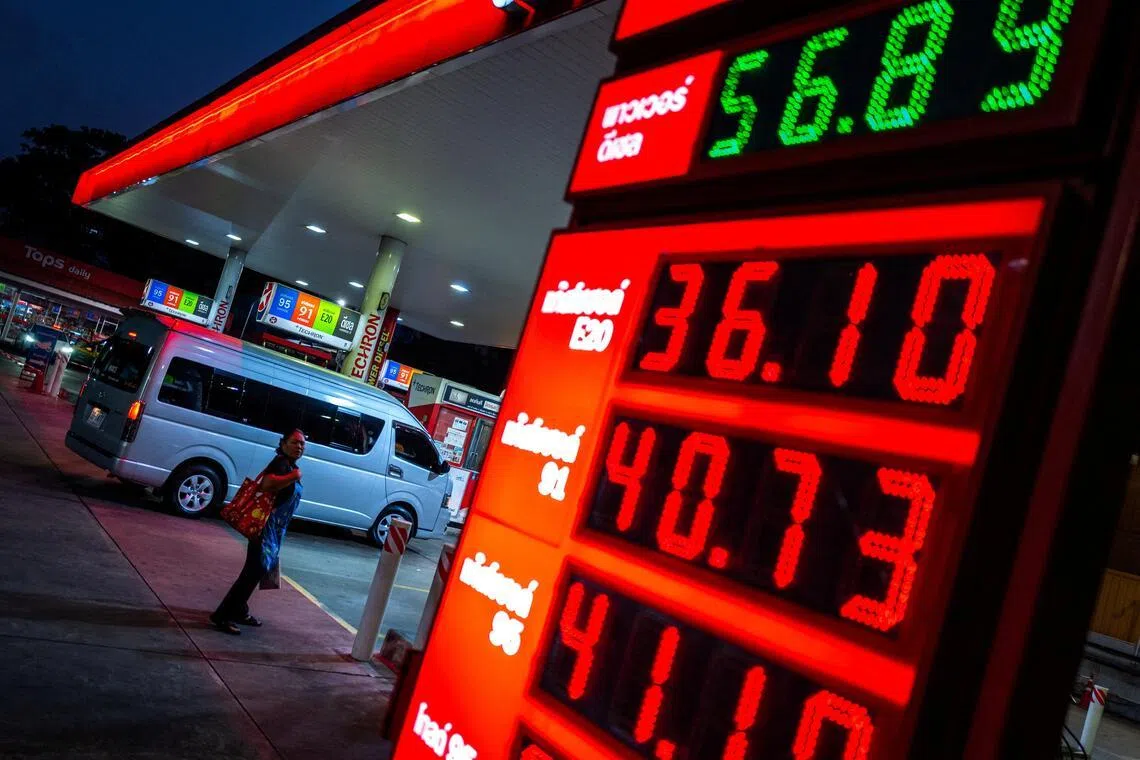
The Oil Fuel Fund Committee approved an increase in compensation for high-speed diesel, a move that directly raised retail prices at the pump. The decision reflects the government’s attempt to balance consumer relief with the financial health of the Oil Fuel Fund, which has been strained by the global price surge. Between April 1 and April 29, Thailand produced an average of 74.32 million litres of diesel per day and sold 54.91 million litres per day, indicating a production surplus that provides some buffer. However, the rising cost of imported crude and refined products is putting pressure on the fund’s reserves.
400 Billion Baht Emergency Loan Signals Fiscal Recalibration
In a parallel response to the Middle East shock, Thailand is planning a 400 billion baht emergency loan to recalibrate its fiscal position. The loan is intended to cushion the economy from the ripple effects of higher energy costs and supply chain disruptions, though details of the borrowing structure and repayment timeline have not yet been disclosed. The emergency loan is part of a broader government strategy that includes reviving the Land Bridge megaproject — a multibillion-dollar infrastructure plan to create an alternative shipping route bypassing the Strait of Hormuz — and accelerating medical investment to build a regional healthcare economy.
Broader Economic and Diplomatic Moves Amid the Crisis
Beyond energy, Thailand is escalating a nationwide crackdown on nominee business networks to close foreign ownership loopholes, and it has signaled support for gradual ASEAN engagement as the Myanmar crisis shifts toward controlled diplomacy. Chinese Foreign Minister Wang Yi is on a five-day diplomatic tour reasserting China’s Southeast Asia strategy, which includes deepening ties with Bangkok. Thailand is also expanding its North American tourism push, targeting Los Angeles, Washington, and Vancouver as key growth markets, even as airlines adjust capacity in response to shifting travel demand across the Asia-Pacific region. The Thai Airways fuel surcharge hike is already signaling rising travel costs for passengers.
Outlook: Energy Security and Fiscal Discipline in the Balance
Thailand’s 108-day oil reserve provides a temporary cushion, but the closure of the Strait of Hormuz and the volatility in global crude markets pose a sustained threat to the country’s energy security and fiscal stability. The government’s dual approach — raising diesel prices while planning a massive emergency loan — reflects the difficult trade-off between containing inflation and maintaining economic growth. With the UN warning that the crisis is dragging down the global economy by the hour, and the White House exploring domestic production acceleration, Thailand’s ability to navigate the coming weeks will depend on how quickly alternative supply routes and fiscal measures can be implemented. The Land Bridge project, if revived, could reshape energy and shipping strategy for the entire region, but it remains a long-term solution to an immediate crisis.
The bottom line
- Thailand’s 108-day oil reserve provides a short-term buffer but is under pressure from the ongoing Strait of Hormuz closure.
- The government raised diesel retail prices by increasing compensation to the Oil Fuel Fund, reflecting a balancing act between consumer costs and fund solvency.
- A 400 billion baht emergency loan is planned to recalibrate fiscal policy in response to the Middle East shock.
- Global crude benchmarks showed sharp divergence: WTI and Brent fell while Dubai crude rose, indicating regional supply concerns.
- Thailand is pursuing multiple long-term strategies — including the Land Bridge megaproject, medical investment, and tourism expansion — to diversify its economy away from energy vulnerability.
- The crisis has prompted diplomatic and regulatory moves across ASEAN and the US, with China’s foreign policy tour underscoring the geopolitical stakes.





Lakers' 3-0 series lead evaporates as Rockets force Game 6 with stifling defense

Hantavirus Suspected in Three Deaths on Dutch Cruise Ship Off West Africa
Hantavirus outbreak on Atlantic cruise ship kills three, sickens at least three others