USGS Maps Reveal Millions of Disabled Americans at Risk in Earthquake Zones
A new study identifies 252.5 million people in areas with at least a 2% earthquake probability, highlighting access and functional needs often overlooked by early warning systems.
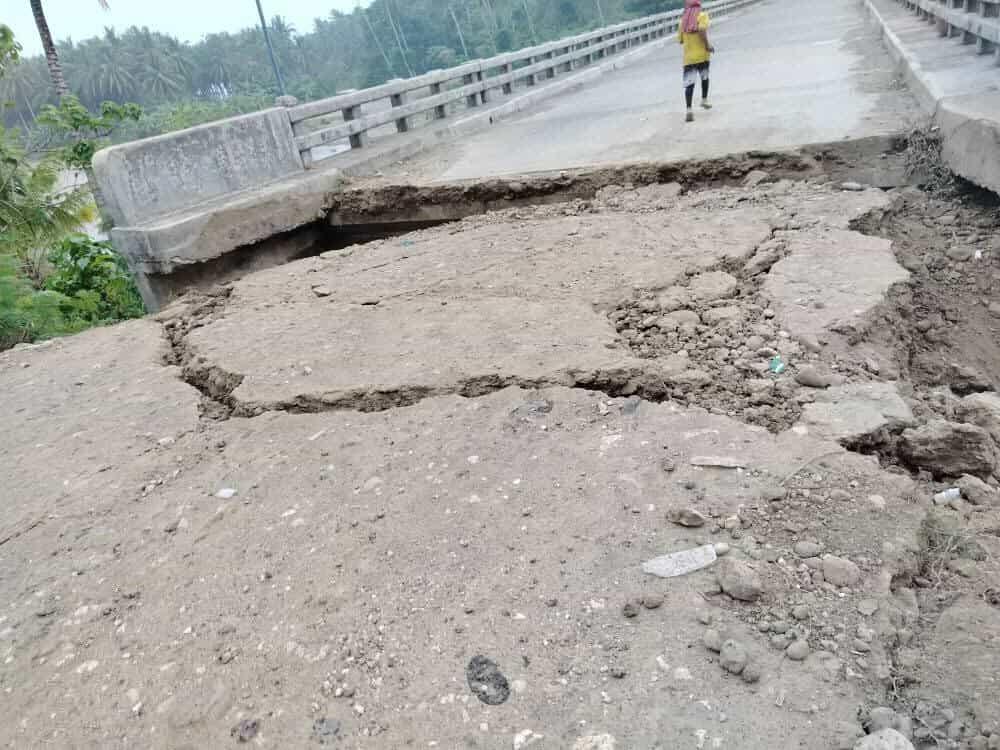
PHILIPPINES —
Key facts
- 252.5 million people live in U.S. areas with at least a 2% chance of a damaging earthquake in 50 years.
- 75% of the U.S. population resides in these earthquake-prone zones.
- 1.4 million people are dependent on durable medical equipment such as ventilators or electric wheelchairs.
- The study maps 13 distinct variables across four functional challenge categories: accessing, processing, and acting on information, plus caregiver reliance.
- Variables include hearing difficulty, vision difficulty, cognitive difficulty, limited English proficiency, and ambulatory difficulty.
- The research uses the CMIST framework (Communication, Maintaining Health, Independence, Support and Safety, Transportation).
- The analysis covers county-level data from the entire United States.
Mapping Vulnerability Beyond the Alert
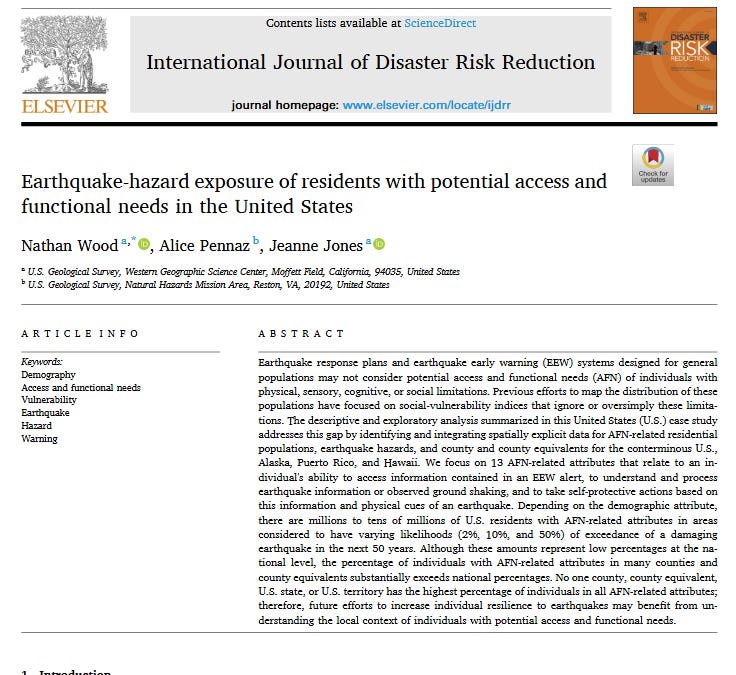
Earthquake early warning systems such as ShakeAlert are designed to give the general population a few seconds to take cover. But a new study from the U.S. Geological Survey reveals that millions of Americans face barriers that prevent them from receiving, understanding, or acting on those warnings. The research, led by Nathan Wood, Alice Pennaz, and Jeanne Jones, maps where populations with access and functional needs (AFN) live relative to earthquake hazard zones, using county-level data covering the entire United States. The study finds that 252.5 million people — 75 percent of the U.S. population — reside in areas with at least a 2 percent probability of a damaging earthquake in the next 50 years. Within those areas, the authors identify tens of millions of children, older adults, and people with limited English proficiency, as well as several million individuals with hearing, vision, cognitive, ambulatory, or self-care difficulties. About 1.4 million people are dependent on durable medical equipment such as ventilators, dialysis machines, or electric wheelchairs.
A Functional Framework for Emergency Planning
The study moves beyond generic labels like “disability” or “special needs” by adopting the CMIST framework, originally developed by Kailes and Enders. CMIST stands for Communication, Maintaining Health, Independence, Support and Safety, and Transportation — a functional understanding of what people actually need to prepare, survive, and recover from a disaster. Rather than collapsing disability, age, language, and technology access into a single vulnerability score, the authors identify 13 distinct variables and map each one separately. They organize these variables by the specific functional challenge they create: accessing information, processing information, acting on information (mobility), and acting on information (caregiver reliance). This approach allows emergency managers to pinpoint the exact intervention needed for each community.
Accessing Information: The First Barrier
The first functional challenge is accessing information: can a person receive a warning? The variables here include hearing difficulty, vision difficulty, households without a telephone, and households without a computer. For individuals with hearing difficulties, a standard audible alert is useless; they need visual or haptic signals. Those without a telephone or computer may not receive digital alerts at all. The study’s data shows that millions of Americans fall into these categories, yet current early warning systems largely assume universal access. The authors emphasize that a community with high rates of hearing difficulty requires different alert infrastructure than one where vision difficulty is prevalent.
Processing and Acting on Warnings
Even if a warning is received, it must be understood. The study identifies cognitive difficulty and limited English proficiency as key variables affecting information processing. People with cognitive difficulties may not recognize that ground shaking is dangerous or know how to respond. Those with limited English proficiency may not understand the alert message. Acting on information involves physical protection. Variables include ambulatory difficulty, dependence on durable medical equipment, and mothers with newborns. A person in a wheelchair cannot easily “duck and cover.” Someone reliant on a ventilator cannot leave it behind. The study counts about 1.4 million people dependent on such equipment in earthquake-prone areas.
Caregiver Reliance and Institutional Populations
The fourth category is caregiver reliance: does a person need someone else to help them prepare or respond? This includes children under 18, adults 65 and older, people with self-care difficulty, and institutionalized populations such as those in nursing homes and correctional facilities. These groups cannot act independently in an emergency. a large institutionalized population requires facility-level emergency plans, not just individual alerts. The mapping of these variables separately — rather than in a composite index — gives decision-makers the specific information needed to design targeted interventions.
Implications for Earthquake Preparedness
The study overlays AFN data with USGS National Seismic Hazard Model maps, showing areas with different probabilities of a damaging earthquake. The methodology is transportable to other hazard types, though the definitions and associated variables would likely change. Evidence from past earthquakes and other disasters shows elevated death and injury rates among people with disabilities. By making these vulnerabilities visible at the county level, the USGS researchers hope to bridge the gap between evidence and action. The findings underscore that early warning systems are only as effective as the population’s ability to use them.
A Call for Tailored Interventions
The study’s innovation lies in its refusal to simplify. Each of the 13 variables implies a different intervention point: visual alerts for the hearing impaired, simplified messaging for those with cognitive difficulties, language translation for non-English speakers, and physical accommodations for those with mobility challenges. As the authors conclude, a composite index that blends these factors would obscure exactly the information an emergency manager needs. The map of vulnerability is not a single number but a mosaic of specific needs. The next step is for policymakers and local authorities to use this data to design inclusive warning systems and evacuation plans that leave no one behind.
The bottom line
- 252.5 million Americans (75% of the population) live in areas with at least a 2% earthquake probability in 50 years.
- The USGS study maps 13 distinct access and functional needs variables, not a single vulnerability score.
- 1.4 million people dependent on durable medical equipment are in earthquake-prone areas.
- Current early warning systems may fail those with hearing, vision, cognitive, or mobility difficulties.
- The CMIST framework provides a functional approach to emergency planning beyond disability labels.
- County-level data allows targeted interventions such as visual alerts, language translation, and facility-level plans.


Anthony Edwards cleared for Game 1 against Spurs after nine-day recovery from knee injury

NLEX and Converge Collide in High-Stakes PBA Duel with No. 1 Seed and Playoff Hopes on the Line

Strait of Hormuz Closure Drives Global Fuel Crisis as Oil Hits $110