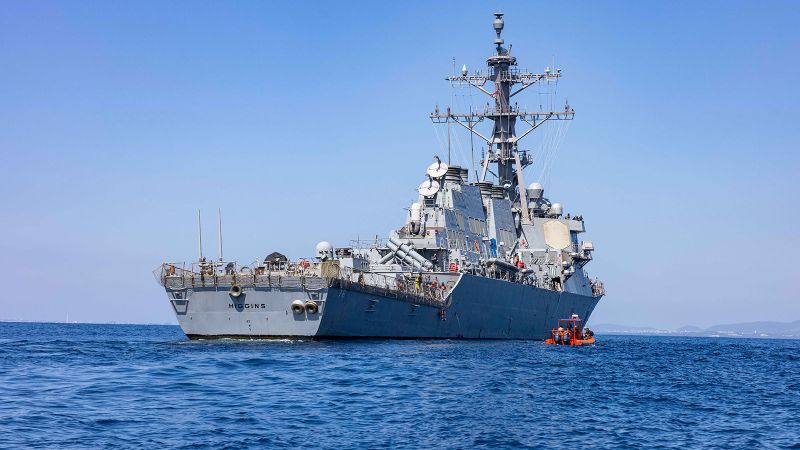
USS Higgins loses power and propulsion for hours after electrical fire in Indo-Pacific
The guided-missile destroyer, homeported in Japan, suffered an engineering casualty that left it 'helpless' and 'electronically blind' for several hours, the Navy said.
PHILIPPINES —
Key facts
- USS Higgins, an Arleigh Burke-class destroyer, lost power and propulsion for several hours on Tuesday.
- The incident was caused by an electrical fire that was contained to one piece of equipment.
- among the crew of about 300.
- The ship is homeported in Yokosuka, Japan, and assigned to the 7th Fleet.
- Power and propulsion have been restored, and the cause is under investigation.
- The Higgins was ported in Singapore as of February, according to vessel data.
- The ship is named after Marine Col. William Higgins, who was kidnapped and murdered by Hezbollah-linked militants in 1988.
Electrical fire leaves destroyer powerless for hours
A fire broke out Tuesday aboard the USS Higgins, a guided-missile destroyer, knocking out electricity and propulsion for several hours.ed the event as an “engineering casualty” caused by an electrical malfunction that produced sparking or smoke before being extinguished. The flames were contained to a single piece of equipment and did not spread, officials said. among the crew, and the ship is now underway with power and propulsion restored, the Navy stated. The cause of the malfunction remains under investigation.
‘Helpless and electronically blind’: analysts describe risks
Naval analysts said the loss of power left the Higgins vulnerable. “The ship is helpless, electronically blind and immobile,” said Carl Schuster, a former U.S. Navy captain. Emergency diesel generators would only power communications and air conditioning, not combat systems or propulsion. The outage lasted several hours, a defense official confirmed, a significant period for a warship to be adrift. During that time, electrically operated radars and defensive systems were inoperative, leaving the vessel unable to control its movements or detect threats.
Crew response and Navy investigation underway
The crew immediately extinguished the fire, the Navy said. Cmdr. Matthew Comer, a spokesperson for the 7th Fleet, stated that initial reports indicate an electrical malfunction, which may have produced sparking or smoke that ceased once power was removed. The Navy has launched an investigation into the incident. A defense department official said in a statement: “An electrical fire occurred aboard the USS Higgins while at sea in the Indo-Pacific. The fire was immediately extinguished by the crew, and there are no reported injuries. The situation is under control, and the ship is currently underway. The cause is under investigation.”
USS Higgins: a workhorse of the 7th Fleet
The USS Higgins is an Arleigh Burke-class destroyer, commissioned in 1999, measuring 505 feet long and displacing more than 8,200 tons. It carries a crew of about 300 and is equipped with the Aegis combat system and vertical launch tubes for Tomahawk missiles and other weapons. Homeported in Yokosuka, Japan, the ship is part of the Navy’s forward-deployed forces assigned to the 7th Fleet, a key component of U.S. Indo-Pacific Command, which oversees operations across more than half the globe. The Higgins was ported in Singapore as of February.
Recent fires on other carriers raise concerns
The Higgins incident follows two other fires on U.S. Navy carriers this month. On the USS Dwight D. Eisenhower, a small fire injured eight sailors, the U.S. Naval Institute reported. Separately, a fire in laundry spaces aboard the USS Gerald R. Ford injured two sailors. The Ford and its strike group are expected to leave the Middle East in the coming days, a U.S. official confirmed. The Higgins incident underscores ongoing maintenance and safety challenges across the fleet.
Ship named after Marine colonel killed by Hezbollah
The USS Higgins is named after Marine Col. William Higgins, a Vietnam War veteran who served in a United Nations peacekeeping mission in southern Lebanon. He was kidnapped in February 1988 by Hezbollah-linked militants, tortured, interrogated, and murdered. He was promoted to colonel while in captivity, and his remains were found on a Beirut street in December 1991. The ship’s namesake adds a layer of historical significance to the vessel, which has been a mainstay of U.S. naval presence in Asia for over two decades.
Outlook: investigation and operational impact
The Navy has not disclosed the exact location of the incident within the Indo-Pacific Command area, which stretches from the U.S. West Coast to India and from the North Pole to Antarctica. Details on damage to specific sections of the ship and repair timelines are not yet available. As the investigation proceeds, the incident raises questions about the reliability of aging destroyers in the fleet. The Higgins, now 24 years old, is one of more than 70 Arleigh Burke-class destroyers in service. The Navy will need to determine whether the electrical malfunction points to a broader systemic issue or an isolated failure.
The bottom line
- The USS Higgins suffered an electrical fire that caused a loss of power and propulsion for several hours, leaving it defenseless.
- No injuries were reported, and the crew extinguished the fire quickly; power has been restored.
- The incident occurred in the Indo-Pacific, but the exact location has not been disclosed.
- The cause of the electrical malfunction is under investigation by the Navy.
- The Higgins is a 24-year-old Arleigh Burke-class destroyer homeported in Yokosuka, Japan, and assigned to the 7th Fleet.
- The fire follows two other carrier fires this month, raising concerns about fleet safety and maintenance.


NLEX and Converge Collide in High-Stakes PBA Duel with No. 1 Seed and Playoff Hopes on the Line

Knicks on Brink of East Semifinals as Hawks Face Elimination in Game 6
Magnitude 5.8 Earthquake Strikes Near Yilan, Taiwan, as Global Seismic Activity Intensifies
