US Air Force Tanker Declares Emergency Over Strait of Hormuz
A KC-135 Stratotanker issued a 7700 code before altering course, amid heightened regional tensions.
PAKISTAN —
Key facts
- A US Air Force KC-135 Stratotanker transmitted a 7700 emergency code on Tuesday, May 5.
- The aircraft took off from Al Dhafra Air Base in the United Arab Emirates.
- The KC-135 was reportedly carrying fuel for US forces operating in the region.
- The aircraft altered course towards Qatar following the distress signal.
- Flight tracking data showed the plane entered a holding pattern and began descending.
- The incident occurred during 'Project Freedom,' a US-led operation to secure civilian vessels.
- Iran has denied any connection to the incident and dismissed the US operation.
Distress Signal Over Strategic Waterway
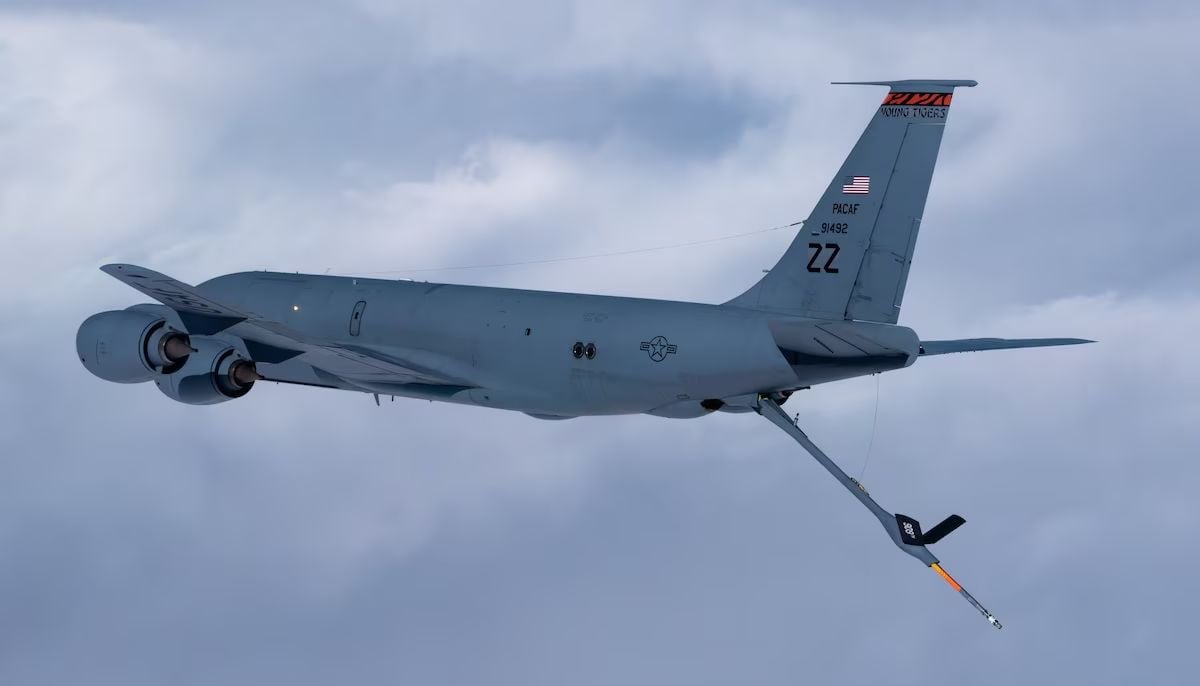
A United States Air Force KC-135 Stratotanker aircraft broadcast an international emergency signal, code 7700, while flying over the Strait of Hormuz on Tuesday, May 5. The aircraft, which had been airborne for several hours, subsequently altered its course and began a descent, reportedly heading towards Qatar. Flight tracking data confirmed the 7700 squawk, an aviation code universally understood to signify a general emergency. The KC-135, a vital aerial refuelling asset for the U.S. military, was understood to be carrying fuel for American forces engaged in operations in the sensitive Middle Eastern region. The incident unfolded against a backdrop of heightened tensions in the Persian Gulf, a critical chokepoint for global trade and military activity. The U.S. military has not issued an official statement regarding the specific cause of the emergency or any potential link to hostile actions.
Flight Path and Uncertain Landing
According to flight tracking information, the KC-135 Stratotanker had departed from Al Dhafra Air Base in the United Arab Emirates prior to transmitting its distress signal. After issuing the 7700 code, the aircraft reportedly entered a standard holding pattern, a manoeuvre often used to maintain stability or prepare for an eventual landing. Details surrounding the aircraft's landing remain unconfirmed. At one point, the plane's tracking signal was briefly lost over Qatar, adding a layer of uncertainty to its condition and whereabouts. The exact reason for the emergency has not been officially disclosed, with possibilities ranging from technical malfunctions to onboard system issues. While on the incident using flight data, it did not attribute any actions to Iranian forces. The Iranian Foreign Minister, Abbas Araghchi, has previously dismissed the U.S. security initiative in the region as 'Project Deadlock'.
Context of Regional Tensions and Operations
The KC-135's emergency declaration occurred on the second day of 'Project Freedom,' a U.S.-led operation launched on May 4 to enhance the security of civilian vessels transiting the Strait of Hormuz. This initiative followed a warning from Iran for the U.S. to withdraw from the channel, which Iran has controlled since mid-February. Iranian authorities have officially denied any involvement in the KC-135 incident and have also rejected previous claims of striking the Fujairah oil port. The incident also follows a separate event in March where a KC-135 crashed in western Iraq, resulting in the deaths of all six crew members. At that time, U.S. officials stated the aircraft was not brought down by hostile fire, though Iran-backed groups claimed responsibility for an action they described as being 'in defence of sovereignty and airspace'.
The KC-135 Stratotanker: A Workhorse of Air Mobility
The KC-135 Stratotanker is a long-serving military aerial refuelling aircraft developed by Boeing, with its design inspired by the prototype Boeing 367-80 and the Boeing 707 airliner. First introduced in the late 1950s, it has become a cornerstone of U.S. Air Force air mobility operations for over six decades. Its primary function is air-to-air refuelling, enabling fighter jets, bombers, reconnaissance aircraft, and allied military planes to extend their operational range and endurance without needing to land. This is achieved through a flying boom system operated by a dedicated boom operator stationed at the rear of the aircraft. The robust and versatile nature of the KC-135 has made it one of the most widely utilized tanker aircraft globally, playing a critical role in supporting complex military missions and power projection across vast distances.
Rescue Efforts Underway
Following the loss of communication with the KC-135, two light utility helicopters were immediately dispatched from Al Udeid Air Base in Qatar. This rapid deployment signals that a rescue attempt is likely in progress, underscoring the seriousness of the mid-air emergency. The deployment of helicopters from the base where the KC-135 was destined to refuel highlights the immediate concern for the aircraft and its crew. The specifics of the rescue operation, including its success or any challenges encountered, have not yet been officially detailed. The ongoing situation emphasizes the critical nature of aerial refuelling capabilities for sustained military operations in the region and the potential risks associated with such missions, particularly in volatile geopolitical environments.
The bottom line
- A U.S. Air Force KC-135 Stratotanker declared a general emergency over the Strait of Hormuz on May 5.
- The aircraft altered course towards Qatar after transmitting the 7700 distress code.
- The incident occurred during a U.S.-led operation to secure maritime traffic in the Persian Gulf.
- Iran has denied any involvement in the KC-135's emergency.
- The KC-135 Stratotanker is a vital aerial refuelling aircraft with a long service history.
- Rescue efforts were initiated following the distress signal.





US Summer Electricity Bills to Rise 8.5% as Grid Upgrades and Data Center Demand Drive Costs
U.S. Begins Guiding Ships Out of Strait of Hormuz as Iran Threatens Attack

Islamabad Braces for a Week of Rising Temperatures as Clear Skies Take Hold
